

Table of Contents
- Introduction
- What Are Autism Signs and Autistic Traits in Children?
- Early Signs of Autism in Babies and Toddlers (0–36 Months of Age)
- Signs of Autism in Young Children (Ages 3–7 Years)
- Signs of Autism in Older Children and Teenage Years
- Autism Signs in Girls and Boys – Understanding Autistic Girls
- Core Autism Symptoms Seen Across Autistic Children
- When to Seek Professional Evaluation and Early Intervention
- FAQs
- Conclusion
In Focus Summary
- This guide is for parents and caregivers wondering about possible child autism signs
- It explains early signs of autism from infancy through the teenage years
- Autism signs can affect social interaction, language skills, behaviour, and sensory experiences
- Autistic traits vary widely between children and may look different in girls and boys
- Early identification and professional evaluation can support positive outcomes
- Support focuses on understanding a child’s needs – not changing who they are
Recognising Child Autism Signs Early
To some parents and caregivers, identifying possible signs of autism in children may seem daunting and emotionally distressing. Children are developing at different rates, and each difference does not always indicate a neurodevelopmental disorder. Nevertheless, identifying behavioural patterns that are associated with autism spectrum disorder can aid families in comprehending their child’s developmental progress and in obtaining necessary support.
Autism is a lifelong neurodevelopmental condition that can affect how a child experiences the world, particularly in relation to social communication, behaviour, and sensory processing. Early signs often emerge in early childhood, sometimes within the first year of life, but they may be subtle and easily overlooked – especially when children meet some developmental milestones on time.
AuDHD Psychiatry’s clinicians regularly work with families who are seeking clarity about autism symptoms, developmental differences, and whether a professional evaluation may be appropriate. If you are concerned about your child’s development or behaviour, a timely assessment can provide reassurance, guidance, and access to the right support. You can explore our autism assessment services for children and families at any stage of concern.
What Are Autism Signs and Autistic Traits in Children?
Autism signs refer to patterns of behaviour, communication, and interaction that are commonly associated with autism spectrum disorder. These patterns are sometimes described as autistic traits, and they tend to appear across multiple areas of a child’s life rather than in isolation.
For example, a child may show similar interaction styles at home, in nursery, and during structured assessments. This cross-context consistency is one reason clinicians place less emphasis on individual behaviours and more on overall developmental patterns.
Moreover, autistic traits are perceived as neurodevelopmental. Studies indicate that autistic traits involve atypical brain development, which impacts social understanding, sensory integration, and cognitive flexibility. Such brain differences are not a result of parent-child interactions, trauma, or social exposure, although environmental factors may affect how traits are articulated or manifested.
Autism Signs vs Developmental Delay
Some children have a developmental delay that resolves with time, especially with regards to speech or motor skills. However, the signs of autism usually represent a persistent developmental difference rather than a delay.
This may include:
- Skills developing unevenly rather than globally
- Differences in how skills are used socially
- Persistent difficulties with flexibility, shared attention, or reciprocal interaction
The most important things are not individual missed milestones, but ongoing patterns that impact social interaction, play, and flexibility.
How Autistic Traits Relate to Autism Spectrum Disorder
Autistic traits are part of a broad spectrum. This means children can share core features of autism while presenting very differently from one another. Some children may have advanced language skills but significant social challenges, while others may show clear language delays alongside strong visual or problem-solving abilities.
Children may meet diagnostic criteria through very different combinations of traits. For example, one child may have fluent language but marked difficulty understanding social nuance, while another may have limited spoken language alongside strong visual reasoning skills. Scientific consensus recognises autism as a heterogeneous condition, meaning there is no single presentation or pathway.
Why Autism Signs Can Look Different in Every Autistic Child
Research has demonstrated that there is a variation in how autism is presented. Genetic studies show that autism is a result of multiple interacting genes that result in varied development profiles. In addition to this, there are many other factors that can influence how autism is expressed, such as sensory sensitivity, cognitive style, temperament, and any other comorbid conditions.
The social environment is also influential. Traits that are noticed, supported, and left unaddressed all depend on the social expectations related to the child. These can be related to gender, culture, and a mixture of the two. In response to the social expectations, some children may modify their behaviour, while others will not, resulting in different external presentations while having the same internal neurodevelopmental differences.
Importantly, clinicians look for patterns that persist over time and across settings, rather than isolated behaviours. With this, let’s take a look at how these traits can show up in different age groups.
Early Signs of Autism in Babies and Toddlers (0–36 Months of Age)
Some early signs of autism can be seen in young children during the first three years of life. These signs may emerge gradually and are often identified during routine developmental checks. These signs may emerge gradually and are often identified during routine developmental checks.
Social Communication and Early Interaction Differences
Some infants show differences in early social engagement, such as:
- Limited eye contact or poor eye contact during interactions
- Reduced response to their name
- Differences in nonverbal communication, including pointing or waving
- Less variation in facial expressions during social interaction
Language Development and Early Language Skills
Differences in language skills may include:
- Delayed language development or fewer vocalisations
- Limited babbling or back-and-forth sounds
- Use of single words without progressing to phrases
Not all autistic children have language delays, but differences in communication style may still be present.
Play Skills, Pretend Play, and Engagement
Some toddlers show:
- Little interest in pretend play
- Preference for repetitive play or fascination with how objects move
- Playing with unusual objects rather than toys as intended
Sensory Differences and Sensory Experiences
Sensory differences may involve:
- Strong reactions to loud noises or bright lights
- Distress related to textures, touch, or movement
- Seeking or avoiding certain sensory experiences
Developmental Milestones and Early Screening
Monitoring developmental milestones helps identify early signs of autism. Health visitors and GPs may recommend screening tools if concerns arise, particularly for children considered at higher risk.
Signs of Autism in Young Children (Ages 3–7 Years)
As children enter preschool and early school years, autism signs may become more noticeable in group settings.
Social Interaction and Social Skills Development
Children may experience:
- Difficulty with social interaction and understanding social cues
- Challenges navigating peer relationships
- Limited interest in cooperative play or shared activities
Communication Patterns and Language Delays
Some children show:
- Echolalia, where phrases are repeated rather than used flexibly
- Literal interpretation of language
- Ongoing language delays affecting conversation
Repetitive Behaviors and Repetitive Movements
Common examples include:
- Hand flapping or other repetitive movements
- Repetitive patterns of behaviour
- Significant distress around routine changes
Sensory Input, Daily Activities, and Regulation
Sensory differences can affect:
- Participation in daily activities
- Tolerance of busy or unpredictable environments
- Emotional regulation during transitions or minor changes
If concerns are increasing, this can be an appropriate time to seek a professional opinion. Early guidance can help families understand available support.
Signs of Autism in Older Children and Teenage Years
In older children and adolescents, autism signs may be shaped by increased social expectations and academic demands.
Social Communication Challenges in Older Children
Difficulties may include:
- Misunderstanding body language or facial expressions
- Difficulty maintaining friendships
- Feeling excluded or confused in complex social situations
Emotional Regulation, Anxiety, and Social Pressure
Many autistic young people experience:
- A hard time coping with busy environments
- Increased anxiety during school years
- Exhaustion from masking or compensating socially
Restricted Interests and Intense Interest Areas
Studies define restricted interests as phenomena consisting of deep fascination and concentration directed towards certain subjects (e.g., topics, objects, activities). One of the differences that motivates this phenomena has been defined as an unconscious preference and habitual behaviour, but rather involves attention regulation and reward processing. Examples of restricted interests can include collecting copious information about a certain subject, repetitively engaging and exploring a subject, or spending extensive amounts of time on an activity that is predictable and motivating (even if that motivation is intrinsic).
Interests may be perceived as negative, and may even include an obsession where the individual has such a focus that it restricts their ability to be flexible about a subject; though, studies have repeatedly shown that restricted interests can positively influence the individual’s learning of the subject, emotional control, and self- esteem. These interests can be negative when they are acknowledged in the daily routines and learning processes of individuals with autism.
Autism Signs in Girls vs Boys
Autism has historically been under-recognised in girls, leading to later diagnosis and unmet needs.
Why Autism Signs Are Often Missed in Autistic Girls
Autistic girls may mask difficulties through social imitation, appear socially engaged while struggling internally, and/or show fewer overt repetitive behaviours.
You can read more about this in our detailed guide on autism symptoms in girls and our female autism checklist.
Differences in Social Communication and Play
Girls may show:
- Subtle differences in social communication
- Strong imaginative play that still feels scripted
- Internalised stress rather than externalised behaviour
Impact of Late Identification on Mental Health
Failure to recognise issues early can create anxiety, burnout, and problems accessing suitable support in adolescence and adulthood.
Core Autism Symptoms Seen Across Autistic Children
Though every autistic child is different, studies have found core neurodevelopmental patterns associated with autism spectrum disorder that are consistent across research. These core patterns focus on the social information processing, behavioural regulation, and sensory experiences of autistic children. The symptoms we described are important to consider, but the presence and severity of symptoms differ, meaning that children may experience them in different ways and to differing extents.
Social Communication and Social Interaction Differences
Aspects of social communication that differentiate individuals on the autism spectrum pertain to the understanding, responses, and active engagement in social interactions. These differences are not indicative of an individual’s disinterest in social relationships; rather, they reflect differences in social cognition and the processing of social communication.
Common features may include:
- Difficulty interpreting social cues such as tone of voice or implied meaning
- Challenges with reciprocal conversation, including turn-taking and topic-shifting
- Differences in eye contact, shared attention, or social engagement styles
These patterns tend to be consistent across settings, even when a child has an age-appropriate vocabulary or strong factual language.
Repetitive Movements and Repetitive Behaviors
Repetitive behaviours are understood in research as serving regulatory, sensory, or predictability-related functions. They are often more noticeable during periods of excitement, stress, or uncertainty.
Examples may include:
- Hand flapping, rocking, pacing, or other repetitive movements
- Repetitive routines or rituals that support a sense of structure
- Strong preferences for sameness in how tasks or activities are completed
Such behaviours are not inherently problematic, but can become distressing when disrupted or misunderstood.
Sensory Differences and Sensory Issues
Repetitive behaviours are understood in research as serving regulatory, sensory, or predictability-related functions. They are often more noticeable during periods of excitement, stress, or uncertainty.
Examples may include:
- Hand flapping, rocking, pacing, or other repetitive movements
- Repetitive routines or rituals that support a sense of structure
- Strong preferences for sameness in how tasks or activities are completed
Such behaviours are not inherently problematic, but can become distressing when disrupted or misunderstood.
Developmental Differences and Uneven Skill Profiles
Some children show strong abilities in certain areas alongside delays in others. They can also be observed with advanced fine motor skills but delayed language skills, or vice versa.
When Should I Seek an Autism Assessment for My Child?
In clinical practice, an assessment is usually recommended not because of a single behaviour, but because of ongoing patterns that affect a child’s daily life, learning, or emotional well-being.
Signs Your Child May Benefit From Professional Evaluation
A formal assessment might be beneficial if your child exhibits:
- Multiple autism signs across different environments, such as home, nursery, or school
- Ongoing challenges with social communication, flexibility, or understanding expectations
- Distress that interferes with learning, relationships, or overall wellbeing
It is essential to note that if you are not confident, you can still seek an assessment. Numerous families initiate the evaluation process to understand the situation better, to feel at ease, and to obtain advice about the best course of action.
Autism Screening Tools and Healthcare Professionals
Healthcare professionals often use structured screening tools as an initial step. These do not provide a diagnosis but help identify whether further assessment is warranted.
The process may involve:
- Parent-report screening tools such as the Modified Checklist
- Observations by developmental paediatricians or psychologists
If you would like to understand your options, you can explore our guide to private autism assessment costs.
Early Diagnosis, Early Intervention, and Extra Support
Early intervention focuses on supporting a child’s development and wellbeing, not changing who they are. Support may include:
- Guidance for families
- Speech and language therapy
- Occupational therapy tailored to sensory and daily living needs
What Happens After an Autism Diagnosis
After diagnosis, families are supported with:
- A more thorough assessment of strengths and needs
- Planning the right support for the child’s needs
- Accessing education and community resources
Interested to learn more about this condition? You may also find it helpful to understand levels of support such as Level 2 autism.
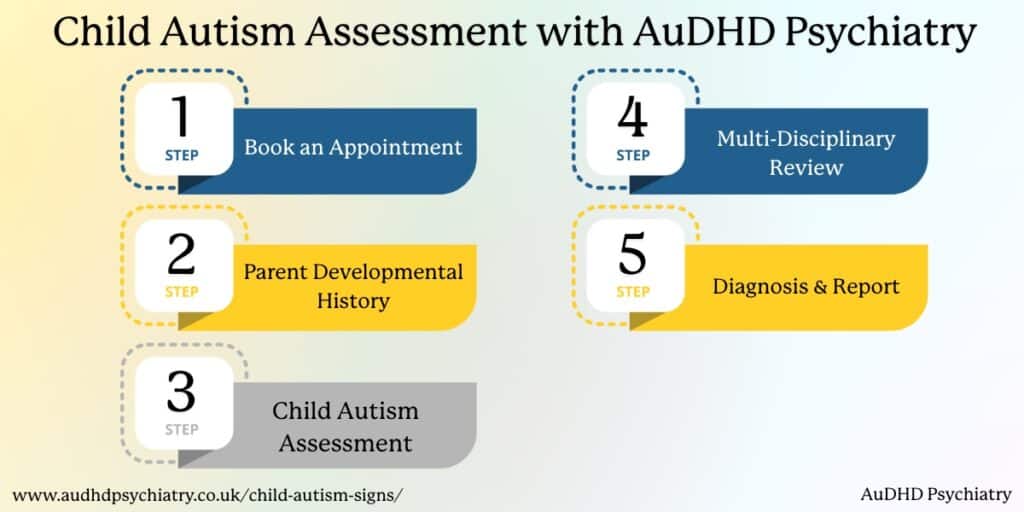
How AuDHD Psychiatry’s Child Autism Assessment Process Works
You’re also welcome to book a consultation with our clinic. Here’s a simple guide to our child-friendly, neurodivergent-affirming process:
Step 1 – Book an Appointment
Choose a time that suits your family. There’s no referral needed, and we keep the booking process simple. We begin with a short screening call to understand your concerns, including masking, school behaviour, and early signs.
Step 2 – Parent Developmental History
You’ll have a friendly, unhurried conversation with an autism specialist. We explore your child’s early development, strengths, needs, and the wider context at home and school.
Step 3 – Child Autism Assessment
Your child participates in a gold standard child-friendly assessment. These are ADOS-informed and aimed to provide a relaxed atmosphere and accurately reflect naturalistic communication and behaviour, including instances of behavioural masking.
Step 4 – Multi-Disciplinary Review
Our clinicians review information from parents, school, and the child assessment, aligning findings with NICE guidance for a balanced, specialist-led conclusion.
Step 5 – Diagnosis & Report
You receive a clear outcome, a detailed report, and a feedback call with practical next steps for home and school.
Frequently Asked Questions About Autism Signs in Children
Can an autistic child make eye contact and still be autistic?
Yes. Eye contact varies widely among autistic people, and some children use eye contact comfortably in certain situations.
Do autism signs change as children grow older?
Autism signs often change in how they present, especially as children learn coping strategies or face new social demands.
How reliable are autism screening tools in early childhood?
Screening tools are helpful for identifying risk but are not diagnostic on their own. A full assessment is always required. If you’re keen, you can also try a child autism test at no cost.
Can a child have autism symptoms without language delays?
Yes. Some autistic children have age-appropriate or advanced language but still experience social communication differences.
Is genetic testing useful when autism signs are present?
Genetic testing is not a diagnostic test for autism itself, but it may be recommended in specific clinical situations.
Child Autism Signs: Conclusion
Recognising child autism signs means you get to understand more of their unique way of experiencing the world and ensure they receive the right support at the right time. Autism is a lifelong condition, but with understanding, understanding environments, and appropriate adjustments, autistic children can thrive.
Seeking clarity can be an empowering step for both children and families, helping you move forward with confidence and support. When you’re ready, get in touch with us, and we’ll be happy to guide you and your child through an accurate, expert-led child autism assessment.
References
- Johnson, C. P., & Myers, S. M. (2007). Identification and evaluation of children with autism spectrum disorders. PEDIATRICS, 120(5), 1183–1215. https://doi.org/10.1542/peds.2007-2361\
- Maestro, S., Muratori, F., Cesari, A., Cavallaro, M., Paziente, A., Pecini, C., Grassi, C., Manfredi, A., & Sommario, C. (2005). Course of autism signs in the first year of life. Psychopathology, 38(1), 26–31. https://doi.org/10.1159/000083967
- Ozonoff, S., Iosif, A., Baguio, F., Cook, I. C., Hill, M. M., Hutman, T., Rogers, S. J., Rozga, A., Sangha, S., Sigman, M., Steinfeld, M. B., & Young, G. S. (2010). A prospective study of the emergence of early behavioral signs of autism. Journal of the American Academy of Child & Adolescent Psychiatry, 49(3), 256-266.e2. https://doi.org/10.1016/j.jaac.2009.11.009
- Sicherman, N., Charite, J., Eyal, G., Janecka, M., Loewenstein, G., Law, K., Lipkin, P. H., Marvin, A. R., & Buxbaum, J. D. (2021). Clinical signs associated with earlier diagnosis of children with autism Spectrum disorder. BMC Pediatrics, 21(1), 96. https://doi.org/10.1186/s12887-021-02551-0
Author:


Contact Us
We’re here to answer any questions you might have.
Get in Touch
Opening Hours
Contact Form
We’re here to help. Reach out and we’ll get back to you within 24 hours (Monday – Friday).
Leave a Reply