


Many men wonder why everyday life is so challenging when motivation is lost, focus is dispersed, and small tasks become overwhelming. The answer is often the result of ADHD in men, which is a neurodevelopmental disorder that can go unnoticed until adulthood. Exploring the impact of this condition is worthwhile and can be life-changing, whether these symptoms are being evaluated as part of a personal journey or to assist someone close to you.
ADHD manifests in various ways and at different points during a person’s lifetime. Many adult men only recognise that they can potentially be living with undiagnosed childhood ADHD when they read about the symptoms or start speaking to a professional. If you have these questions, contact us. We’ll be happy to address any confusion or concerns about ADHD assessments and why it can be a life-changing decision to make.
This article focuses on the specific symptoms, challenges, and available support for men in the UK, intended to guide you to the next steps you can take.
Understanding ADHD Symptoms in Adult Men
Recognising how symptoms of attention deficit hyperactivity disorder (ADHD) present in adult men is important for discovering patterns that may have been overlooked in growing up. Though lots of folks link ADHD with visible symptoms of hyperactivity, the truth is more complex. For men, symptoms are more likely to take the form of internal restlessness, sustained attention challenges, and executive function inconsistencies. These adversities have the potential to impact work, relationships, and day-to-day life, often causing men to blame themselves without looking into the possibility of a neurodevelopmental condition.

Male ADHD Symptoms and Core Patterns
ADHD symptoms in men stem from differences in their executive function and brain function. Adult men might notice that while they’re able to develop a hyperfocus on topics of their interest, there is a struggle with completing monotonous administrative work. Some are simply inundated with a rapid thinking mental overload, with every thought being on a fast switch and no ‘completion’ to be observed. This is in no way a lack of ability. Rather, it is a reflection of the core symptoms of ADHD.
Inattentive, Hyperactive, and Impulsive Symptoms
Symptoms of ADHD fall into the following categories: inattentive, hyperactive, and impulsive.
Examples include:
- Easily distracted or losing focus
- Restlessness that appears internal rather than physical
- Snap decisions or speaking quickly
Our resource on ADHD Without Hyperactivity may be helpful if you relate more to the inattention side than the hyperactivity.
How ADHD Symptoms in Men Differ from ADHD in Women
While symptoms of ADHD are present in both men and women, research indicates men are more prone to outwardly exhibiting impulsivity and other behavioural symptoms, especially during their teenage years. However, in adulthood, these symptoms are likely to transition to more internal patterns, such as issues with organisation, maintaining attention, and controlling emotions.
Men may cope with or conceal these patterns of difficulty by putting in overtime or steering clear of tasks that require their full concentration for a prolonged period. On the other hand, women with ADHD present their symptoms as subtle inattention, meaning the condition is more likely to go undiagnosed in women, and men may be portrayed as in the ADHD spectrum when they are primarily exhibiting inattentiveness and lack of motivation.
Adult ADHD Symptoms Over Time
Symptoms in adult males can change over the years. Symptoms like hyperactivity, for example, can later evolve to more of a mental restlessness. Emotional dysregulation can look like irritability or frustration, or shutting down in high-stress situations. These can be long-term patterns, and often a man doesn’t realise the extent of how ADHD drives the symptoms until he investigates how ADHD affects adults.
Identifying the symptoms affecting you might be the first step you need for gaining a deeper understanding of the experiences that have shaped your life and the potential support that might be beneficial.
Co-Occurring Mental Health Conditions in Men with ADHD
Most men diagnosed with ADHD have additional mental conditions which affect their mood, behaviour, and overall health. The additional challenges are not merely character flaws. They are common and are a byproduct of how the ADHD brain handles stress and emotions, as well as the tasks at hand. Recognising these challenges is the first step and helps men understand that the challenges are not theirs to conquer alone and there is help that works.

Anxiety, Mood Disorders and Personality Disorders
Many adult men diagnosed with ADHD have anxiety disorders because of the many years spent at the mercy of a poorly managed to-do list, sense of overwhelm, and inconsistent focus. It can become a vicious cycle of self-criticism and worry. Mood disorders are also common. They are especially common, and certainly not limited to men, when there is a sense of being misunderstood in work and home settings.
Some traits obvious to certain personality disorders can also be symptoms of ADHD, and include emotional sensitivity, being impulsive, and having a hard time with relationship management. A well-trained mental health professional can help in sorting out what experiences may be amplified by ADHD and what might need additional work.
Low Self-Esteem, Shame, and Mood Swings
For some men, a prolonged sense of disengagement is a common experience in their lives. The result may be a sense of unfulfilled potential and embarrassment due to deficiencies in performance or lack of goals. Emotional mood swings are also possible, especially when there are difficulties with emotional self-regulation. The eventual result may be more serious as a consequence of the potential accumulation of these experiences over time.
Curious about feeling drained from work and taking a break only refuels you enough for a few months, and the same cycle just goes on again? Check out our guide on ADHD Burnout.
Substance Misuse, Addiction, and Sleep Problems
Some men use medications to enhance their ability to concentrate or to better control their emotions. Relying on these meds may pose risks for ADHDers. Common difficulties include:
- Substance misuse or dependency
- Attempts to self-medicate symptoms
- Sleep problems worsening attention and mood
In the absence of a supportive structure, this cycle is very difficult to escape from. If these struggles sound like the challenges you’re going through, talk to a neurodivergence-informed clinician today. We’ll be happy to help you find out if your own experiences align with ADHD in men.
Mental Health Issues and Societal Expectations
For men, societal expectations often create the pressure to be self-sufficient and to contain their emotions. This norm can create the greatest challenge for men when it comes to seeking help or even in recognising the mental health distress they are in. The feeling of being misunderstood may avoid use of help and thus increase the social stress of the situation, which may be more prominent in relationships with spouses, employers, or family.
Knowing how these conditions overlap and exactly how and what the treatment options available for these conditions are could result in an overall improvement in well-being.
How ADHD Impacts Daily Life, Work, and Relationships
If you’ve been diagnosed with ADHD, there are far more effects of this condition on your life. For the large number of ADHD males, it affects stress levels, their work effort and performance, the emotions they are lugging around, and communication. These effects can be significantly noticed during the day-to-day cycle of working.
A large number of men find the concentration and attention needed for work to be some of the most stress-inducing factors. They may be just as driven and productive as needed, but feel incapable in their ability to tackle tasks. Tools that can be offered to reduce these experiences in the workplace are more and more being offered by businesses and companies. Businesses are improving awareness and adapting to ADHD, willingly helping employees find appropriate accommodations.

Executive Functioning, Time Management, and Organisation
ADHD often affects executive functions, which support planning, decision-making, and problem-solving. Common difficulties include:
- Time management struggles
- Multitasking challenges
- Difficulty maintaining calendars or inboxes
Practical strategies and tools can be found in ADHD Tools for Daily Tasks.
Relationship Problems and Family Dynamics
Problems communicating and being emotionally present due to ADHD can cause several issues in a relationship. For example, a partner may think that their spouse is being inconsiderate and emotionally neglecting the relationship, while in actuality, the man in the relationship may feel that he is being misunderstood. Family members may struggle to understand and interpret volatile shifts in the person’s energy and emotional presence.
Emotional Regulation, Retreating, and Overwhelm
A tendency to withdraw when experiencing feelings of being overwhelmed is a common self-reported characteristic of men diagnosed with ADHD. Emotional dysregulation is the term that describes the rapid escalation of difficult-to-control emotions. The combination of these two traits can have a negative impact on relationships when the man feels bombarded by emotions and/or emotionally triggering stimuli.
Conflict can be lessened, and more positive communication patterns can be established when the recognition of these patterns is present. Men, when provided with the right support, can work their way through these issues and build strong relationships in the workplace and at home.
Strengths, Positive Traits, and the ADHD Experience in Men
Talking about the difficulties of having ADHD might be more common than discussing its advantages. But men admit there exist certain ADHD strengths. These strengths shape professional life, social life and self-esteem. Recognising these strengths helps them understand the positive aspects of the ADHD experience and build self-confidence after years of feeling misunderstood.
Creativity, Much Energy, and Problem Solving
ADHD men are some of the most creative thinkers. Many describe strengths such as:
- Quick ideas
- Engagement in meaningful work
- Unique angles for solving problems
ADHD brains challenge problems from a different and unique side. These men thrive in flexible and fast work environments. This spontaneity should not be seen as an inconsistency, but rather reframed as an extraordinary cognitive potential.

Hyperfocus and New Ways of Thinking
Hyperfocus is not unique to those with ADHD and is an asset when geared towards the right things. ADHDers can finish huge amounts of complex work in short periods of time, master new skills, or learn in great detail about technical subjects. If you’re experiencing this on tasks that are not exactly productive or helpful, read this guide.
Men with ADHD envision problems and challenges in new and different ways. They can create unique approaches to problem-solving. New and different ways of thinking are helpful in being part of a team and are essential in creative fields, new businesses, and fast-moving environments.
Why Men with ADHD Can Excel in Roles and Relationships
With the right support, men can excel in roles requiring fast thinking, empathy, and the capability to overcome challenges. Attributes that may have been frustrating in the past can be quite advantageous. With the right support, coaching, and therapy, men can learn to harmonise with their mental function. A
Recognising these strengths helps shift the narrative from struggle to capability, offering a more complete and empowering understanding of life with ADHD.
ADHD Diagnosis for Adult Men
For lots of men, an ADHD diagnosis changes their lives in very positive and transformative ways.
Understanding the ADHD Diagnosis Process
ADHD diagnosis consists of recognition of chronic symptoms affecting one’s day-to-day life from childhood. Men suffer from stigma and self-compassion and so tend to unhelpfully suffer for longer. Evaluations demonstrate that ADHD is a bona fide neurodevelopmental disorder, not a failing of character.
A more thorough description can be found in How to Get Diagnosed With ADHD.
Medical History, Psychological Tests, and Clinical Evaluation
A thorough assessment encompasses a review of medical history, structured psychological assessment, and the behaviours of the individual across life stages. The clinician is looking for chronic patterns of inattention, hyperactivity, or of impulsivity. They will then broaden the scope of the investigation to include mood, sleep, and executive functioning.
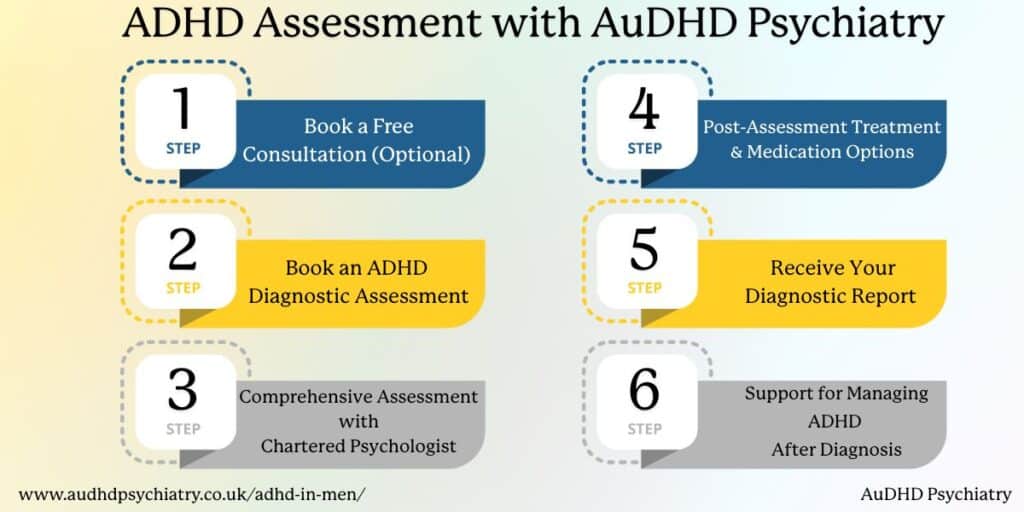
A primary concern with all of the above is the uncertainty that comes from not knowing, and so understanding what happens during an assessment can ease that burden. The image above shows the simple 6-Step process AuDHD Psychiatry uses for ADHD assessments. We have a resource that might further help explain this, called What to Expect at an ADHD Assessment.
ADHD Specialists, Healthcare Providers, and Primary Care Providers
The assessment in question may include an ADHD specialist, a healthcare provider, or primarily a primary care provider, according to the referral pathway you choose. You can either go for a free NHS ADHD assessment that requires a GP referral and waiting times of up to years, or choose a paid private assessment that accepts self-referrals and offers flexible consultation schedules.
AuDHD Psychiatry’s ADHD Assessment for Men
An accurate assessment is an integral part of an ADHDer’s journey. The image above summarises our ADHD diagnostic process in 6 easy steps, but make no mistake. Our assessments are comprehensive and based on DSM-5 diagnostic standareds. Because this condition can manifest differently between men and women, it’s important to get diagnosed by qualified clinicians who are aware of how ADHD may present in both genders. At AuDHD Psychiatry, our process revolves around your unique experiences, so that your treatment and support are personalised from initial consultation to ongoing treatment.
Treatment Options for Men with ADHD
ADHD is a long term condition, but with effective strategies, men are able to handle their symptoms and effectively manage responsibilities. At AuDHD Psychiatry, we believe every experience is unique. Treatment is individualised, and clinicians allow for each method to be customised.
Most Effective Treatments for ADHD in Men
Successful treatment approaches for ADHD in Men mostly involve a combination of multiple methods that can include therapy, medication, emotional support, and functional support. Each area is important, as each focuses on a different issue of ADHD.
Stimulant Medication, Side Effects, and Alternatives
Stimulants are a key treatment option for ADHD. They may be able to improve focus and reduce impulsivity by aiding neurotransmitter function. Like all medications, they come with side effects, so a clinician should be contacted to monitor these.
ADHD Medication 101 can help you understand ADHD medications better. Alternatives to ADHD Medications may also be suggested for those who prefer not to have medications, or find that they prefer not to use stimulants.
Cognitive Behavioural Therapy and Other ADHD Therapies
Men can improve emotional regulation and develop coping mechanisms through cognitive behavioural therapy. Other support that focus on ADHD can be helpful, like coaching, behavioural interventions that are structured, aimed at building executive functioning.
Lifestyle Changes, Sleep, Exercise, and Physical Activities
Daily habits play a significant role in managing symptoms. A structured daily routine, good sleep hygiene, and like other regular physical activities, exercise can help mood stability and focus. Practical knowledge can be found in our guide The Role of Exercise in Managing ADHD.
Navigating Relationships and Family Life with ADHD
As we’ve previously mentioned, ADHD can directly impact how ADHD men communicate and emotionally interact with those around them in intimate relationships. Similarly, men report feelings of being misunderstood by the other partner or family member, as ADHD symptoms can look like forgetfulness, becoming distracted, or emotionally withdrawing. This provides the ADHD individual with the ability to understand relational aspects to the symptoms and make for healthier and supportive relationships with those around them.

Communication, Emotional Regulation and Impulsivity
When ADHD is in the picture, communication in relationships can become even more difficult. Men may experience a certain form of emotional dysregulation in these situations, causing a specific emo to accelerate in a certain direction or severity. This can create a breakdown in communication and lead to misunderstandings. ADHD can also impact decision-making and reactiveness. One example of this is impulsively interjecting during a conversation or removing oneself from the conflict.
These ADHD communication and emotional symptoms could be a byproduct of the ADHD brain. Those who are close to a person with ADHD, especially partners, may carry these burdens alone. This poses a need for proper communication around the core aspects of ADHD.
Couples therapy, reading articles together, or simply conversing about one another’s lived experiences can assist partners in trust-building and resentment repair. General motivation, focus, and emotions are easier to speak about and understand in the context of a neurodevelopmental condition.
Support for Family Members and Social Media Communities
ADHD is a family affair, affecting loved ones and partners too. Support groups, educational materials, and professionals can help partners and children. Families may incorrectly assume symptoms are a result of inconsistency or simply being lazy. If this has been a problematic issue in the family, the resource ADHD or Laziness? provides good information to clarify.
Patience, communication, and a mutual understanding of ADHD are required to create strong relationships. Learning about ADHD together can have a positive impact on the stability and compassion of a family unit.
ADHD in Men: Conclusion
Taking the first step towards understanding ADHD in men is an act of courage. Understanding what is going on symptom-wise and what can be done about it, and the support and guidance available, can be life-changing. We’ve also talked about how help can be received from a support group, workplace accommodations, educating yourself and your loved ones, and a mental health professional.
We can help answer your questions and regain confidence that you can improve your quality of life. Book a free intro call with a specialist today to discuss your symptoms, and we’ll help you take on the next steps of your journey.
Author:




Contact Us
We’re here to answer any questions you might have.
Get in Touch
Opening Hours
Contact Form
We’re here to help. Reach out and we’ll get back to you within 24 hours (Monday – Friday).
Leave a Reply