


The ADHD brain: what’s different, and what causes it

Reviewed by Dr Darren O’Reilly, Chartered Psychologist and Clinical Director
Review and publication details
Clinically reviewed by Dr Darren O’Reilly, DPsych, Chartered Psychologist (CPsychol), HCPC registered practitioner psychologist, registration number PYL041661 (check the HCPC register).
AuDHD Psychiatry is the trading name of ADHDdegree Ltd, a company registered in Scotland, company number SC822923. Registered office: 3f1 Third Floor, Hill Street, Edinburgh, EH2 3JP. Registered with the ICO, number ZB823033.
In this article
Page summary
The ADHD brain works differently from a typical brain in how attention, planning and self-control develop. The differences are real but small, and they’re seen across groups, not in one person’s scan. ADHD usually comes from many small genetic and early-life risks, with genes playing the largest part. A clinician diagnoses ADHD by talking through your history, because a scan can’t show it. AuDHD Psychiatry is a UK practice that assesses adults for ADHD online.
Many adults with ADHD have spent years being told to just try harder. Learning that your brain works differently can come as a real relief, because it explains so much without blaming you. A brain difference isn’t an excuse, and it isn’t a flaw. Dr Darren O’Reilly has ADHD and autism himself, so nobody here will tell you to just try harder.
At a glance
- What’s different: some brain areas differ slightly in size and development, on average.
- What causes it: many genetic and early-life factors add up, each carrying a small risk.
- How it’s diagnosed: a clinician diagnoses ADHD in an assessment, by talking through your history.
- Where treatment fits: adults are offered medication when problems remain after changes at work and home.
What is different in the ADHD brain?
ADHD involves real, physical differences in the brain, but they’re slight. The NHS describes ADHD as a condition where the brain works differently to most people [1]. Brain research adds detail to that picture, and it sits alongside the wider question of what ADHD is.
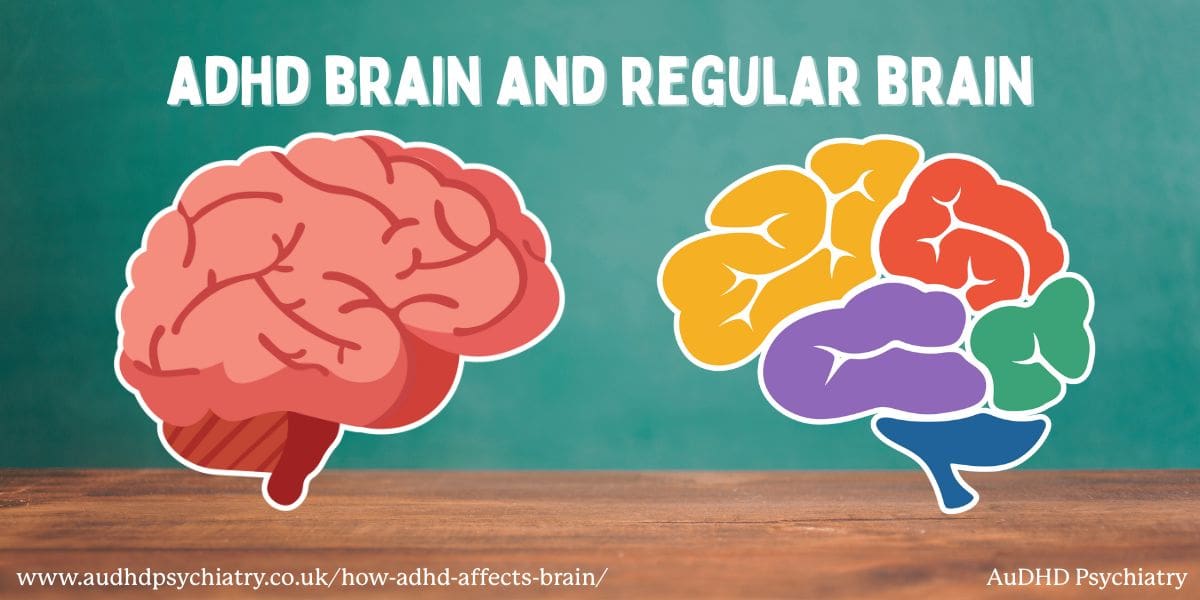
A pooled analysis of brain scans from about 3,200 people compared those with ADHD and those without [2]. On average, several deep brain areas were slightly smaller in the people with ADHD [2]. The total volume inside the skull was slightly smaller too [2]. The areas involved are linked to reward, emotion and memory [2].
How does an ADHD brain compare with a typical brain?
An ADHD brain differs only slightly from a typical brain, and only on average. An international consensus statement agreed by 80 experts calls the brain differences small [3]. They’re found when groups are compared, and they can’t be used to diagnose one person [3]. In the pooled scan analysis, the differences showed in children but not in adults [2]. That doesn’t mean ADHD goes away, because it often continues into adult life.
The clearer difference is timing. A 2007 study that followed brain scans of 446 children tracked the outer layer of the brain as it thickened [4]. In children with ADHD, the outer layer reached its peak thickness about three years later on average [4]. The delay was greatest at the front of the brain, the prefrontal cortex, which helps with attention and planning [4]. Development still followed the same order as in other children, just later [4]. That 2007 study suggests a later timetable in childhood, rather than a fault.
How does ADHD affect the brain day to day?
ADHD shows up in everyday attention, energy and self-control. The NHS describes those three areas as the core of ADHD symptoms [1]. Planning, holding things in mind and self-control are often grouped as executive function. For adults, the signs are often everyday moments that keep adding up. A browser tab stays open for a week because you’ve forgotten why you opened it. An appointment you wrote down still gets missed. A task gets started three times and finished once. Keys and cards go missing, and sitting through a long meeting feels hard.
Some adults interrupt without meaning to, or make quick decisions without thinking about the result [1]. The brain findings help explain signs like these in broad terms. Researchers can’t yet point to one brain area for each habit.
What causes ADHD?
ADHD usually comes from many small risks added together. The international consensus statement found ADHD is rarely caused by one genetic or environmental factor [3]. Most cases come from many risks combined, each with a very small effect of its own [3]. The NHS says the cause isn’t always known [1]. It lists things linked to ADHD, including being born early, epilepsy and a brain injury [1]. Being autistic is on the same list, which means the two are linked, not that one causes the other [1].
A review of 12 studies found ADHD about three times as common in people born very early or very small [3]. Preterm birth, epilepsy and brain injury also appear in NICE guidance, among groups with a possibly higher rate of ADHD [5]. Sugar isn’t a known cause: a review of seven studies with over 25,000 young people found no link [3].
Is ADHD genetic or hereditary?
ADHD is largely genetic, and it’s often hereditary, meaning it runs in families [1]. Genes play the largest part in causing it [6]. Family, twin and adoption research suggests about three quarters of the differences in ADHD come down to genes [6]. Researchers call this figure heritability, and it describes a whole population, not the chance a parent passes ADHD on. There’s no single ADHD gene either.
A study of the genes of over 20,000 people with ADHD found many small variants, each with a tiny effect [3]. The consensus statement adds that genes work together with a person’s environment, based on 37 twin studies [3]. NICE guidance also notes that ADHD is possibly more common in people with a close family member who has it [5].
Is ADHD linked to dopamine?
ADHD is linked to dopamine, but the link is small and only part of the picture. Dopamine and noradrenaline are chemical messengers that carry signals between brain cells. ADHD medicines act on these two chemicals, so researchers looked for ADHD genes in the same systems [6]. Studies of ADHD genetics found small links with genes for dopamine receptors and the dopamine transporter [6]. Each link was weak, and the results often differed from one study to the next [6].

The NHS says methylphenidate is thought to raise dopamine and noradrenaline while you take it [7]. That raises activity in the brain areas that control attention and behaviour [7]. Dopamine is one piece of a bigger picture, alongside many other genes and early-life factors.
What does the ADHD brain mean for treatment?
ADHD medication is thought to change how some brain areas work while you take it [7]. Large scan studies of over 4,000 patients found no sign that ADHD medication changes brain structure [3].
Adults should be offered medication if symptoms still cause significant problems after changes at work or home, NICE guidance says [5]. It names lisdexamfetamine or methylphenidate as the first choices, and both are a type of stimulant medication [5]. Before any medicine starts, a full health check covers pulse, blood pressure and heart health [5]. For adults who choose not to take medication or can’t tolerate it, NICE says to consider structured psychological support [5]. At AuDHD Psychiatry, the prescriber decides on any medicine after a full clinical assessment. Our page on ADHD medication covers the rest.
How is ADHD diagnosed if not by a brain scan?
A qualified clinician diagnoses ADHD by interviewing you [3]. For a child, a parent or carer is interviewed too [3]. At AuDHD Psychiatry we assess adults living in the UK, and the lists below can help you decide whether to book.
An assessment may help if:
- the signs above have been with you since childhood.
- they cause real problems at work, study or home.
- you’ve wondered for years whether ADHD explains them.
It might not be right today if:
- you need urgent help now. Call NHS 111 and choose the mental health option, or in Northern Ireland call Lifeline free on 0808 808 8000, any time. In an emergency, call 999 or go to A&E [8].
- you’re under 18, where a child ADHD assessment applies.
Our adult ADHD assessment is one online appointment, with no GP referral needed. Before you book with AuDHD Psychiatry, the free ADHD test offers a short screen. A free 15-minute call can answer your questions first.
Questions people ask
Can a brain scan show ADHD?
No, a brain scan can’t show whether one person has ADHD [3]. The differences found in research are small, and they only appear when large groups are compared. Research scans still matter, because they help scientists understand how ADHD develops.
Is ADHD a brain difference or a disorder?
Both words are used: ADHD is a recognised medical diagnosis and a difference in how the brain works [1]. Some people with ADHD also call themselves neurodivergent, a word for brains that work differently from most. If that word is new to you, here’s what neurodivergent means. The label you use for yourself is your own choice.
Does ADHD get worse with age?
ADHD itself doesn’t usually get worse with age, but it can feel worse at times. The NHS says anxiety and depression can make its symptoms worse [1]. In the pooled scan study, the brain differences showed in children but weren’t found in adults [2]. ADHD often continues into adulthood, where it can look quieter from the outside. More demands at work or home can still make the same signs harder to manage.
Does sugar cause ADHD?
No, a large review found no link between eating sugar and ADHD in young people [3]. Diet can affect how anyone feels from one day to the next. Sugar hasn’t been shown to cause ADHD, whatever you ate as a child. If you’re worried about your child’s eating, a GP can talk it through with you.
If I have ADHD, will my child have it?
Not necessarily, although ADHD often runs in families [1]. The figure of about three quarters from family and twin research describes a whole population [6]. It isn’t the chance that you’ll pass ADHD on to your child. NICE guidance lists people with a close family member with ADHD among groups where it’s possibly more common [5]. So it’s worth noticing signs in your child, without assuming them.
Does ADHD medication change the brain?
Large scan studies found no sign that ADHD medication changes brain structure [3]. Brain activity is a different question. A review of 14 brain-imaging studies looked at young people with ADHD while they took medication [3]. It found medication changed activity in brain areas that control thinking [3]. No study can tell you how your own brain will respond.
In short
The ADHD brain differs from a typical brain in small but real ways. Those differences show on average, across large groups of people. Genes play the largest part, and early-life factors add to the risk. Diagnosis comes from a careful conversation with a clinician about your history. If the signs in this article sound like your life, an adult ADHD assessment is the next step to consider.
Related
Four pages pick up where this article stops:
- private ADHD assessment for adults
- one assessment for ADHD and autism together
- starting ADHD medication
- whether ADHD is a real condition
- Mythbusters: “Bad parenting (or sugar, or screen time) causes ADHD”
Sources
- NHS, “ADHD in adults”, page last reviewed 19 March 2025. https://www.nhs.uk/conditions/adhd-adults/
- Hoogman M, Bralten J, Hibar DP and others, “Subcortical brain volume differences in participants with attention deficit hyperactivity disorder in children and adults: a cross-sectional mega-analysis”, Lancet Psychiatry, April 2017, 4(4):310-319. https://pmc.ncbi.nlm.nih.gov/articles/PMC5933934/
- Faraone SV, Banaschewski T, Coghill D and others, “The World Federation of ADHD International Consensus Statement: 208 Evidence-based conclusions about the disorder”, Neuroscience and Biobehavioral Reviews, September 2021, 128:789-818. https://pmc.ncbi.nlm.nih.gov/articles/PMC8328933/
- Shaw P, Eckstrand K, Sharp W and others, “Attention-deficit/hyperactivity disorder is characterized by a delay in cortical maturation”, Proceedings of the National Academy of Sciences, December 2007, 104(49):19649-19654. https://pmc.ncbi.nlm.nih.gov/articles/PMC2148343/
- National Institute for Health and Care Excellence (NICE), guideline NG87, “Attention deficit hyperactivity disorder: diagnosis and management”, published 14 March 2018, last updated 13 September 2019. https://www.nice.org.uk/guidance/ng87
- Faraone SV, Larsson H, “Genetics of attention deficit hyperactivity disorder”, Molecular Psychiatry, April 2019, 24(4):562-575. https://pmc.ncbi.nlm.nih.gov/articles/PMC6477889/
- NHS, “Common questions about methylphenidate for adults”, page last reviewed 25 March 2025. https://www.nhs.uk/medicines/methylphenidate-adults/common-questions-about-methylphenidate-for-adults/
- nidirect, “Mental health emergency: if you’re in crisis or despair”. https://www.nidirect.gov.uk/articles/mental-health-emergency-if-youre-crisis-or-despair
About AuDHD Psychiatry
AuDHD Psychiatry is the trading name of ADHDdegree Ltd, a company registered in Scotland. The company number is SC822923. Our registered office is 3f1 Third Floor, Hill Street, Edinburgh, EH2 3JP.
Registered with the ICO, number ZB823033.
Last updated: 13 October 2026
Where to go from here
A private online screening for ADHD traits, with your results at the end. No commitment.
Take the free testA free, no-obligation call with our team to ask questions and find the right assessment for you.
Book a free callDarren is a Chartered Psychologist and specialist in ADHD and autism, with over 11 years of experience working in mental health and neurodevelopmental services. He holds a Doctorate in Counselling Psychology and has presented research at the British Psychological Society Annual Conference.
Read Darren’s full profileThis article is for general information and does not replace a clinical assessment. If you are struggling with your mental health right now, please contact your GP or NHS 111.