


Starting ADHD medication as an adult: what the first weeks are like

Reviewed by Dr Darren O’Reilly, Chartered Psychologist and Clinical Director
Review and publication details
Clinically reviewed by Dr Darren O’Reilly, DPsych, Chartered Psychologist (CPsychol), HCPC registered practitioner psychologist, registration number PYL041661 (check the HCPC register).
AuDHD Psychiatry is the trading name of ADHDdegree Ltd, a company registered in Scotland, company number SC822923. Registered office: 3f1 Third Floor, Hill Street, Edinburgh, EH2 3JP. Registered with the ICO, number ZB823033.
In this article
Page summary
ADHD medication eases symptoms like poor concentration, and starting it means a low dose raised over weeks. Before the first dose, a specialist checks your heart, health and history. The small steps are called titration and last until symptoms ease with manageable side effects. Once the dose is steady, your GP can take over prescribing under shared care. If a medicine isn’t helping or can’t be supplied, your prescriber has safe next steps. At AuDHD Psychiatry, our prescribers start and manage ADHD medication online for people we assess.
Plenty of people feel hopeful and wary at the same time before a first dose, especially of a stimulant. The first weeks are built to be watched and adjusted. Questions and second thoughts are part of the process, and your prescriber expects them.
At a glance
- Who starts it: an ADHD specialist starts the medicine, and a GP can’t start it alone.
- Before the first dose: checks on your heart rate, blood pressure, weight and medical history.
- The first weeks: a low dose, raised in small steps while side effects are watched.
- How long it takes: a few weeks to find the right dose. After that, methylphenidate starts working 30 to 60 minutes after each dose, and other medicines have their own timings.
- Once you’re stable: your GP can take over prescribing under a shared care agreement.
What does ADHD medication do?
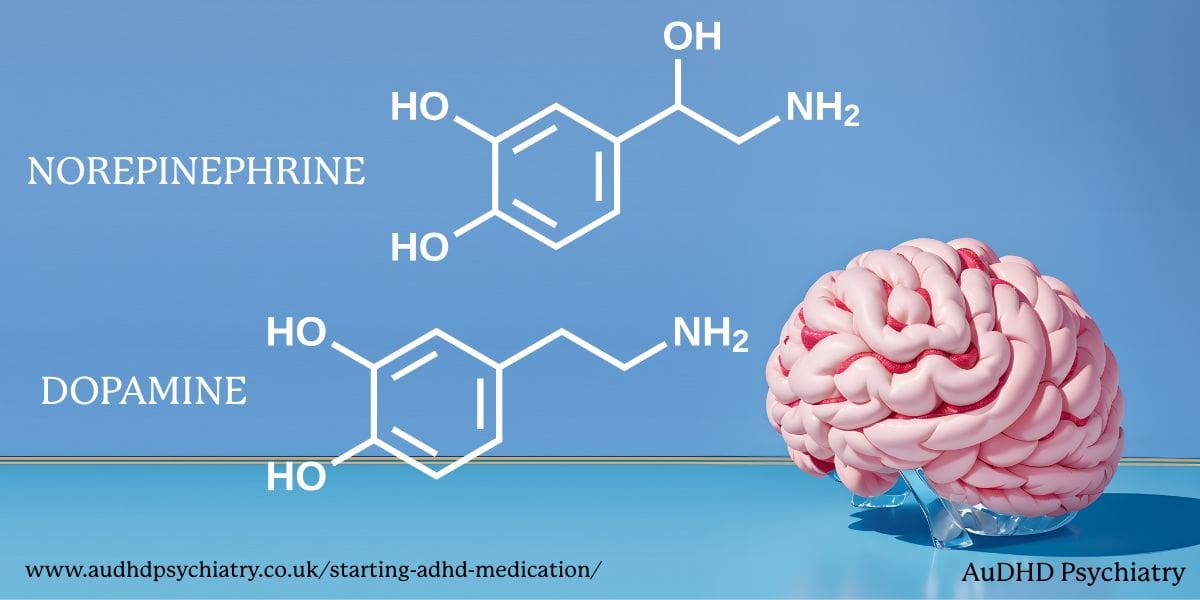
ADHD medication helps ease ADHD symptoms, such as trouble concentrating and sitting still [3]. Lisdexamfetamine and methylphenidate, the two first choices for adults in NICE guidance, are both stimulants [1]. The NHS says methylphenidate is thought to raise dopamine and noradrenaline, two chemical messengers in the brain [5]. That can increase activity in the parts of the brain that control attention and behaviour [5].
What happens before you start ADHD medication?
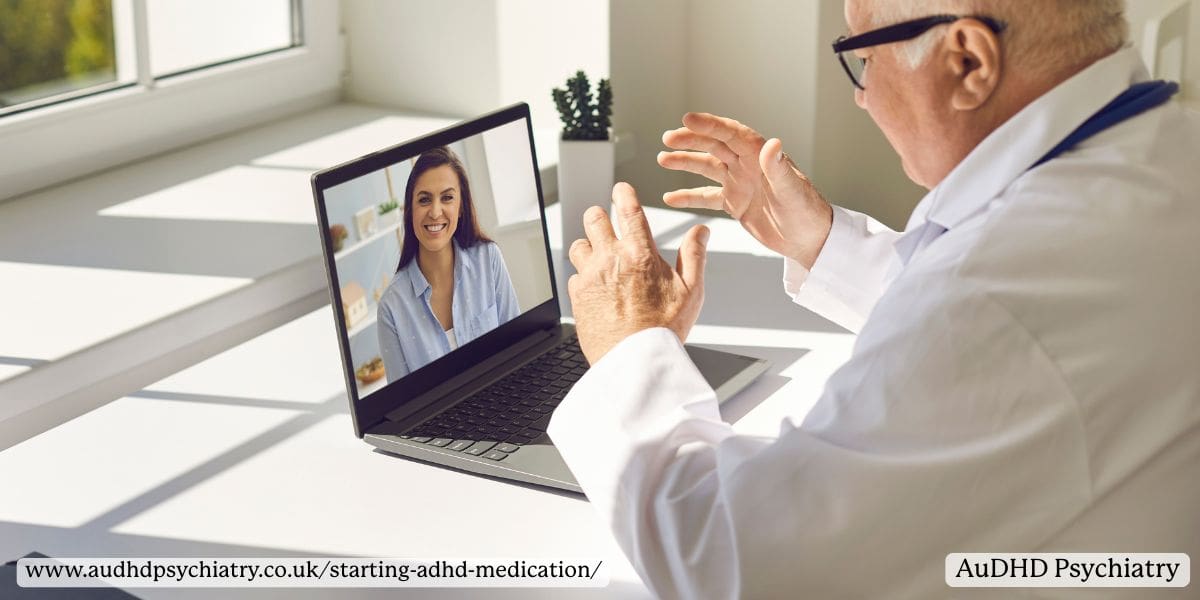
A specialist review always comes before your first ADHD prescription. In NICE guidance, only a professional trained in diagnosing and managing ADHD should start medication [1]. The review covers your mental health, other conditions, work or study, and any risk of misuse. It also checks your medical history, current medicines, height, weight and heart [1]. Most people don’t need an ECG, a tracing of the heart’s rhythm, before they start. You’d only need one if your history or another medicine points to a heart risk [1].
AuDHD Psychiatry prescribes after an ADHD assessment with us. Before prescribing, we ask for your GP summary and your blood pressure readings. Next comes an initial medication appointment of 45 to 60 minutes with one of our prescribers. If medication is right for you, you’ll get your first prescription in that appointment, sent to the pharmacy you choose. Our prescribing team includes a consultant psychiatrist, nurse prescribers and a senior clinical pharmacist. Our founder, Dr Darren O’Reilly, has ADHD and autism himself.
Our medication pathway may suit you if:
- you’ve been assessed by us and want to start medication.
- you can complete the safety checks before your first dose.
- you want dose changes made step by step, with regular reviews.
It might not be right today if:
- you need urgent help now. Call NHS 111 and choose the mental health option, or in Northern Ireland call Lifeline free on 0808 808 8000, any time. In an emergency, call 999 or go to A&E [2].
- you mainly want a quick prescription without monitoring.
- you’re happy with the prescriber who already manages your ADHD medication.
- you live outside the UK and mainly want medication supply.
Which ADHD medicine will you start on?
NICE guidance names the same two first choices for adults [1]. If one doesn’t help enough after a 6-week trial at a proper dose, adults can switch to the other [1]. For children and young people, methylphenidate comes first, and lisdexamfetamine is the next step [1]. Some people try more than one medicine before they find one that suits them [3]. So the first medicine you try isn’t a final choice. Your prescriber chooses with you, using what your health checks and history showed. Our ADHD medication comparison sets out how the main medicines differ, including how long each dose lasts.
How long does ADHD medication take to work?
Methylphenidate usually takes a few weeks to work fully [4]. You and your prescriber need time to find the right type and dose [4]. Once the right dose is found, each dose should start working within 30 to 60 minutes of taking it [4]. How quickly it acts depends on whether you take a standard or slow-release form [4][5]. So there are really two clocks to keep in mind: minutes for each dose, and weeks for the treatment to settle.
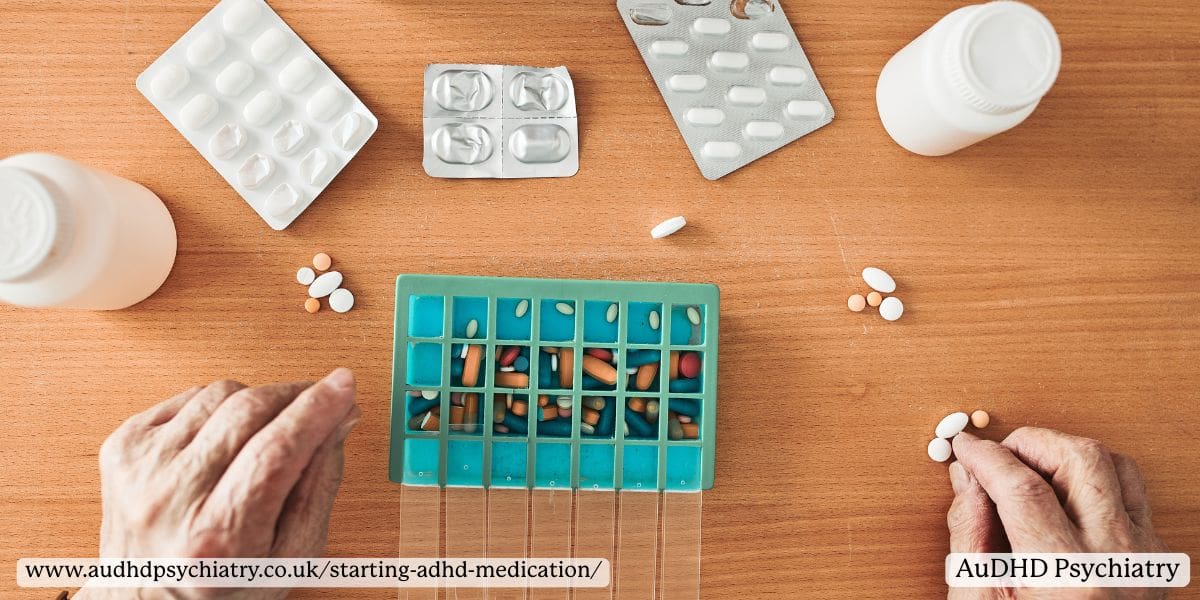
In NICE’s terms, a medicine is working when symptoms ease and your work, study and relationships improve [1]. Any side effects also need to be ones you can tolerate [1].
What is titration, and how long does it take?
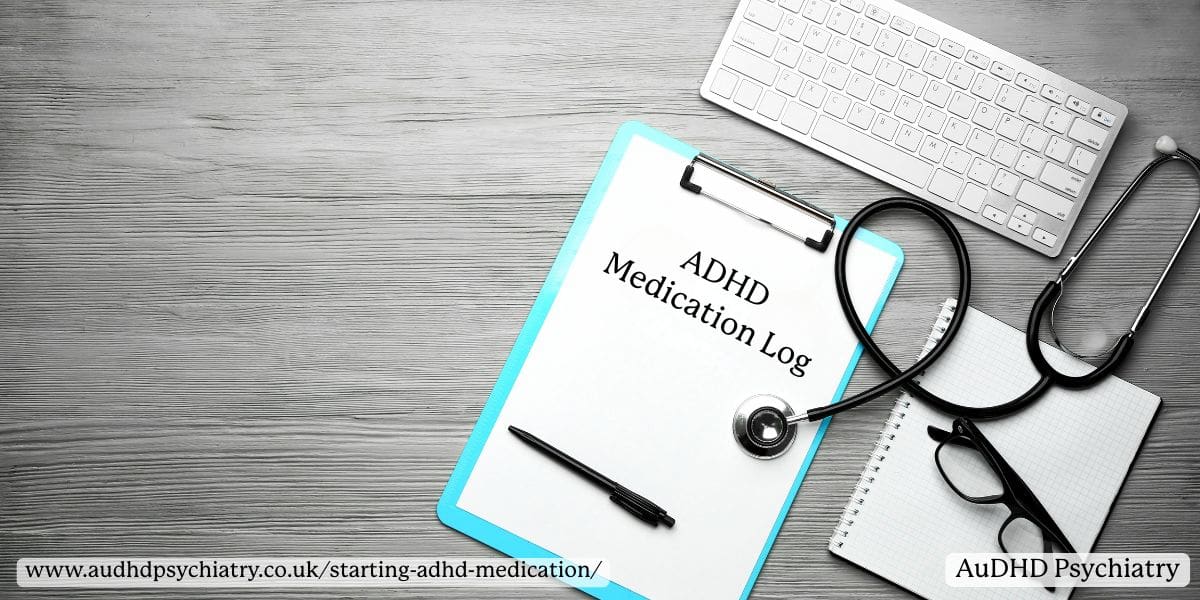
Titration means starting on a low dose and raising it in small steps [4][1]. The steps continue until you and your prescriber find the dose that works best for you [5]. Your symptoms and side effects should be recorded at the start and at every dose change [1]. You should also have regular contact with your specialist while the dose is changing [1]. The heart checks from before your first dose are repeated before and after each change [1]. Titration runs more slowly, with closer monitoring, if you’re also autistic, or have tics, anxiety, epilepsy or heart disease [1].
Our titration usually takes around 3 to 4 follow-up appointments, spaced 3 to 4 weeks apart. Some people need fewer, and some need more. Each dose step is agreed with you, based on what you report between appointments.
What are the first few weeks on ADHD medication like?
The first few weeks are a time of small changes and close watching. Common side effects of methylphenidate include headaches, trouble sleeping and loss of appetite [6]. Some weight loss can happen in the first few months [6]. It helps to note side effects as they happen, for example on a simple checklist [1]. As an adult, you’ll have your weight checked every 6 months during treatment [1].
Try not to drink alcohol while taking methylphenidate, because it can increase the medicine’s effects and side effects [5]. It’s best not to drive, cycle or use machinery until you know how the medicine affects you [5]. You must tell the DVLA if your ADHD or your medicine affects your driving [7]. Our guide to ADHD medication side effects covers them in more detail.
What should you ask your prescriber before you start?
A few written questions help you get more from your first appointment. Before you go, note the parts of your life you most want to improve. Write down what’s working for you now and what isn’t. Then take these questions with you:
- What will my dose steps be, and how often will you see me?
- Which side effects should I report, and how do I report them?
- What should I do if I miss a dose?
- How do I fit my dose around sleep, meals and work?
- What happens if the pharmacy can’t supply my usual brand?
- When would you ask my GP about shared care?
Keep the answers somewhere easy to find, such as with your medicine leaflet, so you can check them between appointments.
What helps ADHD medication work?
Medication is one part of ADHD treatment in NICE guidance, not the whole of it [1]. It works alongside changes around you, at home and at work or study [1]. Medication can ease symptoms, while these changes make daily life easier to run. A structured psychological treatment alongside medication is also worth considering if symptoms still get in the way [1]. At work or study, useful changes include a quiet workspace, written instructions and help planning tasks [3]. For better sleep, avoid screens, caffeine and alcohol close to bedtime [3].
ADHD coaching can sit alongside medication, and you don’t need a diagnosis to start it.
What if your ADHD medication isn’t working, or you can’t get it?
Your prescriber has clear next steps if a medicine isn’t helping. Sometimes the medicine suits you but the dose doesn’t, and our guide on whether your dose is right explains the signs. Otherwise, the next step is usually to try the other first-choice medicine after a fair trial [1]. Adults who can’t tolerate either first choice, or who haven’t responded to both, can be offered atomoxetine [1]. If a stimulant and a non-stimulant have both failed to help, NICE suggests a second opinion or a specialist ADHD service [1].
If your usual brand of methylphenidate is unavailable, a similar medicine from another brand is sometimes possible [5]. Staying on the same brand is best, because brands release the medicine differently [4]. So talk to your prescriber before any change of brand during an ADHD medication shortage. Methylphenidate is a controlled drug, so the pharmacy can ask you to prove your identity when you collect it [4]. You also have to collect it within 28 days of the prescription date [4]. Don’t stop suddenly or stretch your doses to make them last. Stopping methylphenidate suddenly can cause withdrawal symptoms such as low mood [5].
What happens when a child starts ADHD medication?
A child starts ADHD medication after the same kind of specialist checks as an adult, with growth checks added during treatment [1]. Our page on ADHD medication for children explains how titration, reviews and shared care work for a child.
What happens once your dose is stable?
After titration, the usual next step is shared care with your GP. Shared care means your GP prescribes and does some checks, while the specialist stays involved under a written agreement [3]. Prescribing and routine monitoring then move to primary care [1]. Shared care is always your GP’s decision, so it cannot be guaranteed. If your GP doesn’t accept shared care, we carry on prescribing privately.
AuDHD Psychiatry reviews adults’ medication every 6 months. The minimum in NICE guidance is a review once a year [1]. Our fees page shows what medication costs, and our ADHD medication guide covers treatment more widely.
Questions people ask
Can a GP start ADHD medication?
No, a GP can’t start ADHD medication on their own [3]. If you haven’t been diagnosed, a GP may refer you for an assessment with an ADHD specialist [3]. If you start medication with us, your GP practice can supply the GP summary we ask for first.
Do you need an ECG before starting ADHD medication?
You usually don’t need an ECG before your first dose. NICE says an ECG isn’t needed before stimulants, atomoxetine or guanfacine unless your history suggests a heart risk [1]. Your heart is checked in simpler ways instead, as part of the physical checks. NICE also advises against routine blood tests or ECGs during treatment without a clinical reason [1].
Can you drive when you start ADHD medication?
Yes, as long as the medicine doesn’t affect your driving. Wait until you know how the medicine affects you before you drive [5]. You only need to tell the DVLA if your ADHD or your medicine affects your ability to drive safely [7]. Deciding whether it’s safe to drive is your own responsibility [5].
Can you start ADHD medication if you were diagnosed elsewhere?
Yes, you can ask to transfer your care to us if another provider diagnosed you. We review your assessment and diagnosis first, then start treatment if you’re eligible. AuDHD Psychiatry still runs its own checks before any first prescription. NICE’s review before treatment confirms that you still meet the criteria for ADHD and still need treatment [1]. So the safety checks and the initial medication appointment still go ahead.
Is ADHD medication for life?
Not always: NICE says ADHD medication should be reviewed at least once a year, to check it’s still needed [1]. It also suggests planned breaks or a lower dose where the balance of benefit and harm points that way [1]. Any break or stop is planned with your prescriber, never done suddenly. Stopping methylphenidate suddenly can bring on withdrawal symptoms such as low mood [5]. Our guide to pausing or stopping ADHD medication explains more.
In short
Starting ADHD medication is a careful process of small, watched steps rather than a single prescription. Specialist checks come before the first dose and carry on around each dose change. If a medicine doesn’t suit you or can’t be supplied, you and your prescriber have safe ways forward. If you haven’t been assessed yet, the first step is an adult ADHD assessment with AuDHD Psychiatry.
Related
Sources
- National Institute for Health and Care Excellence (NICE). Attention deficit hyperactivity disorder: diagnosis and management, guideline NG87. Published 14/03/2018, last updated 13/09/2019. https://www.nice.org.uk/guidance/ng87 (read 30/09/2026)
- nidirect. Mental health emergency: if you’re in crisis or despair. https://www.nidirect.gov.uk/articles/mental-health-emergency-if-youre-crisis-or-despair (read 29/09/2026)
- NHS. ADHD in adults. https://www.nhs.uk/conditions/adhd-adults/ (read 30/09/2026)
- NHS. About methylphenidate for adults. https://www.nhs.uk/medicines/methylphenidate-adults/about-methylphenidate-for-adults/ (read 30/09/2026)
- NHS. How and when to take methylphenidate for adults, https://www.nhs.uk/medicines/methylphenidate-adults/how-and-when-to-take-methylphenidate-for-adults/, and Common questions about methylphenidate for adults, https://www.nhs.uk/medicines/methylphenidate-adults/common-questions-about-methylphenidate-for-adults/ (both read 30/09/2026)
- NHS. Side effects of methylphenidate for adults. https://www.nhs.uk/medicines/methylphenidate-adults/side-effects-of-methylphenidate-for-adults/ (read 30/09/2026)
- GOV.UK. Attention deficit hyperactivity disorder (ADHD) and driving. https://www.gov.uk/adhd-and-driving (read 30/09/2026)
About AuDHD Psychiatry
AuDHD Psychiatry is the trading name of ADHDdegree Ltd, a company registered in Scotland. The company number is SC822923. Our registered office is 3f1 Third Floor, Hill Street, Edinburgh, EH2 3JP.
Registered with the ICO, number ZB823033.
Last updated: 13 October 2026
Where to go from here
A private online screening for ADHD traits, with your results at the end. No commitment.
Take the free testA free, no-obligation call with our team to ask questions and find the right assessment for you.
Book a free callDarren is a Chartered Psychologist and specialist in ADHD and autism, with over 11 years of experience working in mental health and neurodevelopmental services. He holds a Doctorate in Counselling Psychology and has presented research at the British Psychological Society Annual Conference.
Read Darren’s full profileThis article is for general information and does not replace a clinical assessment. If you are struggling with your mental health right now, please contact your GP or NHS 111.