


The best planners for ADHD: paper, digital and wall calendars

Reviewed by Dr Darren O’Reilly, Chartered Psychologist and Clinical Director
In this article
Page summary
The best planner for ADHD is the one you’ll keep looking at, wherever your day happens. Planners give outside structure, so dates and tasks stop living only in your head. The main kinds are paper planners, digital planners, wall calendars and bullet journals. Many people use two together, such as a phone calendar and a paper list. Small daily habits keep a planner going after the first enthusiastic fortnight. A planner supports daily life with ADHD, but it doesn’t treat the condition. Adults across the UK can have an online ADHD assessment with AuDHD Psychiatry.
Maybe you know the pattern: a new planner, a pack of colour pens and one perfect first week. Then come two blank weeks, and the planner joins the others in a drawer, along with a guilty feeling. That’s very common with ADHD, and it says more about the planner’s fit than it says about you. The aim is a planner that fits how your day really runs, not how a planner is supposed to look.
At a glance
- The best planner: the one you’ll look at several times a day.
- Paper or digital: paper suits people who remember by writing, digital suits people who live on their phone, and many use both.
- One place: every date and task goes in one planner, not spread across three.
Why can a planner help with ADHD?
A planner helps by moving dates and tasks out of your head. Among the signs of ADHD in adults, the NHS lists being forgetful and finding it hard to organise your time [1]. Planning leans on executive function, the mental skills you use to plan ahead, keep track and switch between jobs. When those skills are under strain, a written list gives you something outside your head to check.
NICE lists written instructions, alongside spoken ones, as one everyday change that eases the impact of ADHD [2]. A planner brings the same idea home. The plan sits on paper or a screen, where you’ll see it, instead of in your memory.
What kinds of ADHD planner are there?
There are four main kinds of ADHD planner for adults. Each one suits a different way of remembering, so it’s worth knowing what each does well and where it falls short:

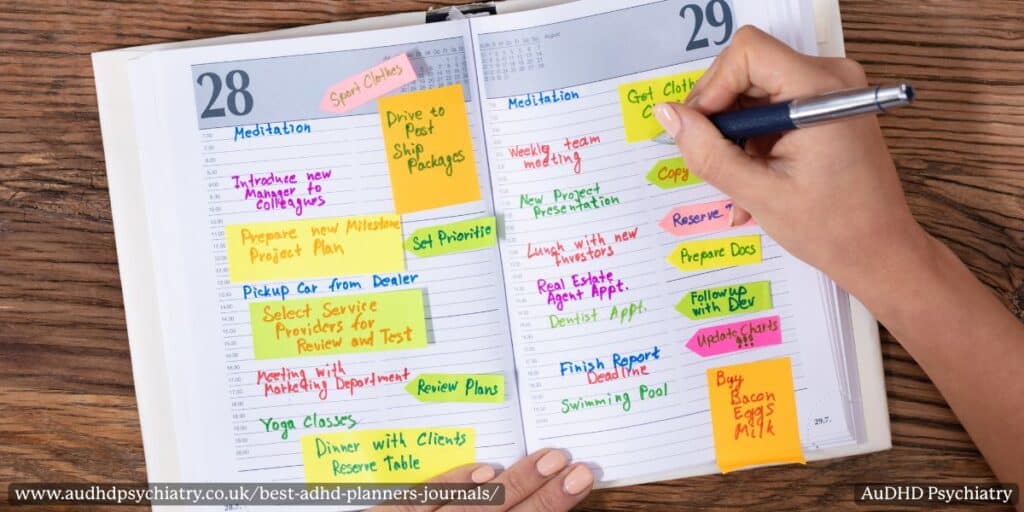
- Paper planner: a printed diary with dated or undated pages. It suits you if writing something down helps you remember it.
- Digital planner: a calendar or task app on your phone or computer. Reminders come to you, so you don’t have to go looking.
- Visual calendar: a wall planner or whiteboard showing the whole week or month. It works best somewhere you walk past every day.
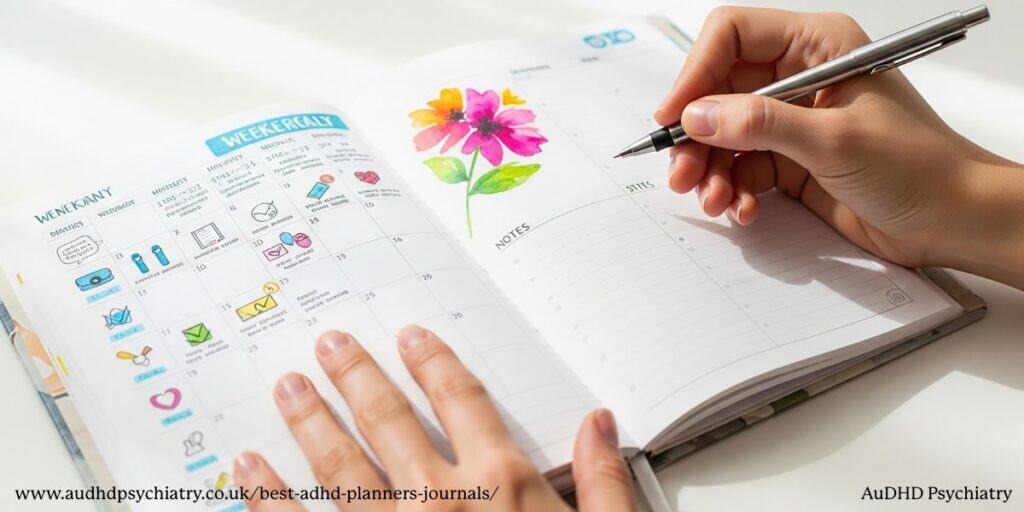
- Bullet journal: a blank notebook you set up yourself, with your own lists and layouts. It’s flexible, but setting it up takes time and keeping it going takes consistency.
Digital or paper: which planner suits ADHD better?
Neither one wins for everyone, because paper and digital help in different ways. Paper shows you the whole day or week at once, and writing a task by hand can help some people remember it. There are no notifications to pull you off track, but paper can’t remind you of anything.
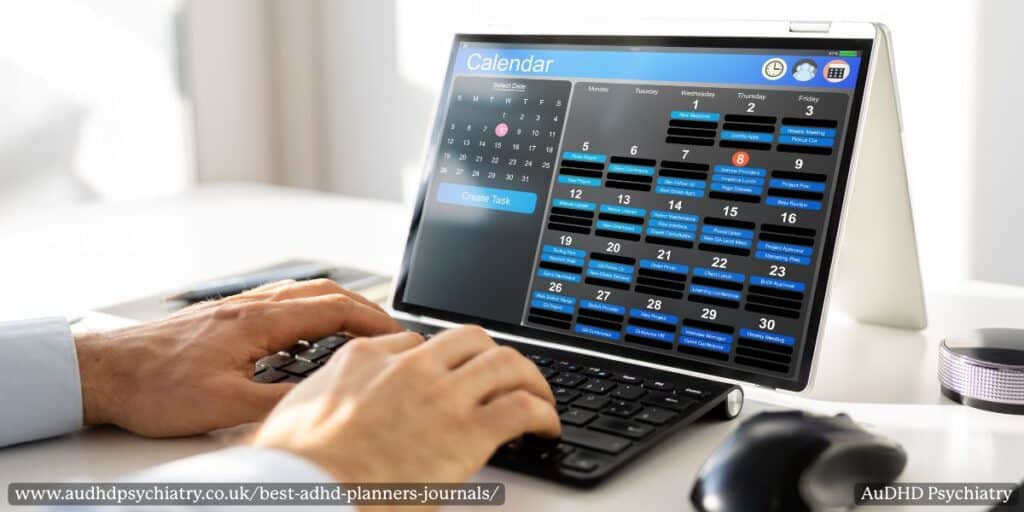
A digital planner sends reminders, repeats regular events and can sync with a work calendar. It’s always in your pocket, but it shares a screen with everything else on your phone. That’s why plenty of people combine the two: a digital calendar for fixed times, and a paper list for the day itself.
The best digital planner for ADHD adults
A good digital planner for ADHD is one simple enough to open every day. Look for reminders that come to you, a view of the whole week and syncing across your devices. A phone’s built-in calendar already does most of this. Our guide to apps that help with focus covers tools beyond the calendar.
How to choose the best productivity planners for ADHD
Choose a planner for the job it needs to do, not for its looks. Before you buy or download anything, check it against this short list:
- You can see the whole week at a glance.
- There’s room for a short daily list, not a long one.
- It lives where your day happens: in your bag, on your desk or on your phone.
- It takes minutes to set up, not an afternoon.
- It has space for appointments and to-dos side by side.
- It isn’t so lovely that you’re afraid to spoil it.
A few things tend to make a planner harder to keep. Too many sections leave you unsure where anything goes. Too many colours become one more system to keep up with. And a planner kept in a drawer gets forgotten, however good it is.
How do you use a wall calendar or visual planner with ADHD?
A wall calendar works when it hangs where you’ll see it every day. The hallway, the fridge or the wall by your desk all beat a spare room. An ADHD wall calendar does its job by being hard to miss, so treat its spot as part of the plan.
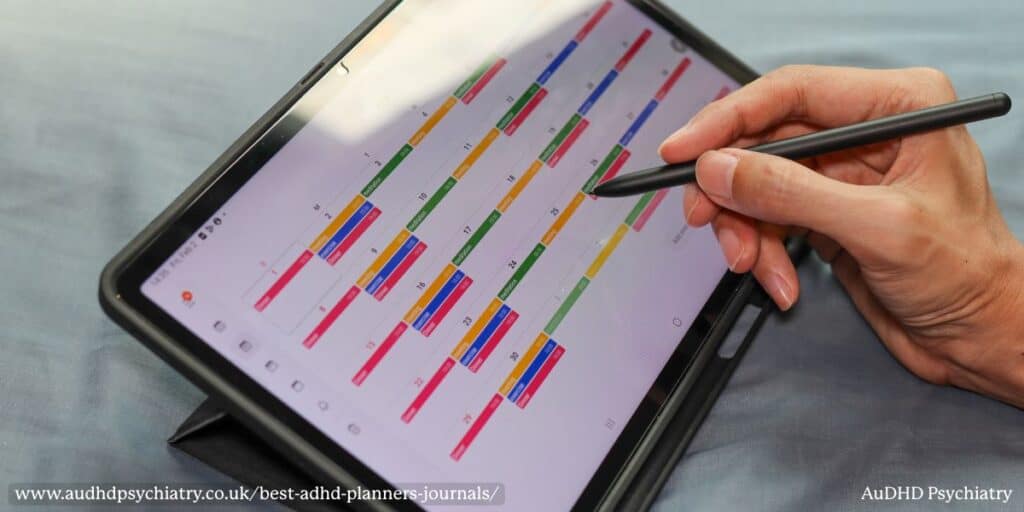
A few habits make a visual planner easier to live with:
- Colour-code by area of life, such as work, home and appointments, and keep to three or four colours.
- Add simple symbols for things that repeat, like a star for bin day.
- Take a quick look each morning and a longer look once a week.
- Cross things off as you go, so you can see what’s done.
If the whole family uses the calendar, give each person one colour. That way nobody has to read every entry to find their own.
How can an ADHD cleaning planner help at home?
An ADHD cleaning planner breaks housework into small jobs spread across the week. A cleaning schedule split by day means no single day has to carry everything. Give each slot one small job, such as “wipe the kitchen worktops” rather than “clean the kitchen”.
A short timer for each job makes it easier to start and to stop. Pin the plan where you’ll see it, such as on the fridge or in your phone’s calendar. Tick-boxes you can see show what’s done, and a weekly reset slot catches anything that slipped. The aim is a home that’s good enough and done, not a show home.
How do you keep using a planner with ADHD?
A planner sticks when it’s tied to something you already do daily. Open it with your morning coffee, or straight after you log in at work. Keep one planner, not three, so you always know where to look. A five-minute review at the same time each day keeps it current. Plan tomorrow the evening before, rather than the whole week ahead.
Once the habit is there, time blocking can help. You give each task its own block of time, rather than leaving it on a list. When you miss days, start again from today, with no catching up on the blank pages. Missing a week is common, and it doesn’t mean the planner has failed.
Can you get support with planning at work?
Yes, you can ask your employer for changes that make planning easier. The NHS says these changes are called reasonable adjustments, and examples include written instructions as well as spoken ones [1]. GOV.UK says employers must make reasonable adjustments so that workers with disabilities or health conditions aren’t substantially disadvantaged [3]. You could ask for tasks to be sent in writing, so they go straight into your planner. Your employer decides which adjustments are reasonable for your role.
Access to Work can give a grant towards things such as specialist equipment and assistive software [4]. In Northern Ireland, Access to Work (NI) runs separately [6]. Our ADHD benefits guide explains how the scheme works and how to apply.
When is it worth getting an ADHD assessment?
An assessment can make sense if every planner works for a fortnight, then stops. If ADHD symptoms are affecting your work, studies or relationships, the NHS says to see a GP [1].
An ADHD assessment may help if:
- organising, remembering and finishing things has been hard since childhood.
- it affects your work and your home life.
- you’re 18 or over and live in the UK.
It might not be right today if:
- you need urgent help now. Call NHS 111 and choose the mental health option, or in Northern Ireland call Lifeline free on 0808 808 8000, any time. In an emergency, call 999 or go to A&E [5].
- you mainly want a better planning system: ADHD coaching can help, with or without a diagnosis.
Our adult ADHD assessment takes a single online appointment, and you won’t need a GP referral. You get an outcome letter the next day and the full report within two weeks. AuDHD Psychiatry also offers a free 15-minute call for information, and a free ADHD test, which doesn’t diagnose.
Questions people ask
What is the best planner for ADHD adults?
There isn’t a single best planner for ADHD adults, because the right one is whichever you keep looking at. Start with where you spend most of your day. If you work at a desk with a notebook open, try paper. If your phone is always in your hand, try its calendar. If home life runs from the kitchen, a wall calendar may be the one you see most.
Is a digital or paper planner better for ADHD?
It depends on how you remember things. Paper shows the whole week at once, while digital reminds you when something is due. Neither choice is permanent, so try one for two weeks. If you’ve stopped opening it by then, switch to the other kind and see whether it lasts longer.
What is an ADHD journal?
An ADHD journal is a notebook for planning, lists and short notes about your day. Many people set one up as a bullet journal, with layouts they design themselves. It tends to work best kept short and simple, so a few lines a day are plenty. A journal you can fill in two minutes is one you’re more likely to keep.
Do ADHD planners actually work?
Planners can help with organising and remembering, which the NHS lists among the signs of ADHD in adults [1]. No planner treats ADHD, though. For treatment and support, NICE recommends a shared plan made with a specialist [2]. A planner sits alongside that care, and it can make day-to-day jobs easier whether or not you have a diagnosis.
Can Access to Work pay for planning tools?
Access to Work grants can help pay for items like assistive software or specialist equipment [4]. What a grant covers depends on what you need to do your job, so no particular planner is promised. A grant doesn’t affect your other benefits, and you don’t pay it back [4]. Your workplace can include your home, if that’s where you work.
Can ADHD coaching help with planning?
Yes, coaching works on practical systems such as planning, and a diagnosis isn’t needed before you start. We also see people who were assessed elsewhere or have never been assessed. AuDHD Psychiatry accepts Access to Work funding and insurance for coaching. A coach can help you build a planning habit that fits your week, then adjust it when your week changes.
In short
Pick a planner for where your day happens, then keep everything in that one. A quick daily look and a guilt-free restart matter more than a perfect layout. Whatever you choose, a planner makes life with ADHD easier to organise rather than treating it. If planning has always been hard, a short, free call with AuDHD Psychiatry is a gentle next step.
Related
Sources
- NHS, ADHD in adults, page last reviewed 19 March 2025, https://www.nhs.uk/conditions/adhd-adults/ (read 01/10/2026)
- National Institute for Health and Care Excellence (NICE), guideline NG87, Attention deficit hyperactivity disorder: diagnosis and management, published 14 March 2018, last updated 13 September 2019, https://www.nice.org.uk/guidance/ng87 (read 01/10/2026)
- GOV.UK, Reasonable adjustments for workers with disabilities or health conditions, https://www.gov.uk/reasonable-adjustments-for-disabled-workers (read 01/10/2026)
- GOV.UK, Access to Work: get support if you have a disability or health condition, https://www.gov.uk/access-to-work (read 01/10/2026)
- nidirect, Mental health emergency: if you’re in crisis or despair, https://www.nidirect.gov.uk/articles/mental-health-emergency-if-youre-crisis-or-despair (read 01/10/2026)
- nidirect, Access to Work (NI): practical help at work, https://www.nidirect.gov.uk/articles/access-work-practical-help-work (read 01/10/2026)
About AuDHD Psychiatry
AuDHD Psychiatry is the trading name of Adhddegree Ltd, a company registered in Scotland. The company number is SC822923. Our registered office is 3f1 Third Floor, Hill Street, Edinburgh, EH2 3JP.
Registered with the ICO, number ZB823033.
Last updated: 13 October 2026
Where to go from here
A private online screening for ADHD traits, with your results at the end. No commitment.
Take the free testA free, no-obligation call with our team to ask questions and find the right assessment for you.
Book a free callDarren is a Chartered Psychologist and specialist in ADHD and autism, with over 11 years of experience working in mental health and neurodevelopmental services. He holds a Doctorate in Counselling Psychology and has presented research at the British Psychological Society Annual Conference.
Read Darren’s full profileThis article is for general information and does not replace a clinical assessment. If you are struggling with your mental health right now, please contact your GP or NHS 111.