


ADHD hyperfocus and hyperfixation: what they are, and how to break the cycle

Reviewed by Dr Darren O’Reilly, Chartered Psychologist and Clinical Director
In this article
Page summary
Hyperfocus is deep, hard-to-break attention on one thing, often something you find rewarding. Many adults with ADHD describe it, yet it has no agreed definition. It isn’t on the NHS list of ADHD signs either. It differs from hyperfixation, and long stretches can end in tiredness and piled-up tasks. Meals, sleep and people can slip, and that’s when it costs you. Breaking the cycle, or using it on purpose, starts with a stopping point set beforehand. Signs that go back to childhood are worth an ADHD assessment. AuDHD Psychiatry offers online ADHD assessments for adults across the UK.
If you’ve looked up from something to find the afternoon gone, dinner missed and three messages unanswered, you’re not careless. The focus that’s so hard to find for dull jobs can be just as hard to switch off for interesting ones. Dr Darren O’Reilly has ADHD and autism himself, and this guide starts from the same place: the pull is real, and it isn’t a character flaw.
At a glance
- What it is: deep, hard-to-break focus on one thing that many adults with ADHD describe, with no agreed definition.
- The cost: time, meals, sleep and other tasks can slip while it lasts.
- What helps: a stopping point decided before you start, and a cue from outside you, such as a timer.
- Coaching: open to adults with or without a diagnosis.
What is ADHD hyperfocus?
Hyperfocus is the name people use for total absorption in one task. You can seem to tune out everything else while it lasts [1]. A 2021 research review found no single agreed definition, and said research into it is still limited [1]. Loose wording doesn’t make the experience any less real. A 2019 study of more than 600 adults found that people with more ADHD traits reported hyperfocus more often [2]. The pattern held at school or university, in hobbies and in screen time.
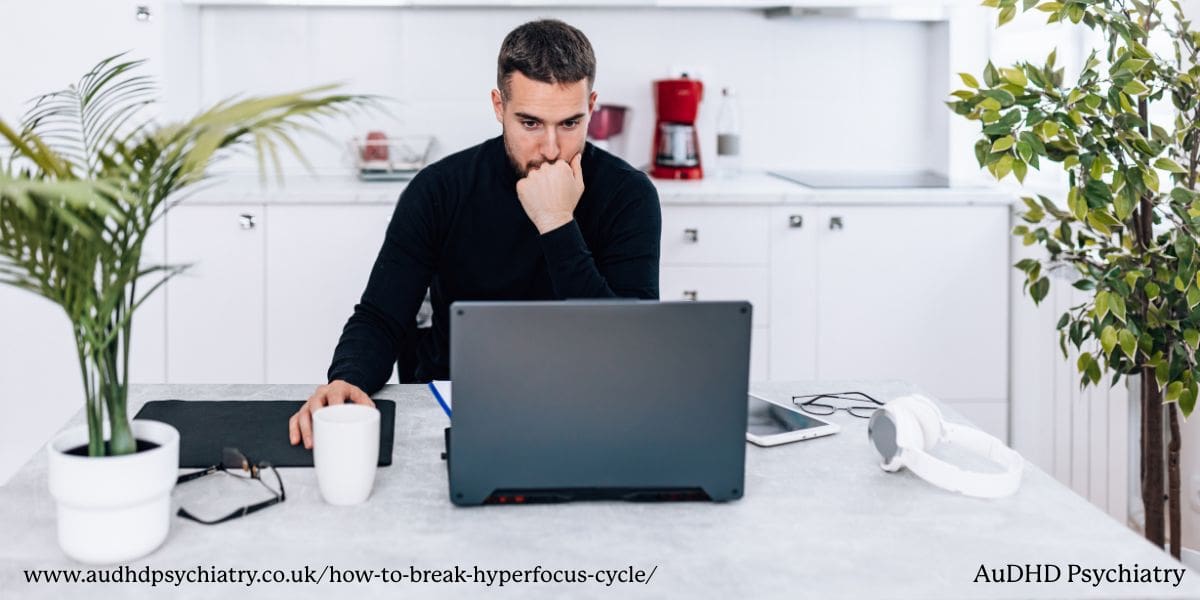
As a word, hyperfocus is a description, not a diagnosis. It isn’t on the NHS list of adult ADHD signs, which includes being easily distracted [3]. That’s the part people find confusing. The same person can struggle to start a dull task and struggle to stop an absorbing one. So a game can swallow a whole evening while homework slides off your attention in moments.
Hyperfocus or hyperfixation: what’s the difference?
Both words describe deep focus, but people use them for different spans of time. Hyperfocus usually means one stretch of absorbed attention on a task, such as a single long evening. Hyperfixation tends to mean a pull towards one topic or interest that lasts well beyond one sitting. Hyperfixation is an everyday word with no research definition, so treat that line as rough.

The 2021 review notes that hyperfocus comes up in autism as well as ADHD [1]. Being very focused on specialist interests is also one of the NHS signs of autism in adults [4]. Many autistic people call these deep, lasting interests special interests. If that sounds closer to you, the full list of signs of autism covers far more than interests.
What does the hyperfocus cycle look like?
The hyperfocus cycle tends to run the same way each time. You’ll probably recognise these steps:
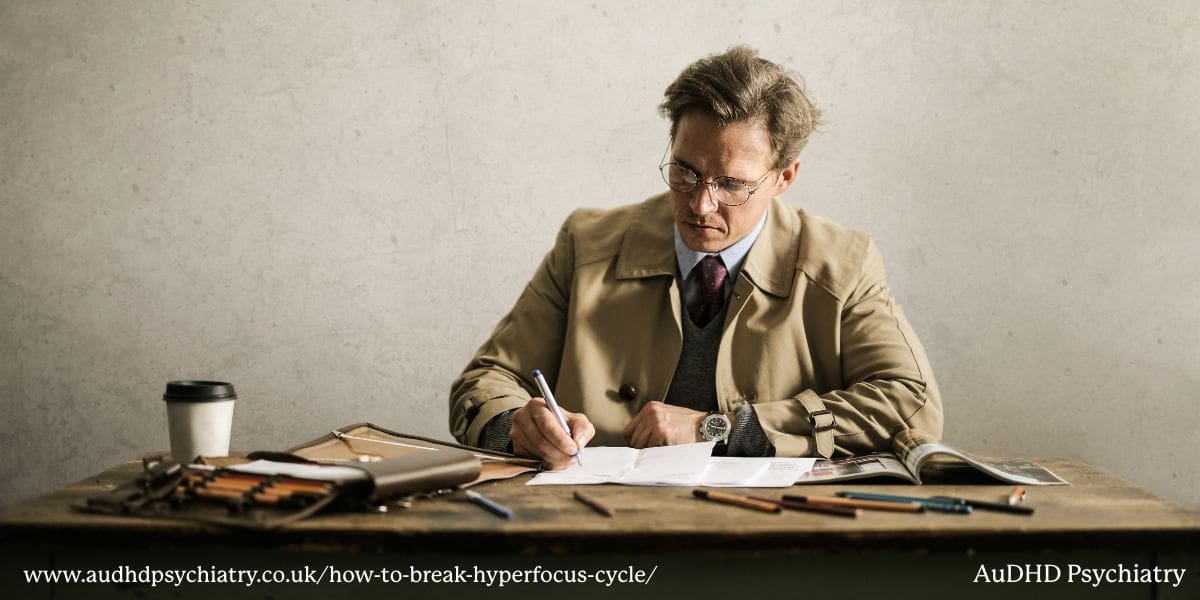
- Something catches your interest: a project, a game, a problem at work, a new hobby.
- Hours pass without you noticing them go.
- Meals, drinks, sleep and messages slide down the list, then off it.
- Stopping feels jarring, as if someone switched the lights on halfway through a film.
- Afterwards you feel drained, and the tasks you set aside have piled up.
Many people describe that tiredness afterwards as a crash. The same difficulty has another side, where you can’t get started at all, and our guide to ADHD task paralysis covers it. When crashes keep stacking up, the tiredness can add up to something heavier, which our guide to ADHD burnout looks at.
When does hyperfocus become a problem?
Hyperfocus becomes a problem when it keeps costing you more than it gives. A long, absorbed afternoon on something you love is fine. The trouble is a pattern, where the same things pay for it week after week. Ask yourself:
- Do you regularly miss meals or sleep because you couldn’t stop?
- Do deadlines, or people you care about, keep getting pushed aside?
- Does it mostly happen on screens, late at night?
- Can you choose when it starts and when it stops?
If you answered yes to the first three, or no to the last, it’s worth acting on. If ADHD symptoms are affecting your studies, work or relationships, the NHS says to see a GP about support [3].
How do you break the hyperfocus cycle?
You break the cycle by setting the end before the start. None of these steps has been tested in a trial, but each is simple to try tonight.
- Decide your stopping point before you begin, not halfway through.
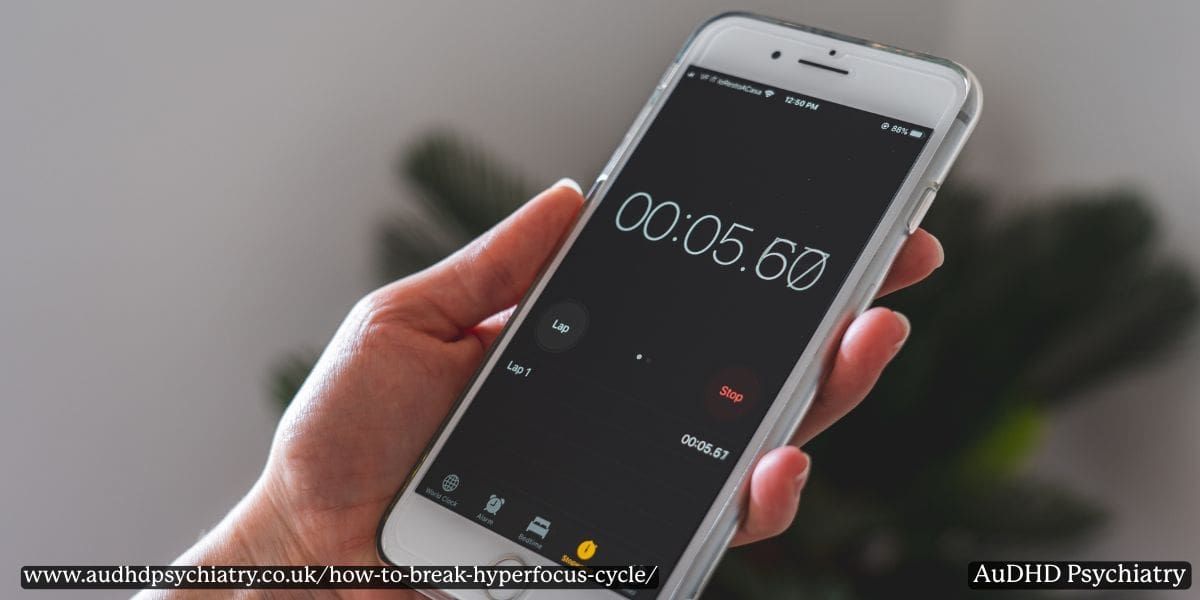
- Use a cue from outside you, such as a timer or an alarm across the room. Many people call it time blindness: it’s hard to notice time passing from inside the task.
- Work in shorter spells, with a break to move between them. NICE guidance lists this among the changes that help [5].
- Put meals, water and bedtime on the plan as fixed points.
- Leave a note of your next step, so stopping doesn’t mean losing your place.
- Ask someone you live or work with to check in at a set time.
Some people use the Pomodoro technique for ADHD as their outside cue. Our guide to focus tools for ADHD covers timers and other simple aids.
Can you use hyperfocus on purpose?
Yes, some people plan for hyperfocus instead of fighting it. Hyperfocus tends to follow interest, so it rarely turns up for a task you find dull [1]. Give your most absorbing work a set window in the day, with a break already planned at the end of it. Keep meals and sleep outside that window, so the good stretch doesn’t eat into them.

ADHD coaching at AuDHD Psychiatry is about planning routines around the way you work. It’s open to you with or without a diagnosis, including if you were assessed somewhere else. We accept Access to Work funding and insurance for coaching.
When is it worth checking for ADHD?
Hyperfocus alone doesn’t point to ADHD. ADHD symptoms usually start before the age of 12 [3], so your history matters.
An assessment may help if:
- you’re easily distracted or find tasks hard to finish.
- those signs go back to childhood.
- they affect your work, study or relationships.
It might not be right today if:
- you need urgent help now. Call NHS 111 and choose the mental health option, or in Northern Ireland call Lifeline free on 0808 808 8000, any time. In an emergency, call 999 or go to A&E [6].
- you’re under 18; children and teenagers have our child ADHD assessment.
At AuDHD Psychiatry, the adult ADHD assessment is one online appointment, with no GP referral needed. The outcome letter comes the next day, and the full report within two weeks. If autistic traits sound familiar too, our AuDHD assessment for adults covers both in three appointments. Or start smaller: the free ADHD test doesn’t give a diagnosis, and a free 15-minute call is an information call, not an assessment.
Questions people ask
Is hyperfocus a sign of ADHD?
Not on its own, because hyperfocus isn’t one of the NHS signs of ADHD [3]. A 2019 study did find that adults with more ADHD traits reported it more often [2]. So losing whole evenings to one thing is worth noticing, but it isn’t proof. What matters for ADHD is the wider pattern of signs, and whether they go back to childhood.
Can you hyperfocus without ADHD?
Yes. A 2021 research review describes hyperfocus in people without any diagnosis, as well as in ADHD and autism [1]. Plenty of people lose track of time in something they love now and then. What makes it worth a closer look is how often it happens and what it costs you.
Why can I focus on games but not on homework?
Hyperfocus tends to follow interest and reward, so it rarely turns up for a task you find dull [1]. A game gives you quick rewards and a fresh challenge every few minutes. Homework, or a report at work, usually gives its reward much later. In the 2019 study, adults with more ADHD traits reported hyperfocus in screen time as well as in study [2]. So the same brain can lock on to one and slide off the other.
Can hyperfocus lead to burnout?
Research on this is very limited, so no one can say for sure. Even so, repeated long stretches without food, rest or sleep can leave you drained. If that keeps happening, lowering the load is a sensible first step. That might mean fewer late-night stretches, meals at fixed times and a regular bedtime you protect.
Is hyperfocus part of autism too?
Being very focused on specialist interests is one of the NHS signs of autism in adults [4]. From the outside, that deep interest can look a lot like hyperfocus. Some adults recognise both ADHD and autistic traits in themselves. If that’s you, an AuDHD assessment looks at both together, instead of one at a time.
Can coaching help me manage hyperfocus?
Coaching can help you plan routines and breaks around the way you work. A coach looks at your real week with you: when your most absorbing work happens, what stays fixed around it, and who could check in. No controlled study shows coaching changes hyperfocus itself, so think of it as practical planning support rather than treatment.
In short
Hyperfocus is a real experience, even though research hasn’t pinned down exactly what it is. The most practical changes sit outside the task: an end point chosen before you begin, and something outside your own head to call time. If the pull comes with ADHD signs you’ve had since childhood, that’s worth looking into. AuDHD Psychiatry can look at the whole picture with you.
Related
Sources
- Ashinoff BK, Abu-Akel A. Hyperfocus: the forgotten frontier of attention. Psychological Research, February 2021, 85(1):1-19. https://pmc.ncbi.nlm.nih.gov/articles/PMC7851038/
- Hupfeld KE, Abagis TR, Shah P. Living “in the zone”: hyperfocus in adult ADHD. ADHD Attention Deficit and Hyperactivity Disorders, June 2019, 11(2):191-208. https://doi.org/10.1007/s12402-018-0272-y
- NHS. ADHD in adults. Page last reviewed 19 March 2025. https://www.nhs.uk/conditions/adhd-adults/
- NHS. Signs of autism in adults. Page last reviewed 6 May 2026. https://www.nhs.uk/conditions/autism/signs/adults/
- National Institute for Health and Care Excellence (NICE). Attention deficit hyperactivity disorder: diagnosis and management, guideline NG87. Published 14 March 2018, last updated 13 September 2019. https://www.nice.org.uk/guidance/ng87
- nidirect. Mental health emergency: if you’re in crisis or despair. https://www.nidirect.gov.uk/articles/mental-health-emergency-if-youre-crisis-or-despair
About AuDHD Psychiatry
AuDHD Psychiatry is the trading name of Adhddegree Ltd, a company registered in Scotland. The company number is SC822923. Our registered office is 3f1 Third Floor, Hill Street, Edinburgh, EH2 3JP.
Registered with the ICO, number ZB823033.
Last updated: 13 October 2026
Where to go from here
A private online screening for ADHD traits, with your results at the end. No commitment.
Take the free testA free, no-obligation call with our team to ask questions and find the right assessment for you.
Book a free callDarren is a Chartered Psychologist and specialist in ADHD and autism, with over 11 years of experience working in mental health and neurodevelopmental services. He holds a Doctorate in Counselling Psychology and has presented research at the British Psychological Society Annual Conference.
Read Darren’s full profileThis article is for general information and does not replace a clinical assessment. If you are struggling with your mental health right now, please contact your GP or NHS 111.