

Inattentive ADHD: ADHD without hyperactivity

Reviewed by Dr Darren O’Reilly, Chartered Psychologist and Clinical Director
Review and publication details
Clinically reviewed by Dr Darren O’Reilly, DPsych, Chartered Psychologist (CPsychol), HCPC registered practitioner psychologist, registration number PYL041661 (check the HCPC register).
AuDHD Psychiatry is the trading name of ADHDdegree Ltd, a company registered in Scotland, company number SC822923. Registered office: 3f1 Third Floor, Hill Street, Edinburgh, EH2 3JP. Registered with the ICO, number ZB823033.
In this article
Page summary
Inattentive ADHD is ADHD where attention, organisation and finishing things are the main struggle. It’s the inattentive presentation of ADHD, the picture people once called ADD. The signs are quiet, so it’s often missed in childhood and only named in adult life. Anxiety, low mood, poor sleep and autism can look similar, so a specialist checks for each. Diagnosis comes from a full assessment, and treatment can include daily changes, medication and coaching. AuDHD Psychiatry assesses adults online, by video, anywhere in the UK.
Maybe you’ve spent years being called lazy, dreamy or careless, while trying harder than anyone could see. If so, effort was probably never the problem. Our founder, Dr Darren O’Reilly, has ADHD and autism himself, so he knows this picture from the inside.
What is inattentive ADHD?
Inattentive ADHD is ADHD in which attention problems, not hyperactivity, take the lead. The diagnostic manual used by clinicians, the DSM-5, calls it the predominantly inattentive presentation [1]. It describes three presentations: predominantly inattentive, predominantly hyperactive-impulsive and combined [1]. When both symptom groups are strong, the presentation is called combined. Which one fits depends on the group of symptoms you’ve had over the past six months [1].
ADD is an older name, and it’s the one that most closely matches the inattentive presentation. It’s diagnosed as ADHD today, and our piece on the difference between ADD and ADHD explains how the names changed.
What are the symptoms of inattentive ADHD?
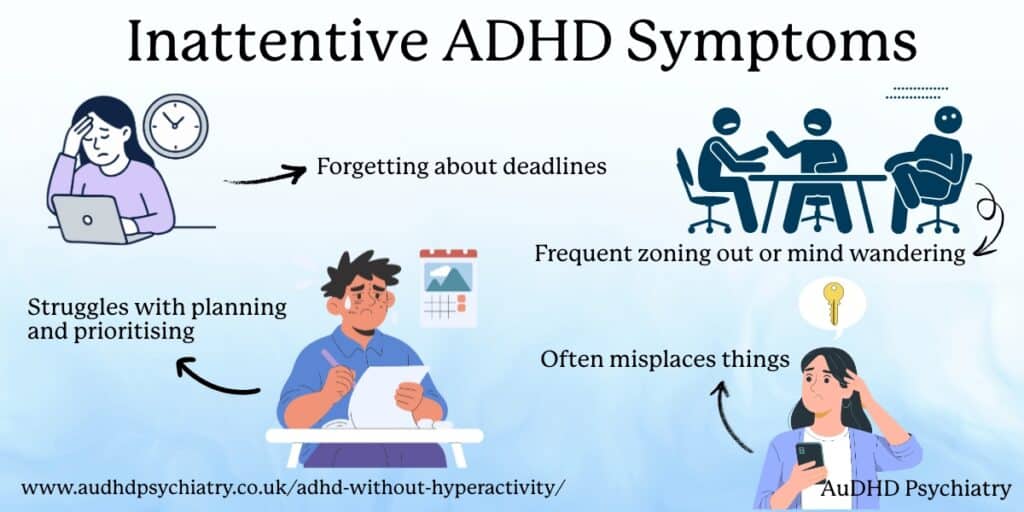
Inattentive ADHD shows up as distraction, forgetfulness and trouble getting organised. The NHS lists these inattentive signs [2]:
- Being easily distracted or forgetful.
- Finding it hard to organise your time.
- Finding it hard to follow instructions or finish tasks.
- Losing things often, such as your wallet, phone or keys.
These signs usually start before the age of 12 [2]. In adult life they tend to look ordinary from the outside, which is part of why they’re hard to name. Some people have a cupboard of half-finished projects. Others drift off halfway through a meeting, or halfway through a friend’s story, and feel awful about it afterwards.
Many of these signs involve executive function and working memory: the skills for planning tasks and holding information in mind. Deadlines slip even when you started early and tried hard. By the evening you’re mentally worn out from keeping track of everything. Friends and partners can feel let down when plans or messages go missing. For a diagnosis, the symptoms have to cause real difficulty in at least two parts of your life [3]. Our guide to the signs and symptoms of ADHD covers every presentation.
How is inattentive ADHD different from the other types?
Inattentive ADHD differs from the other types in which group of symptoms leads. In the other types, hyperactive and impulsive symptoms are strong too. They’re about energy, restlessness and acting fast, and the NHS lists these signs [2]:
- Having a lot of energy or feeling restless.
- Being very talkative or interrupting conversations.
- Making quick decisions without thinking about what might happen as a result.
In the predominantly hyperactive-impulsive presentation, these symptoms lead and attention problems are fewer [1]. In adults, hyperactivity often looks less like running around and more like an inner restlessness. That can mean a busy mind, constant fidgeting, or finding a long film hard to sit through. Our guide to the types of ADHD explains the combined presentation, where both groups are strong.
You can feel restless at times and still have an inattentive presentation. The presentation is decided by which symptom group meets the diagnostic criteria, not by whether you ever feel restless at all [1]. So if the list above only half fits you, that doesn’t rule out ADHD. It simply suggests the inattentive side is the one to look at more closely.
Why is inattentive ADHD missed, especially in adults?
Inattentive ADHD is missed because its symptoms are quiet. A child who daydreams rarely disrupts a classroom, so teachers and parents have less reason to ask questions. Years later, that same adult has usually built a set of workarounds that hide the problem from everyone else.
ADHD is thought to be under-recognised in girls and women, who are also less likely to be referred for assessment [3]. The NHS offers one possible reason: women more commonly have inattentive symptoms, which are harder to spot than hyperactive ones [2]. There’s more on this in our guide to ADD symptoms in women.
Masking plays a part too. In our clinicians’ view, many adults have spent years hiding or working around their difficulties. That’s why AuDHD Psychiatry asks about your whole history, not just how you seem on the day.
Is it inattentive ADHD or something else?
Other conditions can look like inattentive ADHD, so a proper assessment checks for them [3]. Anxiety, low mood and depression, poor sleep, trauma and autism can all affect focus and memory. People with ADHD often have other conditions too, such as depression, anxiety, addictions or dyslexia [2].
Getting this right matters, because the plan changes when more than one thing is going on. A plan built around anxiety alone leaves the attention problems unexplained, and the reverse is true as well. When sleep is the main issue, the first step looks different again. If autism traits are part of the picture too, we offer an AuDHD assessment, which looks at both together.
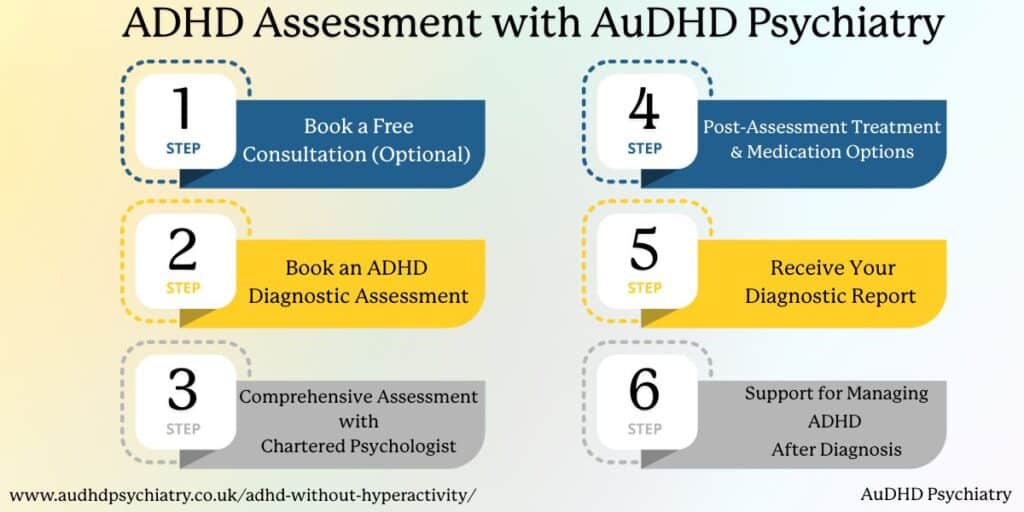
How is inattentive ADHD diagnosed?
A specialist trained in ADHD makes the diagnosis after a full assessment [3]. They take a full history back to childhood, and may ask for reports from someone who knows you [3]. That matters, because a questionnaire or a single observation is never enough on its own [3]. For adults, the DSM-5 criteria mean at least five inattention symptoms, with several present before age 12 [1]. A free ADHD test is a useful first step, but it’s a screen rather than a diagnosis. Our guide to how ADHD diagnosis works in the UK sets out each route.
This is for you if:
- You’re 18 or over.
- You recognise many of the signs above in yourself.
- You want to book directly, without a GP referral.
It might not be right today if:
- You need urgent help now. Call NHS 111 and choose the mental health option, or in Northern Ireland call Lifeline free on 0808 808 8000, any time. In an emergency, call 999 or go to A&E [4][5].
- You’re under 18. Our child ADHD assessment is the place to start.
AuDHD Psychiatry assesses adults online by video, for people living in the UK. Our private ADHD assessment for adults page explains what’s involved.
What treatment helps inattentive ADHD?
Treatment usually starts with practical changes to how your day is set up [3]. Examples include fewer distractions, shorter spells of focus with breaks, and written instructions alongside spoken ones. For adults, NICE says to offer medication if symptoms still cause significant difficulty after those changes have been made and reviewed [3]. The first-line medicines are methylphenidate and lisdexamfetamine, and both can cause side effects, so NICE asks for regular monitoring [3].
Some adults choose not to take medication, or can’t tolerate it. For them, NICE suggests a structured psychological programme focused on ADHD, which can include CBT [3]. If ADHD is found, our prescribers can start medication. Shared care with your GP is possible, but it’s always your GP’s decision. AuDHD Psychiatry also offers ADHD coaching, and you don’t need a diagnosis to start it. Our ADHD medication guide covers each medicine in more depth.
Questions people ask
Is inattentive ADHD the same as ADD?
Yes, in practice: ADD is the older name, and today the same picture is diagnosed as ADHD with a predominantly inattentive presentation [1]. The label changed, but the day-to-day difficulties it describes didn’t. If you were told years ago that you had ADD, it’s still worth mentioning, because that history helps the clinician.
Can you have ADHD without being hyperactive?
Yes. If the attention group meets the diagnostic criteria and the hyperactive group doesn’t, that’s ADHD without the hyperactivity [1]. Some people were told as children that they couldn’t have ADHD because they sat still in class. That was never the full test, and it’s fine to ask about ADHD now.
Can your ADHD presentation change over time?
Yes. The presentation describes your symptoms over the past six months, so it can change as your life changes [1]. In our experience, hyperactivity often turns quieter and more internal with age. So an adult can look more inattentive than they did as a child. Think of a presentation as a snapshot rather than a fixed type. What counts most is how your symptoms affect you now, at work and at home.
Can inattentive ADHD be mistaken for anxiety or depression?
Yes. The signs overlap, and ADHD can also sit alongside anxiety or depression rather than replacing them. Poor concentration, low energy and forgetfulness turn up in all three. A specialist assessment looks for each one, because the right plan depends on the whole picture. If you’re already getting help for anxiety or low mood and your focus hasn’t improved, raise ADHD with whoever is supporting you.
Is there a test for inattentive ADHD?
No single test can diagnose it: a specialist makes the diagnosis from a full assessment [3]. Our free ADHD test is a short screen you can take in a few minutes. It helps you decide whether an assessment is worth pursuing, but it isn’t a diagnosis. Keep a note of your answers, and bring them along if you book an assessment later.
Do you need medication for inattentive ADHD?
Not always. NICE guidance puts changes to your surroundings and routine first, and medication comes in if difficulties continue [3]. Coaching or talking therapy are options alongside medication, or instead of it. Some people start with practical changes and see how far those take them before deciding anything else. Whatever you lean towards, it’s worth talking the options and their side effects through with a prescriber.
Is sluggish cognitive tempo the same as inattentive ADHD?
No, researchers describe it as a set of symptoms distinct from ADHD inattention [6]. Sluggish cognitive tempo covers excessive daydreaming, mental confusion and slowed thinking or movement [6]. In 2023, an international work group renamed it cognitive disengagement syndrome [7]. It isn’t a formal diagnosis yet, so mention these signs at an ADHD assessment rather than looking for a separate test.
In short
Inattentive ADHD is ADHD where attention, not restlessness, causes most of the trouble. It’s easy to miss, in childhood and in adult life, because it rarely disrupts anyone but you. If the signs sound familiar, an ADHD assessment is how you find out whether they fit.
Related
- ADHD and emotional dysregulation
- ADHD diagnosed later in life
- high-functioning ADHD
- our clinical team
- free 15-minute call
Sources
- American Psychiatric Association, Diagnostic and Statistical Manual of Mental Disorders, fifth edition, text revision (DSM-5-TR), 2022.
- NHS, ADHD in adults, page last reviewed 19 March 2025, https://www.nhs.uk/conditions/adhd-adults/.
- National Institute for Health and Care Excellence (NICE), guideline NG87, Attention deficit hyperactivity disorder: diagnosis and management, published 14 March 2018, last updated 13 September 2019, https://www.nice.org.uk/guidance/ng87 (recommendations 1.2.2, 1.3.1 to 1.3.4, 1.5.15, 1.5.16, 1.5.18, 1.7.11).
- NHS, Where to get urgent help for mental health, https://www.nhs.uk/nhs-services/mental-health-services/where-to-get-urgent-help-for-mental-health/ (read 29/09/2026).
- nidirect, Mental health emergency: if you’re in crisis or despair, https://www.nidirect.gov.uk/articles/mental-health-emergency-if-youre-crisis-or-despair (read 29/09/2026).
- Fredrick JW, Becker SP, Sluggish cognitive tempo (cognitive disengagement syndrome) and academic functioning: a systematic review and agenda for future research, Clinical Child and Family Psychology Review, 2023, 26(1):82-120, https://doi.org/10.1007/s10567-022-00411-6.
- Becker SP, Willcutt EG, Leopold DR and others, Report of a work group on sluggish cognitive tempo: key research directions and a consensus change in terminology to cognitive disengagement syndrome, Journal of the American Academy of Child and Adolescent Psychiatry, June 2023, 62(6):629-645, https://doi.org/10.1016/j.jaac.2022.07.821.
About AuDHD Psychiatry
AuDHD Psychiatry is the trading name of ADHDdegree Ltd, a company registered in Scotland. The company number is SC822923. Our registered office is 3f1 Third Floor, Hill Street, Edinburgh, EH2 3JP.
Registered with the ICO, number ZB823033.
Last updated: 13 October 2026
Where to go from here
A private online screening for ADHD traits, with your results at the end. No commitment.
Take the free testA free, no-obligation call with our team to ask questions and find the right assessment for you.
Book a free callDarren is a Chartered Psychologist and specialist in ADHD and autism, with over 11 years of experience working in mental health and neurodevelopmental services. He holds a Doctorate in Counselling Psychology and has presented research at the British Psychological Society Annual Conference.
Read Darren’s full profileThis article is for general information and does not replace a clinical assessment. If you are struggling with your mental health right now, please contact your GP or NHS 111.