

ADHD symptoms in women: hidden signs, ADD and a self-test

Reviewed by Dr Darren O’Reilly, Chartered Psychologist and Clinical Director
Review and publication details
Clinically reviewed by Dr Darren O’Reilly, DPsych, Chartered Psychologist (CPsychol), HCPC registered practitioner psychologist, registration number PYL041661 (check the HCPC register).
AuDHD Psychiatry is the trading name of ADHDdegree Ltd, a company registered in Scotland, company number SC822923. Registered office: 3f1 Third Floor, Hill Street, Edinburgh, EH2 3JP. Registered with the ICO, number ZB823033.
In this article
Page summary
ADHD in women usually looks like distraction and forgetfulness rather than restlessness, so it’s easy to miss. ADD is an older name for ADHD, and the signs are quiet: lost time, unfinished tasks, tiredness. Early evidence suggests hormonal changes and big life changes can make the signs harder to manage. A free online self-test can flag ADHD traits, but it can’t give you a diagnosis. Support can include changes to routines, ADHD medication, and psychological support or coaching. AuDHD Psychiatry assesses adults living in the UK for ADHD online.
Plenty of women spend years calling themselves lazy, scatty or just bad at life. Often they’re working twice as hard as everyone around them to keep up, and nobody sees it. If that sounds familiar, it’s worth a proper look. You don’t need to have it all worked out before you ask.
At a glance
- What ADD means now: ADHD where inattention shows more than hyperactivity, which clinicians call the inattentive presentation.
- Why it’s missed in women: inattentive signs are quieter than hyperactive ones, so other people find them harder to spot.
- Who can diagnose it: a qualified specialist, after a full assessment.
- The self-test: a free adult ADHD questionnaire gives you a screen, not a diagnosis.
- What helps: changes to your surroundings and routines, ADHD medication, and psychological support or coaching.
What does ADD mean for women with ADHD?
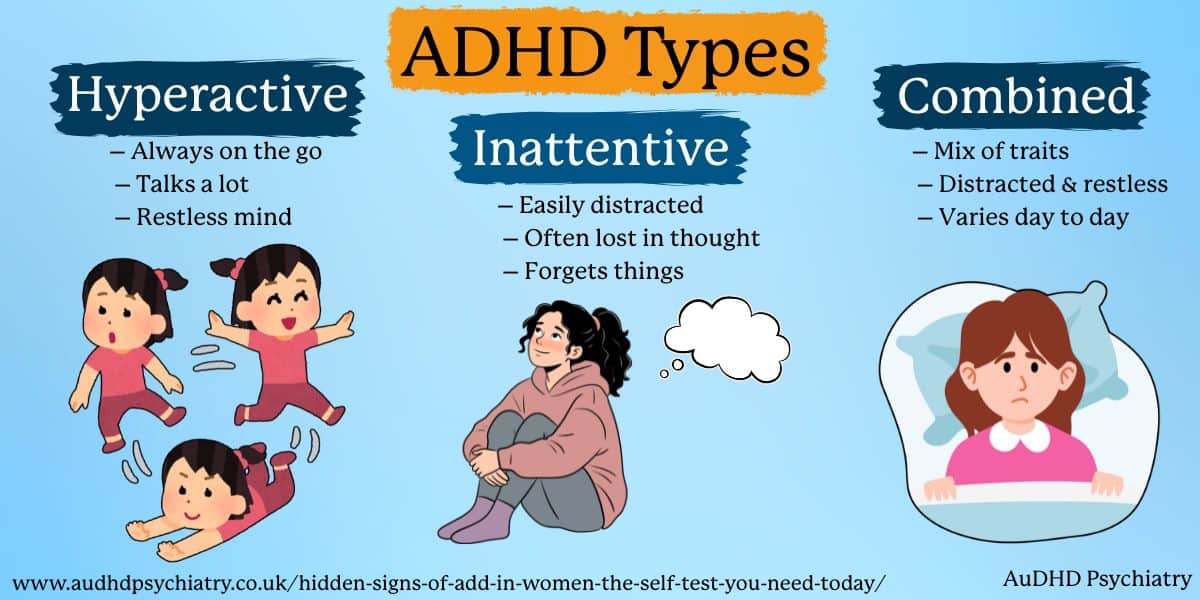
ADD isn’t a different condition: it’s an older name for ADHD. The main diagnostic manual brought in the name ADD, then changed it to ADHD in a later revision [1]. Today ADD isn’t a formal diagnosis, so the difference between ADD and ADHD is mostly one of history. Clinicians now describe ADHD by its presentation, meaning the kind of signs that lead. “Predominantly inattentive” is the term they use when inattention stands out most [2]. Plenty of people still say ADD when they mean ADHD without obvious hyperactivity: the distracted, forgetful side rather than the restless one. If that’s the picture you recognise, our guide to inattentive ADHD goes into it in more depth.
Why does ADD go unnoticed in women?
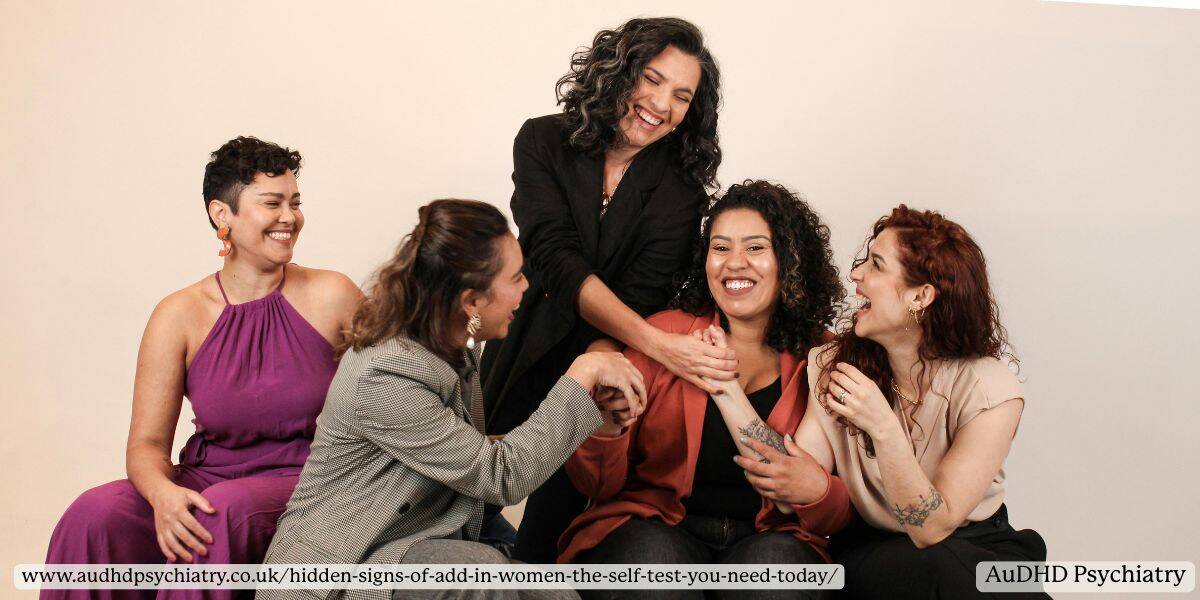
Inattentive signs are quieter than the fidgeting and interrupting most people picture. The NHS says ADHD in women is thought to be recognised less often, possibly because women more commonly have inattentive symptoms [3]. Girls and women are also less likely to be referred, according to NICE guidance [4].
Could this be part of your story?
Try Our Free AuDHD Test Book a Screening CallOur specialist clinicians are here to help you understand yourself better.
A 2020 expert consensus on girls and women with ADHD found the disruptive-boy picture still shapes referrals [5]. It also says the strategies women develop to cope can hide the signs, especially in structured or well-supported settings [5]. Many women get so good at covering the signs that other people miss them, and sometimes they do too. That’s often called masking.
What are the hidden signs of ADD in women?
The hidden signs are everyday struggles that other people rarely notice. The NHS lists being easily distracted or forgetful, struggling with time or tasks, and losing things often [3]. It can also look like feeling overwhelmed or seeming to lack motivation [5]. Day to day, it often looks like this:
- Jobs started keenly and left half-done.
- Drifting off mid-conversation.
- A busy mind nobody else can see.
- Tiredness from the effort of keeping up.
- Big feelings that are hard to manage [5].
An assessment may help if:
- The signs go back as far as you can remember.
- They cause real problems at work, at home or with people.
- Coping takes more effort than it seems to for others.
It might not be right today if:
- You need urgent help now. Call NHS 111 and choose the mental health option, or in Northern Ireland call Lifeline free on 0808 808 8000, any time. In an emergency, call 999 or go to A&E [6].
- You’re under 18, which calls for a child ADHD assessment.
- The signs started only recently: talk to your GP first.
How do ADD symptoms change with age and hormones?
ADD symptoms often become easier to see at times of change, like university, a new job or parenthood [5]. A new setting can take away the structure that helped you cope. Early evidence links worse symptoms to the menstrual cycle, pregnancy and menopause [5]. Tracking your symptoms through these times helps a clinician review your treatment with you [5].
That doesn’t mean ADHD starts in adult life. The NHS says symptoms usually start before the age of 12, even when they’re only noticed much later [3]. What changes is how much the signs get in the way, and how well old coping habits hold.
Is there a self-test for ADD in women?
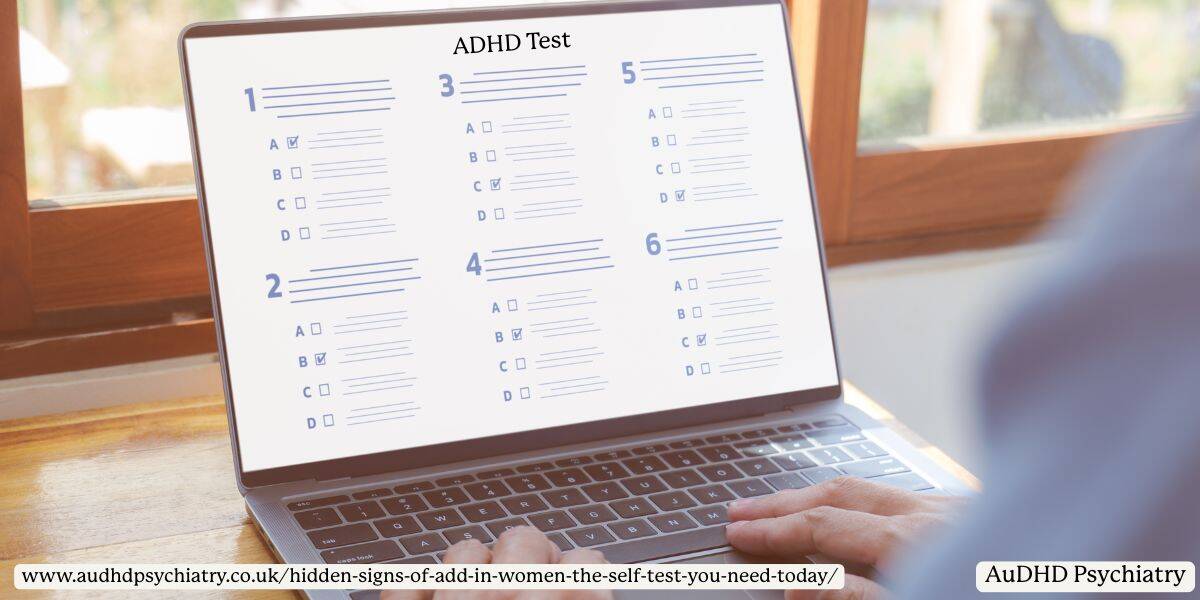
There’s no separate test for women, but there is a free adult screen that anyone can take. The free ADHD test is a short online questionnaire of 13 questions. They’re based on the World Health Organization’s adult ADHD self-report scale, and each one asks how often something happens [7]. Women and men answer exactly the same questions, and the whole thing takes a few minutes.
NICE guidance says ADHD shouldn’t be diagnosed from a rating scale alone [4]. Whatever your result, you can talk it through on a free 15-minute call with AuDHD Psychiatry. The call is for information, and it isn’t an assessment.
What can untreated ADD do over the years?
The 2020 consensus reports higher mental health risks for women with ADHD [5]. It notes that anxiety and depression are reported more often in females with ADHD than in males [5]. Years of pushing on without support can also end in ADHD burnout, when even an ordinary day feels like too much.

None of this is a forecast of your future, whatever your age now. Knowing what’s behind the struggle is what opens the door to the right support, at any age. Talking to your GP about how you’ve been feeling is a sensible first step, whatever you decide next.
What helps with ADD in women?
ADD is usually managed with practical changes, medication and psychological support [4]. Changes to your surroundings and routines usually come first. NICE guidance says to offer medication if significant problems remain once those changes are in place and reviewed [4]. ADHD medication is started and adjusted by a prescriber, with regular checks on side effects and how well it suits you. Your prescriber decides whether medication is right for you.
If you’d rather not take medication, or it doesn’t suit you, NICE suggests psychological support focused on ADHD [4]. The support can include elements of cognitive behavioural therapy, known as CBT [4]. Treatment may need reviewing when your circumstances shift [5]. ADHD coaching is open to adults with or without a diagnosis. If you’re in work, AuDHD Psychiatry accepts Access to Work funding and insurance for coaching.
How do you get assessed for ADD as an adult?
Only a full assessment by a qualified specialist can diagnose ADHD [4]. On the NHS, your GP decides whether to refer you. Our page on how ADHD diagnosis works in the UK sets out that route. AuDHD Psychiatry assesses adults privately and online, and you don’t need a referral from your GP. We assess people living in the UK. An adult ADHD assessment is one appointment, and it looks at your childhood as well as your life now. You’ll get an outcome letter the next day, and the full report within two weeks. Our page on a private ADHD assessment for adults walks through each step.
Questions people ask
Is ADD still a diagnosis?
No: ADD is an older name, and today’s diagnosis is ADHD [1][2]. The word hasn’t gone away, though. You’ll still hear it from friends, in magazines and sometimes from doctors. Say ADD to a clinician and they’ll know what you mean, then talk it through in terms of ADHD.
Can ADD start in adulthood?
Not usually: the signs begin in childhood, though many women only notice them as adults [3]. Recognition often comes at a time of change, such as a first job or a first baby [5]. Noticing the signs late doesn’t mean they weren’t there before. An assessment asks about your early years for exactly that reason, so it’s worth thinking back before you go.
Can women have the hyperactive kind of ADHD?
Yes: women and girls do have hyperactive and impulsive symptoms, usually less obviously than men and boys [5]. Restlessness may be felt inside rather than seen. It can also show as talking a lot or acting on impulse, which people often put down to personality.
Does menopause make ADD worse?
It can, on early evidence. An expert consensus puts menopause among the hormonal times when symptoms may get worse [5]. The NHS calls the time when periods become irregular, before they stop, perimenopause [8]. If you’re noticing a change, keep a simple record of your symptoms through it. A written record gives a clinician something concrete to review, and it’s easier than remembering months of bad days.
Is ADHD in women mistaken for anxiety or depression?
It can be: NICE guidance says women may be more likely to be given another mental health diagnosis before ADHD [4]. Many women are treated for low mood or worry for years, then get a late diagnosis of ADHD. Those conditions can be real alongside ADHD, so an earlier diagnosis isn’t always wrong. An assessment lets you look back at that history with a specialist and see it in a new light.
What if I also recognise autistic traits?
ADHD and autism can happen together, and in women each can hide the other. Some women are recognised as autistic first, and others as having ADHD. Our guide to AuDHD in women, the name often used for the two together, explains how they overlap.
In short
ADD is an everyday name for ADHD where attention, not restlessness, causes the trouble. In women, those signs are easy to miss or explain away, sometimes for decades. Support is there once you know what you’re dealing with. If you recognise yourself here, start with the free self-test or a free call, and go from there.
Related
- signs and symptoms of ADHD
- AuDHD assessment
- free autism test
- our clinical team
- Nelly Furtado: How ADHD Diagnosis Fuels Her Creative Brilliance
- Untreated ADHD in Female Adults: Risks and Support
Sources
- Lange KW, Reichl S, Lange KM, Tucha L, Tucha O. “The history of attention deficit hyperactivity disorder”. Attention Deficit and Hyperactivity Disorders, December 2010, 2(4):241-255. https://pmc.ncbi.nlm.nih.gov/articles/PMC3000907/
- American Psychiatric Association. Diagnostic and Statistical Manual of Mental Disorders, fifth edition, text revision (DSM-5-TR), 2022.
- NHS. ADHD in adults. Page last reviewed 19 March 2025. https://www.nhs.uk/conditions/adhd-adults/
- NICE. Attention deficit hyperactivity disorder: diagnosis and management, guideline NG87. Published 14 March 2018, last updated 13 September 2019. https://www.nice.org.uk/guidance/ng87
- Young S, Adamo N, Ásgeirsdóttir BB and others. “Females with ADHD: An expert consensus statement taking a lifespan approach providing guidance for the identification and treatment of attention-deficit/hyperactivity disorder in girls and women”. BMC Psychiatry, 12 August 2020, 20(1):404. https://pmc.ncbi.nlm.nih.gov/articles/PMC7422602/
- nidirect. Mental health emergency: if you’re in crisis or despair. Read 29/09/2026. https://www.nidirect.gov.uk/articles/mental-health-emergency-if-youre-crisis-or-despair
- Kessler RC, Adler L, Ames M and others. “The World Health Organization Adult ADHD Self-Report Scale (ASRS): a short screening scale for use in the general population”. Psychological Medicine, 2005, 35:245-256. https://doi.org/10.1017/s0033291704002892
- NHS. What are menopause and perimenopause? Page last reviewed 19 May 2026. https://www.nhs.uk/conditions/menopause-and-perimenopause/what-are-menopause-and-perimenopause/
About AuDHD Psychiatry
AuDHD Psychiatry is the trading name of ADHDdegree Ltd, a company registered in Scotland. The company number is SC822923. Our registered office is 3f1 Third Floor, Hill Street, Edinburgh, EH2 3JP.
Registered with the ICO, number ZB823033.
Last updated: 13 October 2026
Where to go from here
A private online screening for ADHD traits, with your results at the end. No commitment.
Take the free testA free, no-obligation call with our team to ask questions and find the right assessment for you.
Book a free callDarren is a Chartered Psychologist and specialist in ADHD and autism, with over 11 years of experience working in mental health and neurodevelopmental services. He holds a Doctorate in Counselling Psychology and has presented research at the British Psychological Society Annual Conference.
Read Darren’s full profileThis article is for general information and does not replace a clinical assessment. If you are struggling with your mental health right now, please contact your GP or NHS 111.