

ADHD burnout: symptoms, causes and recovery

Reviewed by Dr Darren O’Reilly, Chartered Psychologist and Clinical Director
Review and publication details
Clinically reviewed by Dr Darren O’Reilly, DPsych, Chartered Psychologist (CPsychol), HCPC registered practitioner psychologist, registration number PYL041661 (check the HCPC register).
AuDHD Psychiatry is the trading name of ADHDdegree Ltd, a company registered in Scotland, company number SC822923. Registered office: 3f1 Third Floor, Hill Street, Edinburgh, EH2 3JP. Registered with the ICO, number ZB823033.
In this article
Page summary
ADHD burnout is an everyday name for lasting exhaustion in adults with ADHD when coping runs out. It isn’t a medical diagnosis, but the tiredness and struggle behind it are real. Common signs are tiredness that rest doesn’t touch, failing routines and pulling back from people. Telling burnout apart from depression and autistic burnout helps you find the right support. Practical steps start with lowering the load at work and at home. Burnout that keeps coming back can be a reason to check for ADHD. AuDHD Psychiatry assesses adults living in the UK for ADHD, online.
If every small task feels impossible and rest isn’t touching it, you’re not imagining it. What you’re going through has a name, and it isn’t laziness. It’s what happens when coping has cost you more than you had, for a long time. Dr Darren O’Reilly, who founded AuDHD Psychiatry, has ADHD and autism himself. You don’t have to earn a break by falling apart first.
At a glance
- What it is: an everyday name for deep exhaustion in adults with ADHD. It isn’t a medical diagnosis.
- Common signs: tiredness that rest doesn’t touch, routines that stop working, and pulling back from people.
- What helps: lowering the load, and changing how work and home are set up.
- Support without a diagnosis: ADHD coaching is open to adults with or without one.
What is ADHD burnout?
ADHD burnout is a name for exhaustion, not a clinical diagnosis. The World Health Organization lists burn-out as a work-related issue rather than a medical condition [1]. The WHO defines it as chronic workplace stress that hasn’t been managed well, and uses the term for work only [1]. Its three parts are exhaustion, feeling distant or cynical about your job, and doing that job less well.
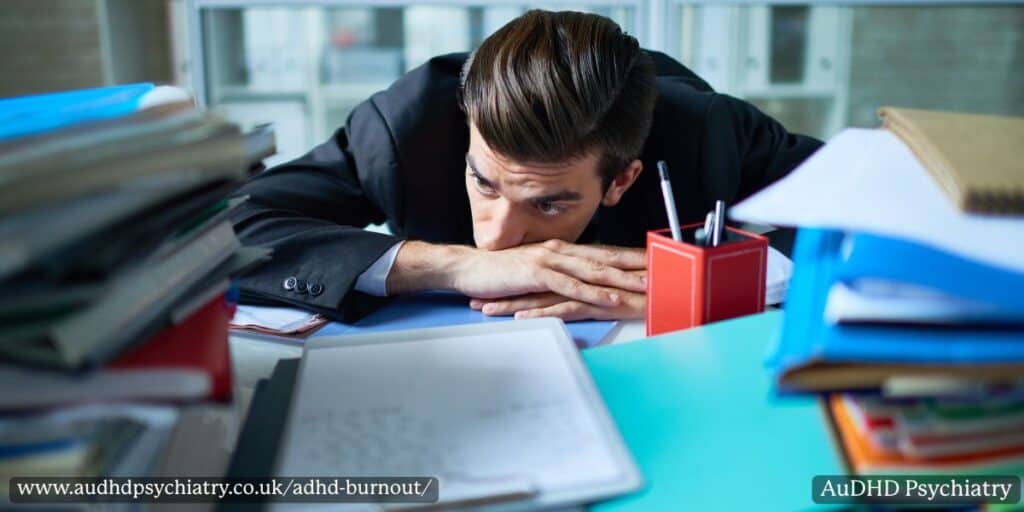
ADHD burnout is the name adults with ADHD use when that exhaustion spreads into home, study and relationships too. There’s no agreed clinical definition of ADHD burnout yet. You can still take it seriously, and act on it, without a label.
What are the symptoms of ADHD burnout?
The signs of ADHD burnout show up in ordinary days getting harder. Common signs of ADHD burnout include:
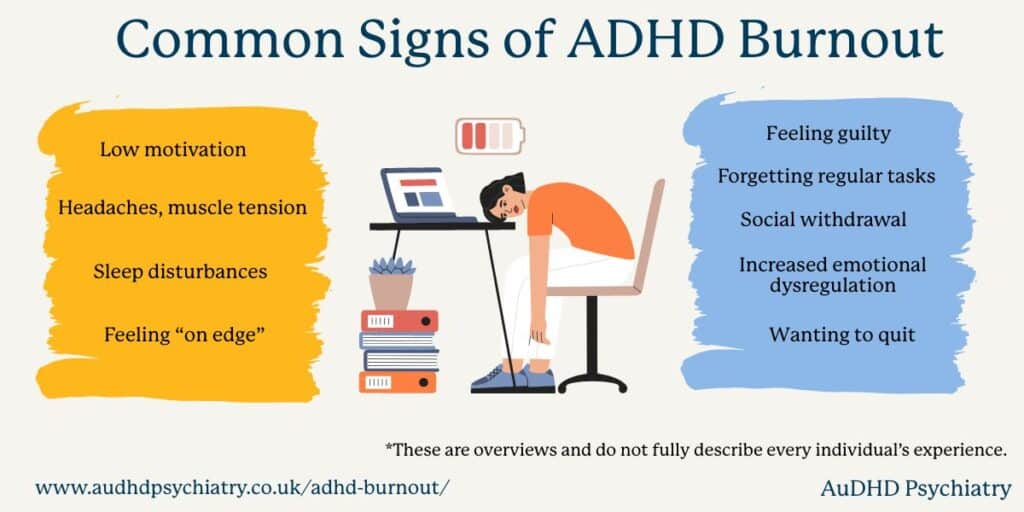
- Tiredness that a weekend or a holiday doesn’t touch.
- Lists, reminders and routines that used to work falling apart.
- ADHD traits feeling louder, such as forgetting more, losing things and losing track of time [2].
- Small tasks, like replying to a message, feeling too big to start.
- Feeling irritable or on edge.
- Pulling back from friends and family.
- Feeling detached or cynical about work, and doing it less well than before [1].
The signs describe what burnout feels like, but they can’t tell you what’s causing it. Several of them overlap with low mood, anxiety and ADHD itself. A GP or a specialist can look at the whole picture with you.
Could this be part of your story?
Try Our Free ADHD Test Book a Screening CallOur specialist clinicians are here to help you understand yourself better.
How is ADHD burnout different from depression?
ADHD burnout and depression overlap, and they can happen together. Both bring tiredness and low motivation. The NHS says depression brings low mood and a loss of interest in things you used to enjoy [3]. Those symptoms last for weeks or months, and they’re bad enough to affect work, social life and family life [3]. If low mood and loss of enjoyment run through every part of your life, start with your GP. Our guide to ADHD and depression looks at how the two conditions meet.
If you’re struggling right now, call Samaritans free on 116 123, day or night, from any phone [4]. Call NHS 111 and choose the mental health option, or in Northern Ireland call Lifeline free on 0808 808 8000, any time. In an emergency, call 999 or go to A&E [5].
What causes ADHD burnout?
Burnout builds up when stress runs on for a long time without relief. For adults with ADHD, the extra effort of keeping up can add to that stress. That effort means holding plans in your head, catching up on missed details and hiding struggles at work.
Masking is part of it. Masking means holding back your ADHD traits so other people don’t see them. Masking, in our clinicians’ view, is common, especially in adults who have spent years compensating. Unrecognised ADHD can make the effort higher, because you’ve been coping without an explanation or support. Our guide on how ADHD affects the brain explains where the traits come from.
How do you recover from ADHD burnout?
Recovery from ADHD burnout starts with lowering the load where you can. There’s no controlled study of recovery from ADHD burnout, so the steps below draw on NHS stress advice and NICE’s ADHD guidance.
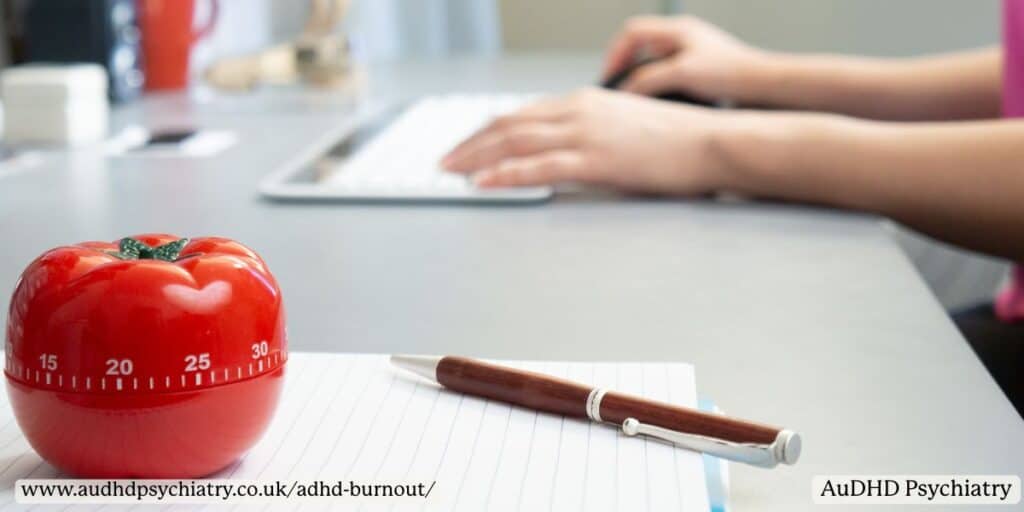
- Change your surroundings. NICE guidance describes changes that reduce the impact of ADHD, such as adjusting lighting and noise [6]. Its examples include headphones, shorter stretches of focus with movement breaks, and written instructions [6].
- Make tasks smaller. NHS advice suggests splitting big tasks into smaller steps, and giving yourself credit for each one [7].
- Lean on people and movement. Talking to someone you trust, being more active and trying self-help CBT techniques can all help with stress [7].
- Ask about support at work. Access to Work can fund practical support, and support with managing your mental health [8].
- Try coaching. You don’t need a diagnosis to start ADHD coaching at AuDHD Psychiatry. We accept Access to Work funding and insurance for coaching.
If you already take ADHD medication, talk to your prescriber before changing anything.
Could burnout be a sign of undiagnosed ADHD?
Repeated burnout can be a reason to look at ADHD, but it’s never proof. Burnout that keeps coming back, with ADHD signs that go back to childhood, is worth checking.
An assessment may help if:
- burnout returns even after rest.
- you recognise ADHD signs from your childhood.
- nothing explains why coping costs you so much.
It might not be right today if:
- you need urgent help now. Call NHS 111 and choose the mental health option, or in Northern Ireland call Lifeline free on 0808 808 8000, any time. In an emergency, call 999 or go to A&E [5].
- you’re under 18, where a child assessment applies instead.
AuDHD Psychiatry runs an adult ADHD assessment as one online appointment, with no GP referral. You get an outcome letter the next day and the full report within two weeks. If you’re autistic too, our AuDHD assessment for adults covers both conditions across three appointments. When you’re running on empty, a free 15-minute call is a low-effort way to start, and so is the free ADHD test.
Questions people ask
How long does ADHD burnout last?
ADHD burnout has no set length, because no study has measured how long it lasts. The time it takes depends on how much the load on you actually changes. If low mood and loss of interest stay for weeks and affect work and home, that can be depression. Your GP can help you work out which it is, and what support fits [3].
What is AuDHD burnout?
AuDHD burnout is an everyday name for burnout in people who are autistic and have ADHD. It isn’t a separate term in research. A 2020 interview study described autistic burnout as long-lasting exhaustion, loss of skills and lower tolerance of noise and light [9]. The autistic adults in that study linked it to life stress building up, and to a lack of support [9]. In AuDHD burnout, those signs can sit alongside ADHD burnout.
Can ADHD medication help with burnout?
ADHD medication treats ADHD symptoms, not burnout itself. NICE guidance says adults with ADHD should be offered medication when symptoms still cause significant problems [6]. The offer comes after changes to their surroundings have been tried and reviewed [6]. Whether medication is right for you is your prescriber’s decision, after a full assessment.
Can masking ADHD lead to burnout?
Masking can add to burnout, because holding back your ADHD traits all day takes steady effort. Noticing where you mask most is a useful first step. You can then choose one place where you ease off and see how it feels.
Can I get support at work while I recover?
Yes, the Access to Work scheme can pay for practical support and help with your mental health at work [8]. You check you’re eligible and then apply for the grant yourself through GOV.UK [8]. Your employer decides on any changes to your workplace, so it helps to talk to them early.
In short
ADHD burnout is real, deep exhaustion. Easing the load and adjusting your surroundings come first. When burnout returns again and again, AuDHD Psychiatry can help you check whether ADHD is part of the reason. Your next step can be as small as one conversation.
Related
- private ADHD assessment for adults
- one assessment for ADHD and autism together
- autistic masking explained
Sources
- World Health Organization, “Burn-out an ‘occupational phenomenon’: International Classification of Diseases”, 28/05/2019. https://www.who.int/news/item/28-05-2019-burn-out-an-occupational-phenomenon-international-classification-of-diseases
- NHS, “ADHD in adults”, page last reviewed 19/03/2025. https://www.nhs.uk/conditions/adhd-adults/
- NHS, “Symptoms: Depression in adults”, read 30/09/2026. https://www.nhs.uk/mental-health/conditions/depression-in-adults/symptoms/
- Samaritans, “Contact a Samaritan”, read 30/09/2026. https://www.samaritans.org/how-we-can-help/contact-samaritan/
- nidirect, “Mental health emergency: if you’re in crisis or despair”, read 30/09/2026. https://www.nidirect.gov.uk/articles/mental-health-emergency-if-youre-crisis-or-despair
- National Institute for Health and Care Excellence (NICE), guideline NG87, “Attention deficit hyperactivity disorder: diagnosis and management”, published 14/03/2018, last updated 13/09/2019. https://www.nice.org.uk/guidance/ng87
- NHS Every Mind Matters, “Dealing with stress”, read 30/09/2026. https://www.nhs.uk/every-mind-matters/mental-health-issues/stress/
- GOV.UK, “Access to Work: get support if you have a disability or health condition”, read 30/09/2026. https://www.gov.uk/access-to-work
- Raymaker DM, Teo AR, Steckler NA and others, “‘Having All of Your Internal Resources Exhausted Beyond Measure and Being Left with No Clean-Up Crew’: Defining Autistic Burnout”, Autism in Adulthood, 2(2):132-143, June 2020. https://pmc.ncbi.nlm.nih.gov/articles/PMC7313636/
About AuDHD Psychiatry
AuDHD Psychiatry is the trading name of ADHDdegree Ltd, a company registered in Scotland. The company number is SC822923. Our registered office is 3f1 Third Floor, Hill Street, Edinburgh, EH2 3JP.
Registered with the ICO, number ZB823033.
Last updated: 13 October 2026
Where to go from here
A private online screening for ADHD traits, with your results at the end. No commitment.
Take the free testA free, no-obligation call with our team to ask questions and find the right assessment for you.
Book a free callDarren is a Chartered Psychologist and specialist in ADHD and autism, with over 11 years of experience working in mental health and neurodevelopmental services. He holds a Doctorate in Counselling Psychology and has presented research at the British Psychological Society Annual Conference.
Read Darren’s full profileThis article is for general information and does not replace a clinical assessment. If you are struggling with your mental health right now, please contact your GP or NHS 111.