


Autistic Masking Guide: What It Is, How It Happens, and More

Reviewed by Dr Darren O’Reilly, Chartered Psychologist
In this article
Table of Contents
2. Examples of Autistic Masking in Everyday Life
3. Why Do Autistic People Mask?
4. Who Is Most Likely to Mask?
5. Signs You May Be Masking Without Knowing It
6. The Impact of Autistic Masking on Mental Health
7. Autistic Masking and Burnout
8. Masking and Autism Diagnosis
9. Unmasking: What It Means and What to Expect
10. How to Support Autistic People Who Mask
11. Frequently Asked Questions
In Focus:
- Autistic masking, also called social camouflaging, refers to the conscious or subconscious process of suppressing natural autistic behaviours to appear neurotypical.
- Masking is extremely common among autistic individuals, particularly autistic women, girls, and those diagnosed later in life.
- Prolonged masking carries serious mental health consequences, including anxiety, depression, identity confusion, and autistic burnout.
- Masking frequently delays autism diagnosis by making outward behaviour appear neurotypical.
If you have spent much of your life working hard to seem normal in social situations, watching other people’s behaviour carefully, rehearsing what to say, forcing eye contact that feels deeply uncomfortable, or coming home from ordinary days feeling inexplicably exhausted, you may be experiencing something that researchers now recognise as autistic masking. Autistic masking is not pretending or dishonesty. It is a coping mechanism: an often subconscious process through which autistic individuals suppress or modify their natural behaviours to meet neurotypical standards.
At AuDHD Psychiatry, a UK-based neurodevelopmental assessment and diagnosis centre, we see the effects of masking regularly. Many of the adults we assess have spent decades managing their presentation so effectively that their autism went undetected. This guide explains what autistic masking is, why it happens, what it costs, and what genuine support looks like. If what you read resonates with your own experience, reach out to our team to explore whether an adult autism assessment may be right for you.
What Is Autistic Masking?
Autistic masking, sometimes referred to as autistic camouflaging or social camouflaging, describes the process by which autistic individuals conceal, suppress, or modify their natural autistic behaviours to fit into social environments and meet societal expectations. It can be conscious or entirely subconscious. In many cases, it begins at such a young age that the masking behaviours themselves become second nature.
Researchers distinguish between several elements of masking:
- Assimilation: attempting to fit in with a social group
- Compensation: developing strategies to work around social difficulties)
- Camouflage: actively hiding autistic traits
Masking is not the same as healthy social adaptation. Everyone adjusts their behaviour to some extent depending on context. The distinction is one of degree, effort, and cost. For autistic individuals, the level of constant effort required to monitor, adapt, and suppress natural behaviours goes far beyond ordinary social adjustment. It is cognitively and emotionally exhausting.
The Camouflaging Autistic Traits Questionnaire (CAT-Q) is the primary validated research tool used to measure camouflaging in autistic people. Developed by Hull and colleagues, the CAT-Q provides a validated framework for understanding the frequency and type of camouflaging strategies an individual uses.
Autism Masking vs. Autistic Camouflaging: Is There a Difference?
The terms masking and camouflaging are often used interchangeably, though researchers sometimes draw distinctions. Camouflaging is the broader umbrella term, encompassing all strategies used to blend in socially. Masking specifically refers to the suppression or hiding of autistic traits such as suppressing stimming, forcing eye contact, or concealing emotional responses. In everyday language, both terms refer to the same broad phenomenon, and we use them interchangeably here.
Examples of Autistic Masking in Everyday Life
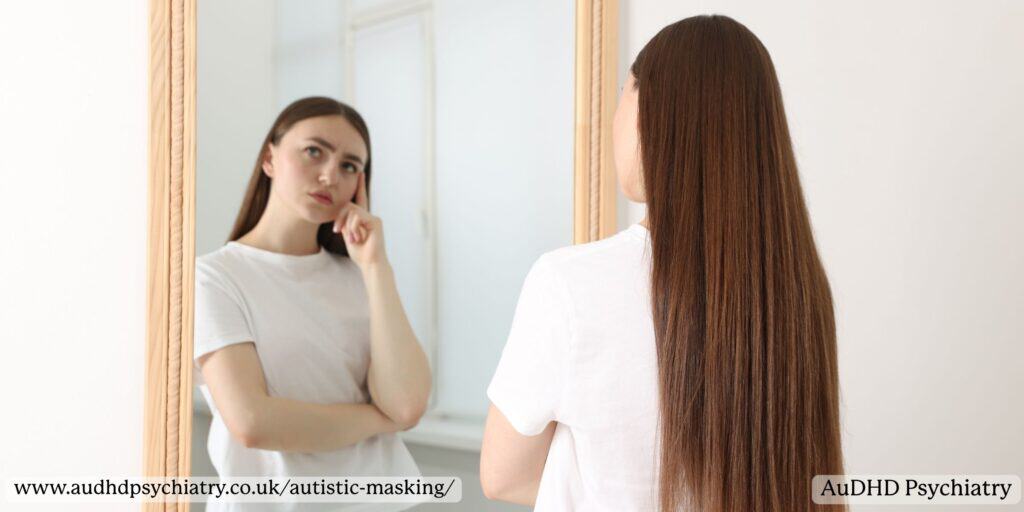
Masking takes many forms. Common examples include:
- Forcing or faking eye contact. Making deliberate eye contact feels deeply uncomfortable for many autistic people. Masking often involves maintaining eye contact because it is expected.
- Rehearsing conversations. Preparing scripts for social interactions—running through likely questions, rehearsing responses, planning small talk—is a common masking strategy that can occupy significant mental energy before a social event even begins.
- Mimicking other people’s body language and facial expressions. Many autistic individuals consciously do this to appear socially fluent.
- Suppressing stimming. Stimming, self-stimulatory behaviour such as rocking, hand-flapping, or repetitive movements, often serves an important self-regulatory function. Many autistic people suppress or hide these behaviours in social contexts.
- Pretending to understand social cues. Rather than asking for clarification in social situations, masking autistic individuals may nod, laugh, or respond in expected ways even when they have not understood the social cues or subtext.
- Hiding sensory needs. Tolerating sensory overload from loud noises, bright lights, or physical discomfort because the need for accommodation feels too exposing or too difficult to explain.
- Performing interest or engagement. Displaying enthusiasm or interest in conversations or activities that are not genuinely engaging.
Why Do Autistic People Mask?
The reasons autistic people mask are deeply human: they are rooted in the need for social acceptance, safety, and belonging. Masking is rarely a conscious choice (at least not initially). It tends to emerge gradually, shaped by repeated experiences of social exclusion, correction, or rejection when autistic traits are visible.
Social Acceptance and Fear of Judgement
From a young age, many autistic children receive direct or indirect messages that their natural behaviours are wrong, strange, or socially unacceptable. The child who stims visibly, who does not make eye contact, who takes language literally, or who struggles with small talk quickly learns that these behaviours attract negative attention. Masking emerges as a response.
Avoiding Bullying, Stigma, and Social Exclusion
For many autistic individuals, particularly in educational settings and during adolescence, the social consequences of visible autistic traits can include bullying, rejection, and social isolation. Masking can become a survival strategy—a rational response to genuinely unsafe social environments.
Workplace and Professional Expectations
In adult professional contexts, the pressure to mask is often intense. Formal situations like job interviews, meetings, and client interactions carry implicit neurotypical standards that can feel impossible to meet authentically.
Safety in Social Environments
For some autistic people, particularly those from marginalised communities or those who belong to multiple minority groups, masking can be directly linked to personal safety. Our guide to pathological demand avoidance explores how differently the pressure to comply can manifest across the autism spectrum, and why understanding individual presentation matters so much.
Who Is Most Likely to Mask?
Research consistently finds that masking is not equally distributed across the autistic population. Several factors shape who masks, how much, and with what consequences.
Autistic Women and Girls
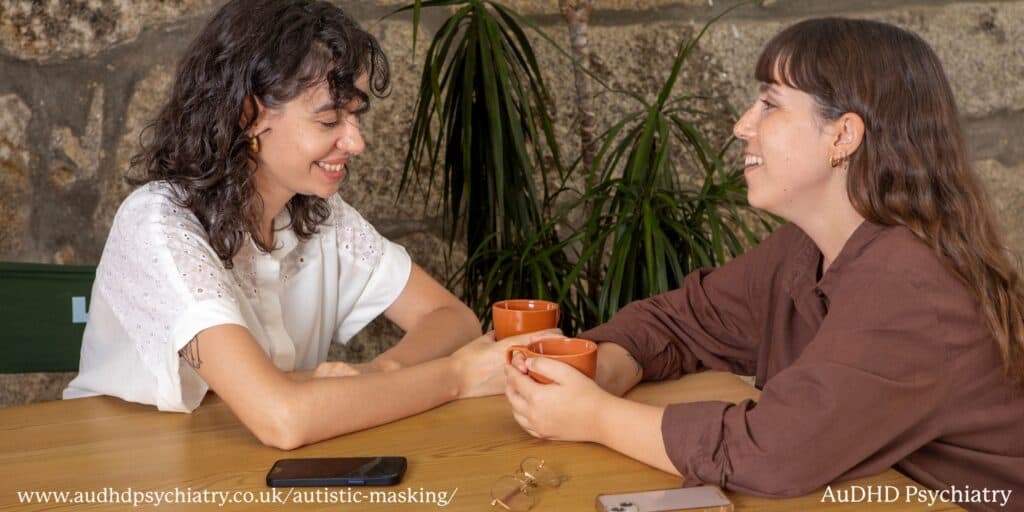
The evidence is clear: autistic women and girls mask at significantly higher rates than autistic men and boys. This is one of the key reasons that autism in women has historically been underdiagnosed and misdiagnosed. Girls are often socialised from an early age to be socially attentive, cooperative, and emotionally attuned. The result is that many autistic women reach adulthood without ever receiving a diagnosis, their autism hidden beneath a surface of social competence.
If you are a woman wondering whether this resonates with your own experience, our female autism checklist is a useful starting point for reflection.
Late-Diagnosed Autistic Adults
Adults who receive an autism diagnosis later in life have almost universally been masking for decades. The very fact of late diagnosis is often evidence of effective masking: the traits were present throughout life, but were sufficiently concealed to avoid professional detection. Many late-diagnosed autistic adults describe the diagnosis itself as a profound relief, finally having language for an experience that has always felt different but was never named.
AuDHD: When Autism and ADHD Co-Occur
A significant number of autistic people also have ADHD: a combination sometimes called AuDHD. The co-occurrence of both conditions can produce a particularly complex masking profile, where compensatory strategies for one condition interact with the demands of managing the other. Understanding both diagnoses together is often essential for getting an accurate picture of a person’s experience and needs.
Autistic Children
Masking can begin very early in childhood, often before any diagnosis has been considered. Early autism signs in children are sometimes missed precisely because children have already begun to adapt their behaviour in response to social feedback.
Signs You May Be Masking Without Knowing It
Because masking is so often subconscious and long-standing, many autistic individuals do not recognise it in themselves until they encounter the concept.
Common signs that you may be masking include:
- Feeling profoundly exhausted after social interactions
- Constantly monitoring your own behaviour during conversations, rather than being present in them
- Feeling like a different person in different contexts
- Having difficulty knowing what you actually think, feel, or want
- Experiencing a sense of relief or release when you are alone
- Struggling to relax fully even in close relationships
- Experiencing social anxiety or dread before social events
- Finding that others describe you as socially capable or even charismatic, while your internal experience feels entirely different
- Noticing that your public presentation feels fundamentally disconnected from your authentic self or true identity
Many of these experiences are also associated with emotional dysregulation, which frequently co-occurs with both autism and ADHD.
The Impact of Autistic Masking on Mental Health
The mental health consequences of prolonged autistic masking are well-documented in the research literature and consistently serious.
Anxiety and Depression
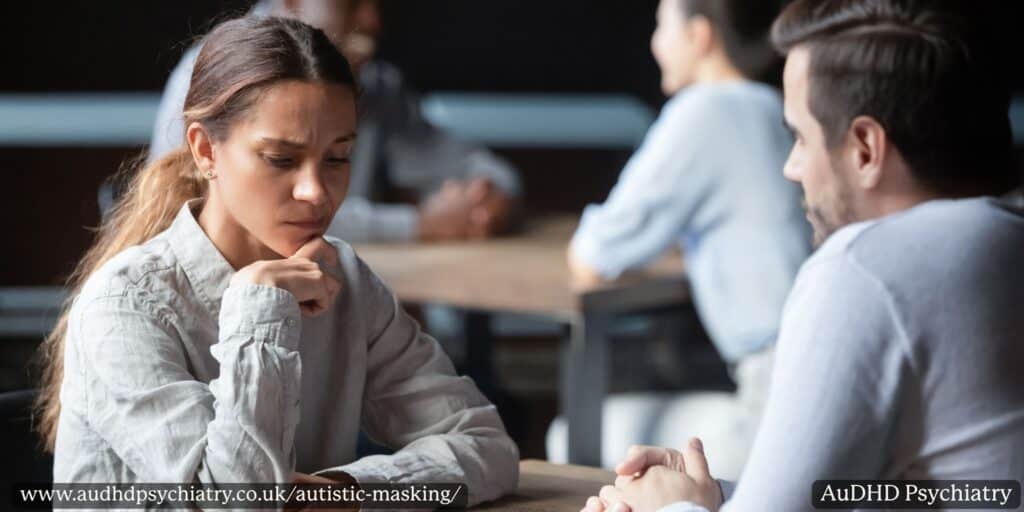
Chronic anxiety is among the most common mental health outcomes associated with masking. The constant effort of monitoring behaviour, anticipating social expectations, and managing the fear of judgement creates a persistent state of low-grade threat that takes a cumulative toll. Depression frequently co-occurs, often rooted in the cognitive dissonance of living a life that feels fundamentally inauthentic, and in the chronic stress of never being able to simply exist.
Identity Confusion and Loss of Self
One of the most profound and underappreciated effects of long-term masking is its impact on autistic identity. When someone has spent years (sometimes their entire life) suppressing their natural traits and performing a constructed social self, they can lose touch with who they actually are. Many autistic adults describe an identity crisis upon diagnosis.
Suicidal Ideation and Self-Harm
Studies consistently show that autistic people, and particularly autistic women who mask heavily, experience significantly elevated rates of suicidal thoughts and suicidal ideation compared to the general population. Research found a direct association between camouflaging and poorer mental health outcomes, including suicidality.
The emotional distress generated by long-term masking can be severe.
Trauma Responses and Emotional Exhaustion
Prolonged masking can produce responses that resemble trauma. The chronic stress of sustained social performance, combined with repeated experiences of rejection or misunderstanding when the mask slips, can leave autistic individuals in a state of hypervigilance and emotional exhaustion. This is closely related to autistic burnout—a distinct and serious phenomenon that deserves its own understanding.
If you are recognising these patterns in your own life, you do not have to keep navigating them alone. Our adult autism assessment team is experienced in identifying masking and can help you understand your neurodevelopmental profile.
Autistic Masking and Burnout
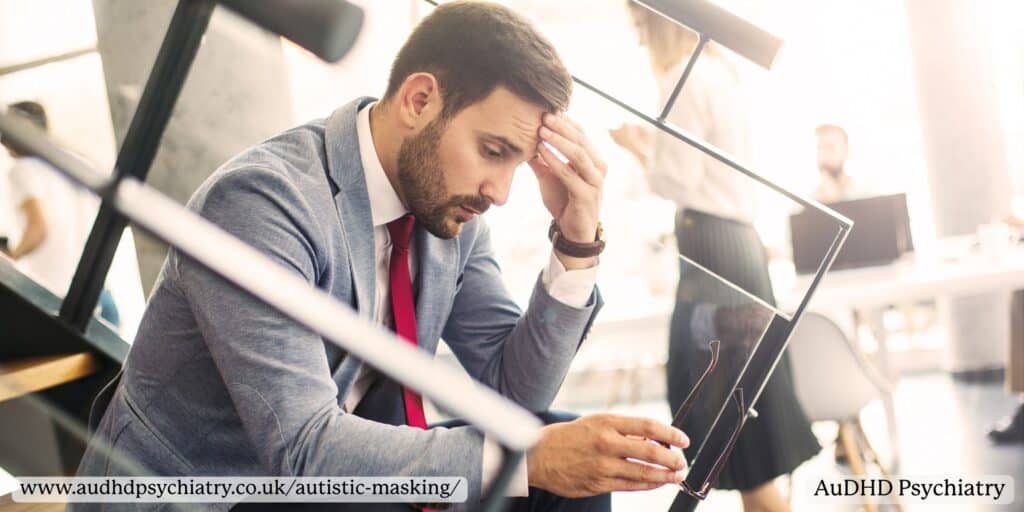
Autistic masking and autistic burnout are deeply intertwined. Burnout is not simply tiredness or stress; it is a state of profound physical, cognitive, and emotional depletion that occurs when the cumulative demands of masking and navigating a neurotypical world exceed an autistic person’s resources.
What Autistic Burnout Looks Like
Autistic burnout is often characterised by:
- A significant loss of functioning in previously manageable areas
- Increased sensory sensitivity
- Withdrawal and social shutdown
- Difficulty communicating
- Profound exhaustion that sleep does not resolve
Burnout episodes can last weeks, months, or longer. They are the predictable consequence of a system that has been running beyond its capacity for too long.
Masking as Cognitive Multitasking
Masking is not a single behaviour. It is a form of continuous cognitive multitasking. While participating in a conversation, an autistic person who is masking may simultaneously be: monitoring their own facial expressions, checking their eye contact, processing the explicit and implicit content of what is being said, managing their sensory environment, planning their next response, and suppressing any behaviours that might attract negative attention.
This is an enormous executive functioning demand running in parallel with ordinary social interaction, and it runs constantly, in every social context, for years.
Autism Diagnosis and the Challenges of Masking
One of the most significant practical consequences of autistic masking is its effect on the diagnostic process. Because autism assessments have historically relied heavily on observable behaviour, autistic individuals who mask effectively have often been missed or misdiagnosed.
How Masking Autistic Traits Delays Diagnosis
When an autistic adult presents for assessment having spent decades developing sophisticated compensatory strategies, their outward presentation may look quite different from the diagnostic stereotypes. They may make adequate eye contact because they have trained themselves to. They may appear socially skilled because they have rehearsed those skills exhaustively. The gap between their internal experience and their external presentation can be enormous. and traditional assessment methods that focus on the external may not capture it.
This is why developmental history, lived experience, and an understanding of the different types of autism presentation are all essential components of a thorough assessment. A clinician experienced in working with masked autistic individuals will look beyond surface behaviour to understand the effort behind it.
What a Good Autism Assessment Looks Like
An assessment that accounts for masking should:
- Take a detailed developmental history: what was life like at school, in relationships, in the workplace?
- Ask about internal experiences, not just observable behaviours
- Understand the compensatory strategies that have been developed over time
- Consider gender, cultural background, and social context in interpreting presentations
- Do not discount autism because someone presents as socially capable on the surface
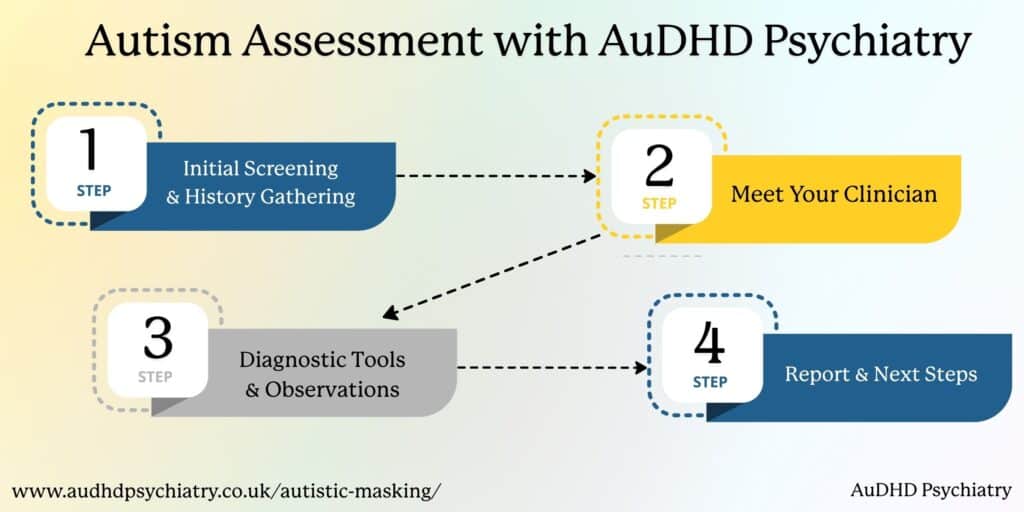
At AuDHD Psychiatry, our assessments are designed to identify masking autistic traits and to provide a complete picture of your neurodevelopmental profile. If you are wondering what private autism assessment costs and what the process involves, we are happy to walk you through everything before you commit.
Masking and the Myth of High-Functioning Autism
The label “high-functioning” autism is often applied to autistic individuals who mask effectively. It is a misleading and increasingly challenged concept. As our article on level 2 autism explores, functioning labels tend to describe how convenient an autistic person’s presentation is for the people around them. Many autistic adults who have been described as high-functioning are quietly experiencing significant mental health challenges, burnout, and distress that their outward competence conceals.
Unmasking: What It Means and What to Expect
Unmasking, the process of gradually allowing one’s authentic autistic self to emerge, is often described by autistic people as both deeply liberating and genuinely disorienting. It is not a single event or a decision, but a gradual process of reconnecting with natural traits, needs, and ways of engaging with the world that were suppressed or buried under years of performance.
The Emotional Experience of Unmasking
For many autistic adults, unmasking begins after a formal diagnosis or even after simply encountering the concept of autistic masking for the first time and recognising themselves in it.
The experience can involve:
- Relief and validation: For finally having language for a lifelong experience
- Grief for the years spent exhausted, performing, not fully known
- Identity confusion: if the mask has been in place for decades, identifying what is genuinely “you” can take time
- Changed relationships: as authentic communication styles and needs become more visible, some relationships deepen whilst others may shift
- A sense of cognitive dissonance between the self that was presented and the self that is being discovered
Practical Strategies for Unmasking
Unmasking is about creating the conditions in which natural behaviours can exist without threat.
Practical supports include:
- Setting boundaries around social obligations that are unsustainably draining
- Creating sensory-friendly environments at home that allow genuine decompression
- Finding an autistic community, connecting with others whose experiences mirror your own
- Working with a therapist experienced in autism, who can support identity exploration without pathologising autistic traits
- Practising self-compassion: recognising that masking was a rational response to genuine pressures, not a character flaw
Many autistic people also find that meeting famous autistic people who are open about their experiences, or reading autistic-led perspectives on identity and acceptance, is a meaningful part of beginning to understand and embrace their authentic selves.
How to Support Autistic People Who Mask
Supporting an autistic person who masks is not primarily about encouraging them to stop performing. It is in creating the conditions in which performing is less necessary. The most effective support centres on psychological safety, genuine acceptance, and practical accommodation.
Create Psychologically Safe Environments
An autistic person will only begin to unmask when they feel genuinely safe to do so. In practice, this means: consistent and predictable social environments, freedom from judgement when autistic traits are visible, and explicit communication that difference is welcome rather than merely tolerated. This applies at home, in schools, in workplaces, and in healthcare settings.
Educate Yourself
Understanding what it means to be neurodivergent and what the research tells us about masking, camouflaging, and the costs of both is the foundation for meaningful support. Challenging your own assumptions about what “normal” social behaviour looks like is part of this work.
Promote Inclusive Schools and Workplaces
Inclusive environments do not simply accommodate autistic differences. They design for it. This means questioning the neurotypical assumptions embedded in workplace culture (are open-plan offices, constant meetings, and informal networking genuinely necessary?), and being willing to make adjustments before problems arise rather than as a reactive response to disclosed need.
Be Patient and Avoid Assumptions
An autistic person’s communication style, social preferences, and need for accommodation may look very different from what you expect. Avoiding assumptions, including the assumption that someone who appears socially capable is not struggling, is a meaningful form of support. Equally, respecting communication differences without treating them as deficits is part of creating genuinely supportive environments.
Frequently Asked Questions
Can autistic masking cause burnout?
Yes. Long-term autism masking is strongly associated with autistic burnout: a state of profound mental, emotional, and physical exhaustion caused by the constant effort of suppressing autistic traits and managing social expectations. Many autistic adults report losing skills, increased sensory sensitivity, and severe fatigue after prolonged periods of masking.
Can you be autistic if you make eye contact?
Yes. Many autistic people learn to force or imitate eye contact as part of masking behaviours. The ability to make eye contact does not rule out autism, especially in adults who have spent years adapting their behaviour socially.
What happens when an autistic person stops masking?
Unmasking can feel relieving, emotional, and sometimes overwhelming. Many autistic people experience greater self-understanding and reduced stress when they stop suppressing natural behaviours, though the process can also involve identity changes, grief, and adjustments in relationships.
Is autism masking conscious or unconscious?
Both. Some autistic people consciously monitor and adjust their behaviour in social situations, while others mask automatically without realising they are doing it. Many late-diagnosed autistic adults only recognise their masking behaviours after learning about autism.
Can children mask autism?
Yes. Some autistic children begin masking from a very early age, especially in school environments where they feel pressure to fit in socially. This can make autism harder for parents, teachers, and clinicians to recognise.
Does masking mean someone has mild autism?
No. A person may appear socially capable while still experiencing significant internal distress, sensory difficulties, anxiety, or exhaustion. Effective masking does not necessarily reflect lower support needs.
What is the difference between autism masking and social anxiety?
Social anxiety primarily involves fear of negative judgement, whereas autism masking involves actively suppressing autistic traits or performing neurotypical behaviours to fit in socially. The two often overlap, and many autistic people experience both.
Autistic Masking: Conclusion
Autistic masking is one of the most important aspects of the autistic experience. For many autistic individuals, it has been the reason their autism went unrecognised for years or decades. It has been the reason their mental health deteriorated quietly behind a surface of apparent competence. And it has been the reason they felt, for much of their lives, like strangers to themselves.
If you have recognised yourself in this guide, in the exhaustion after social interaction, the rehearsed conversations, the disconnect between public and private self, the relief of being alone, then what you are experiencing has a name, and there is support available that takes it seriously. And if you are ready to explore this further, you can book an adult autism assessment with our specialist team or arrange a free introductory call to discuss your concerns and whether an assessment feels right for you.
References
Hull, L., Petrides, K. V., Allison, C., Smith, P., Baron-Cohen, S., Lai, M.-C., & Mandy, W. (2017). “Putting on my best normal”: Social camouflaging in adults with autism spectrum conditions. Journal of Autism and Developmental Disorders, 47(8), 2519–2534. https://doi.org/10.1007/s10803-017-3166-5
Hull, L., Mandy, W., Lai, M.-C., Baron-Cohen, S., Allison, C., Smith, P., & Petrides, K. V. (2019). Development and validation of the Camouflaging Autistic Traits Questionnaire (CAT-Q). Journal of Autism and Developmental Disorders, 49(3), 819–833. https://doi.org/10.1007/s10803-018-3792-6
Hull, L., Levy, L., Lai, M.-C., Petrides, K. V., Baron-Cohen, S., Allison, C., Smith, P., & Mandy, W. (2021). Is social camouflaging associated with anxiety and depression in autistic adults? Molecular Autism, 12(1), Article 13. https://doi.org/10.1186/s13229-021-00421-7
Lai, M.-C., Lombardo, M. V., Ruigrok, A. N. V., Chakrabarti, B., Auyeung, B., Szatmari, P., Happé, F., & Baron-Cohen, S. (2017). Quantifying and exploring camouflaging in men and women with autism. Autism, 21(6), 690–702. https://doi.org/10.1177/1362361316671012
Tierney, S., Burns, J., & Kilbey, E. (2016). Looking behind the mask: Social coping strategies of girls on the autistic spectrum. Research in Autism Spectrum Disorders, 23, 73–83. https://doi.org/10.1016/j.rasd.2015.11.013
Cassidy, S., Bradley, L., Shaw, R., & Baron-Cohen, S. (2018). Risk markers for suicidality in autistic adults. Molecular Autism, 9(1), Article 42. https://doi.org/10.1186/s13229-018-0226-4
Cook, J., Crane, L., Bourne, L., Hull, L., & Mandy, W. (2021). Camouflaging in an everyday social context: An experience sampling study. Autism, 25(4), 1099–1114. https://doi.org/10.1177/1362361320968981
Where to go from here
A private online screening for autism traits, with your results at the end. No commitment.
Take the free testA free, no-obligation call with our team to ask questions and find the right assessment for you.
Book a free callDarren is a Chartered Psychologist and specialist in ADHD and autism, with over 11 years of experience working in mental health and neurodevelopmental services. He holds a Doctorate in Counselling Psychology and has presented research at the British Psychological Society Annual Conference.
Read Darren’s full profileThis article is for general information and does not replace a clinical assessment. If you are struggling with your mental health right now, please contact your GP or NHS 111.