




Table of Contents
- What Are Autistic Meltdowns?
- What Causes an Autistic Meltdown?
- What Does an Autistic Meltdown Look Like?
- Autistic Meltdowns vs Shutdowns: What Is the Difference?
- Autistic Meltdowns vs Tantrums: Why the Distinction Matters
- Meltdowns in Autistic Adults
- How to Help During an Autistic Meltdown
- How to Reduce the Frequency of Meltdowns
- FAQs
- Conclusion
In Focus
- Autistic meltdowns are an involuntary neurological response to sensory or emotional overload.
- They occur because autistic brains process sensory stimuli and regulate emotions differently from neurotypical brains.
- Meltdowns are distinct from shutdowns and temper tantrums, and understanding the difference changes how you should respond.
- Both autistic children and autistic adults can experience meltdowns.
- Identifying potential triggers, adjusting sensory environments, and protecting routines can all significantly reduce how often meltdowns occur.
Autistic meltdowns are one of the most misunderstood experiences in autism. They can look like a temper tantrum, a panic attack, or a complete emotional shutdown, yet they are none of these things. If you have ever witnessed an autism meltdown or lived through one yourself, you already know how overwhelming, confusing, and exhausting the experience can be.
Understanding what is actually happening during (and why) can make a world of difference. Not just in how you respond in the moment, but in the long-term well-being of the autistic person at the centre of it.
AuDHD Psychiatry is a UK-based neurodevelopmental assessment and diagnosis centre specialising in autism and ADHD. We support autistic individuals and their families every day, and autistic meltdowns are one of the subjects we are asked about. If you suspect that meltdowns you or a loved one experiences might be connected to undiagnosed autism, an adult autism assessment can be an important and clarifying first step.
What Are Autistic Meltdowns?
An autism meltdown is an intense response to overwhelming sensory, emotional, or social input—one that is involuntary. When the nervous system reaches a point of intense overload it cannot manage, the result is a complete loss of control over behaviour and emotions.
It may help to think of it like a circuit breaker tripping. The system cannot absorb any more input, so it discharges the excess in whatever way it can. For some autistic individuals, that discharge is external and expressive: shouting, crying, hitting out, or throwing objects. For others, it is internal: a sudden collapse inward, an inability to speak or function.
The single most important thing to understand is that autistic meltdowns are not deliberate. The autistic person has no control over their behaviour in that moment. This is not manipulation, attention-seeking, or a behavioural problem. It is a neurological response to a system that has been overwhelmed.
What Causes an Autistic Meltdown?
Autistic meltdowns rarely appear from nowhere. They are almost always the result of a gradual accumulation of cumulative stress, sensory input, and emotional pressure, sometimes building over hours, sometimes over days. By the time a meltdown happens, the person’s system has typically been under significant strain for quite some time.
Understanding the root causes is the most important step toward reducing how often they happen.
Sensory Overload
Many autistic people experience sensory processing differences. Their brains interpret sensory stimuli far more intensely or in fundamentally different ways than a neurotypical brain does. Sounds, lights, textures, temperatures, and smells that others might barely notice can feel genuinely painful or unbearable for an autistic person.
Spending time in a noisy open-plan office, a busy grocery store, a fluorescent-lit school corridor, or a crowded social event can steadily push someone toward their threshold. The meltdown may appear sudden to observers, but the sensory environment has often been overwhelming for quite some time before it arrives.
Too much noise is one of the most frequently reported triggers. The same is true of loud noises that arrive suddenly and without warning, such as alarms, sirens, or a door slamming.
Common sensory triggers by category:
| Sense | Common Triggers |
| Hearing | Alarms, crowd noise, loud music, overlapping voices, sudden loud noises |
| Sight | Flickering or fluorescent lights, bright screens, cluttered or busy visual environments |
| Touch | Unexpected physical contact, uncomfortable clothing textures or labels, tight spaces |
| Smell | Strong perfume, cleaning products, certain foods cooking, and chemical smells |
| Temperature | Overheated rooms, cold draughts, air conditioning, sudden temperature changes |
Disruption to Routine and Sudden Changes
Autistic people often rely on routine and predictability to manage an unpredictable world. Sudden changes such as a cancelled appointment, an unexpected shift at work, or a different route taken without warning can trigger significant anxiety that builds steadily toward a meltdown.
This is not stubbornness. Routine reduces the cognitive load of navigating daily life and provides a reliable sense of safety. When it is suddenly removed, that safety disappears with it. The anxiety that follows is real, and if left unaddressed, it compounds quickly.
Emotional Overload and Difficulties with Emotional Regulation
Emotional regulation, the ability to manage and process feelings as they arise, can be considerably more difficult for autistic people. Many autistic individuals also experience alexithymia: difficulty identifying or describing their own internal emotional states. This means distress can build unnoticed throughout the day, without the person realising how close to the edge they actually are.
Frustration, social confusion, sensory discomfort, and anxiety may all be accumulating beneath the surface—invisible, even to the person feeling them—until they reach a breaking point. The meltdown itself is the release of everything that has been compressing for hours.
Communication Difficulties
When an autistic person cannot express their needs or distress effectively because of limited verbal communication, because they are in a situation where speaking up does not feel safe, or simply because they are not being heard, the frustration escalates quickly. Communication difficulties remove one of the most important pressure valves for managing stress.
Autistic people who are non-speaking or who lose speech under stress (known as situational mutism) are particularly vulnerable to this cycle. When communication becomes impossible, the only remaining outlet may be a meltdown.
Information Overload
It is not just sensory input that overwhelms. Too much information, such as:
- Being given multiple instructions at once
- Navigating a complex social interaction
- Trying to process body language and social cues simultaneously
- Being placed in a fast-moving situation with too many variables
All these can be just as destabilising as a sensory meltdown. Autistic brains often process information in a more linear, detail-focused way. When the volume of information coming in exceeds a person’s ability to process it in real time, the result can be the same overwhelming situation that sensory overload creates.
Autistic Burnout and Fatigue
Autistic burnout is a state of profound physical, mental, and emotional exhaustion caused by the sustained effort of navigating a world that is not designed for autistic people. When burnout sets in, the threshold for autistic meltdowns drops significantly. Things that are usually manageable feel catastrophic.
What Does an Autistic Meltdown Look Like?
What does an autistic meltdown look like in real life? The honest answer is: it depends on the person. Autistic meltdown symptoms do not look the same in every individual. Knowing the range of presentations helps you recognise a meltdown when it is happening.
External (Expressive) Meltdowns
These are the meltdowns most people picture: outwardly visible emotional outbursts that can be distressing for everyone involved.
Signs include:
- Crying uncontrollably or sobbing
- Shouting, screaming, or making repetitive vocalisations
- Hitting, kicking, biting, or throwing objects
- Self-injurious behaviour such as head-banging, scratching, or hair-pulling
- Running away from an overwhelming situation
- High-intensity stimming like rocking, hand-flapping, spinning, pacing, at a much greater frequency or force than usual
Internal (Implosive) Meltdowns
Not all meltdowns look dramatic. Some autistic individuals, particularly those who have spent years learning to suppress visible reactions in social situations, experience what might appear to be a quiet withdrawal, but is in fact a severe internal meltdown.
They may go very still, stop speaking, stare blankly, or appear frozen. They may seem calm from the outside. Internally, they are in significant distress. The absence of external symptoms does not reduce the severity of the person’s experience. This kind of response is particularly common in autistic adults and in autistic women and girls, which is one of the reasons late diagnosis is so common in these groups.
The Early Signs: Recognising the Build-Up Phase
Most autistic meltdowns are preceded by a build-up phase, sometimes called the “rumble stage”, during which distress is escalating but has not yet peaked.
Watch for:
- Stimming that is more frequent or intense than usual
- Becoming noticeably quieter or more withdrawn
- Visible agitation, restlessness, or an inability to settle
- Difficulty processing or responding to questions and instructions
- Covering ears, shielding eyes, or repeatedly trying to leave a space
- Repetitive questioning or repeating the same phrase several times
- Changes in body language—tension, flushing, rapid breathing, clenching—without an obvious cause
- A rising heart rate or other visible signs of physical distress
The best way to handle an early build-up is to act before it peaks: reduce sensory input, offer a safe space, and drop all demands.
Autistic Meltdowns vs Shutdowns: What Is the Difference?
Both autistic meltdowns and autistic shutdowns are responses to the same underlying problem: too much input and not enough capacity to process it.
| Autistic Meltdown | Autistic Shutdown | |
| Appearance | Outward, expressive, visible | Inward, quiet, withdrawn |
| Behaviour | Crying, shouting, emotional outbursts, and physical reactions | Stillness, non-verbal, disconnected |
| A person’s ability to communicate | Severely reduced | Severely reduced or absent |
| Cause | Sensory or emotional overload | Sensory or emotional overload |
| Visibility of distress | High | Low, but distress is still severe |
| Common after-effects | Exhaustion, emotional rawness, shame | Exhaustion, difficulty communicating, disorientation |
An autistic shutdown is not a milder kind of response to overload. It is a different neurological response to the same overwhelm, where the nervous system turns inward and shuts down input processing, rather than discharging it outwardly. It is also important to know that a shutdown can follow a meltdown. After the intense physical and emotional effort of a full meltdown, many autistic people move into a period of deep withdrawal and exhaustion that can last for hours, or even a full day or two.
Autistic Meltdowns vs Tantrums
This is one of the most critical distinctions to make, especially for parents, teachers, and carers who may be witnessing meltdowns in an autistic child and struggling to understand what they are seeing.
A temper tantrum is goal-oriented behaviour. The child wants something—a toy, attention, to avoid a task—and the tantrum is a way of expressing that want or attempting to achieve it. A child having a tantrum is still aware of their environment. They will often modify their behaviour based on who is watching, and they typically calm down relatively quickly once the situation resolves.
An autism meltdown has no specific goal. The autistic person is not trying to get anything or avoid anything. They have reached a point of neurological overload and have lost control of their behaviour. They cannot calm down on command, and they are not influenced by whether anyone is watching.
Responding to a meltdown as if it were a temper tantrum (with raised voices, punishment, time-out, or removed privileges) is not just ineffective. It is actively harmful. It adds more stress to an already overwhelmed system and can significantly deepen the distress.
Meltdowns in Autistic Adults
Autistic adults experience meltdowns with the same neurological reality as autistic children. The difference is that adults are expected to “hold it together”, which means autistic adults often carry an additional layer of shame, self-blame, and genuine difficulty understanding why they cannot manage what everyone else seems to find straightforward.
Many autistic adults who have not been diagnosed—or who received a late diagnosis—have had their meltdowns misattributed to anxiety disorders, emotional dysregulation, burnout, or mental health problems over many years. The meltdowns were real. The distress was real. The cause was simply misunderstood.
Common meltdown triggers for autistic adults include:
- Workplace environments: open-plan offices, fluorescent lighting, too much noise, back-to-back meetings, and the sustained effort of social masking throughout a full working week.
- Social interaction and expectations: the cognitive and emotional effort of navigating social expectations in relationships, friendships, and professional settings, and the difficulty in understanding unspoken social cues.
- Sudden changes and life transitions: moving home, changing jobs, relationship breakdowns, bereavement, or any significant disruption to established routines
- Cumulative stress and autistic burnout: the result of months or years of masking without adequate rest or appropriate support.
- Communication stress: being repeatedly misunderstood, dismissed, or having to over-explain needs to be taken seriously.
If you are an autistic adult who has been having a hard time with meltdowns without understanding why, or if you have spent years being told you are “too sensitive” or “overreacting”, it is worth asking whether undiagnosed autism might be part of the picture. Learn more about what an adult autism assessment involves and whether it could be the right step for you.
How to Help During an Autistic Meltdown
When someone is in the middle of an autistic meltdown, your two priorities are safety and reducing the intensity of the experience as quickly as possible. Here is what actually helps (and what does not).
What to Do
Create a safe space immediately.
If possible, move the person to a quieter, calmer environment away from crowds, loud noises, bright lights, and other sensory stimuli.
Lower the sensory load.
Turn off background noise such as TVs, loud music, and overlapping voices. Dim the lighting if you can. Remove whatever in the immediate environment might be adding to the overwhelm.
Bring your own voice right down.
Quiet, calm, and slow is far more effective than talking the person through the meltdown at normal volume. If you are not sure whether to speak at all, say less rather than more.
Give space, and do not touch without consent.
Unless there is an immediate safety concern, avoid physical contact without a clear invitation. Unexpected touch during a meltdown significantly amplifies distress for most autistic people.
Drop all demands completely.
Do not ask questions. Do not issue instructions. Do not try to reason through what happened or problem-solve. The person’s cognitive function and capacity to process language are severely reduced. Nothing productive will come from it. Wait.
Regulate yourself first.
Your own emotional state has a direct effect on the person in meltdown. If you are visibly anxious, frustrated, or panicked, it adds to the overload around them. Breathe. Be a steady, calm presence.
Keep them physically safe without restraint.
If there is a risk of injury to themselves or others, you may need to remove objects or calmly guide them away from harm. Physical restraint should be an absolute last resort, used only when there is no other option to prevent immediate serious injury.
What Not to Do
- Raise your voice or tell them to “calm down”
- Use punishment, threats, or remove privileges as a consequence
- Try to reason with them or ask why they are behaving this way
- Assume they can hear and process your words normally (they often cannot)
- Touch them without clear consent
- Force or demand eye contact
- Continue with whatever activity or demand preceded the meltdown

After the Meltdown: The Recovery Phase
Once the meltdown passes, allow genuine time for recovery. Many autistic people feel deeply embarrassed, exhausted, emotionally raw, and disoriented in the aftermath. This is not the moment for a conversation about what happened.
A calm, compassionate conversation about what triggered the meltdown and what might help next time can be genuinely useful, but it belongs later, when the person feels safe and fully recovered. Offer quiet. Offer comfort if it is wanted. Let the person lead.
How to Reduce the Frequency of Meltdowns
Autistic meltdowns cannot always be prevented. But with the right understanding and some effective strategies in place, their frequency and intensity can be meaningfully reduced.
Track Potential Triggers
Keep a simple diary of when meltdowns occur, noting:
- Time of day
- Environment
- Physical state (hungry, tired, unwell)
- What happened in the hours before
Patterns that are invisible in the moment often become very clear when you look back across two or three weeks. Once you can identify potential triggers, you can start to reduce exposure, plan for high-risk situations, and build in recovery time after demanding experiences.
Adjust the Sensory Environment
Work with the autistic person to understand their sensory profile. What environments are hardest? What helps them feel regulated? This is one of the best ways to meaningfully reduce how often meltdowns happen.
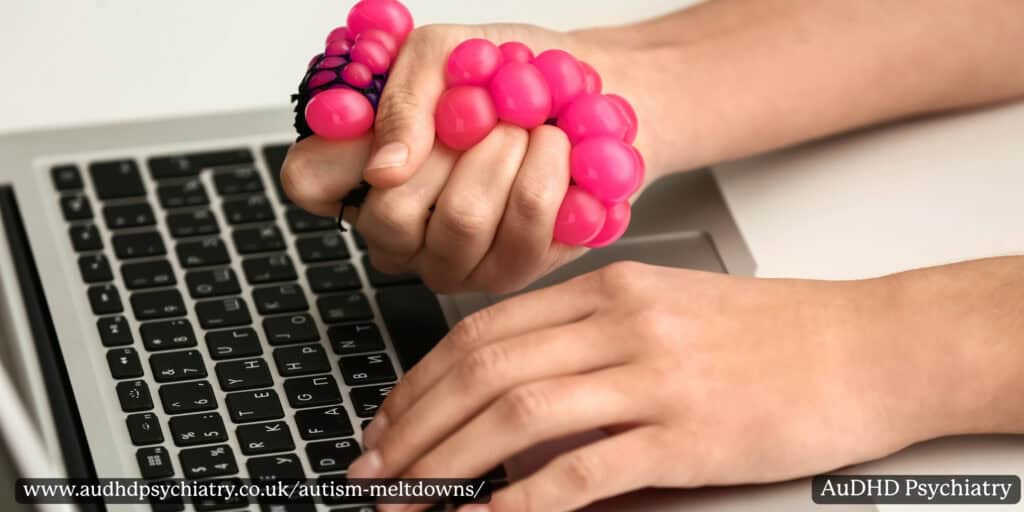
Practical changes make a real difference. Noise-cancelling headphones or ear defenders can help manage overwhelming sound environments. Softer, adjustable lighting replaces the harshness of fluorescent overheads. A stress ball or other sensory tools offers a physical outlet for building tension. Clothing without uncomfortable tags removes a low-level irritant that accumulates throughout the day.
Use Visual Supports and Picture Schedules
Visual supports, including picture schedules, written daily plans, and visual timelines, give autistic individuals a clear picture of what is coming and when. This is particularly helpful for managing transitions and sudden changes that would otherwise catch someone off guard. Picture schedules are widely used with autistic children, but they can be equally valuable for autistic adults.
Where possible, maintain consistent routines and give advance notice of sudden changes. Gentle warnings before transitions, clear communication about what is happening next, and agreed plans for when things go differently than expected all reduce the anxiety that builds when predictability is taken away without warning..
Use Social Stories to Prepare for Difficult Situations
Social stories are short, structured narratives that walk an autistic person through an upcoming or challenging situation—explaining what will happen, what the social expectations are, and how they might respond. They are especially useful in unfamiliar environments like a new workplace, a grocery store that will be busy, or a social event with expectations that the person finds difficult to navigate.
Build In Genuine, Regular Rest
Autistic people, particularly those who mask, need regular, real rest. Not simply sleep, but time that is genuinely free from social demands, sensory input, and the effort of performance. When rest is consistently sacrificed, autistic burnout accumulates. And as burnout builds, the threshold for meltdowns drops—sometimes dramatically.
Teach and Support Coping Strategies
Coping strategies and coping techniques that an autistic person can use independently during the early build-up phase can make a real difference.
These might include:
- Deep breathing exercises to lower heart rate and reduce physical tension.
- Stimming in a way that feels regulating and safe.
- Using a stress ball or other sensory tools to manage sensory stimulation.
- Stepping away from an overwhelming situation before it becomes unmanageable.
- Using agreed signals or cards to communicate distress when words are hard to find.
The best coping techniques are ones the autistic person has chosen and practised themselves, not ones that have been imposed on them in the moment.
Support Communication
Ensuring an autistic person has reliable, accessible ways to communicate their needs and distress, whether through speech, writing, Augmentative and Alternative Communication (AAC) devices, agreed signals, or visual supports, reduces the frustration that so often escalates into a meltdown. When communication channels are open, pressure can be released before it reaches a critical point.
Seek Appropriate Support
Occupational therapists can assess sensory profiles and recommend targeted environmental adjustments. Clinical psychologists and autism-specialist therapists can support emotional regulation and provide cognitive behavioural therapy adapted for autism. A healthcare provider with expertise in neurodevelopmental conditions can also help identify whether co-occurring conditions such as an anxiety disorder are contributing to meltdown frequency.
Frequently Asked Questions
How do you get out of an autistic meltdown?
To recover from an autistic meltdown, reduce as much sensory, emotional, and social input as possible. Quiet spaces, low lighting, familiar routines, and time without demands allow the nervous system to gradually regulate itself again.
Can an autistic meltdown just be crying?
Yes. An autistic meltdown does not always involve shouting, aggression, or dramatic outward behaviour. For some autistic people, especially autistic adults and those who internalise distress, a meltdown may look like uncontrollable crying, emotional overwhelm, or an inability to speak and function normally.
What is the rage cycle in autism?
The “rage cycle” in autism describes the gradual build-up of stress, sensory overload, frustration, or emotional pressure that eventually results in a meltdown. This is often followed by exhaustion, withdrawal, shame, or emotional recovery once the nervous system has discharged the overload.
What are the 6 stages of an autism meltdown?
Autistic meltdowns are often described as progressing through several stages: calm, trigger, rumble, meltdown, recovery, and exhaustion. Early stages may involve increased stress, agitation, or stimming before the nervous system reaches a point of overload.
How long does an autistic meltdown last?
There is no fixed length for an autistic meltdown. Some last only a few minutes, while others can continue for much longer depending on the level of overload, the environment, and how quickly the person can access safety and recovery time. Even after the visible meltdown ends, exhaustion and emotional sensitivity can continue for hours or days afterwards.
Autistic Meltdowns: Conclusion
Autistic meltdowns are not a behavioural problem, a parenting failure, or a character flaw. They are a sign that an autistic person’s nervous system has been pushed past what it can handle—and that, with the right support and understanding in place, things can genuinely get better. Whether you are an autistic person trying to make sense of your own emotional experience, a parent supporting an autistic child through a hard time, or a partner, colleague, or family member learning how to help, the more clearly you understand the nature of meltdowns and why they happen, the more effective and compassionate that support will be.
If meltdowns are a regular and distressing part of your life and autism has not yet been formally explored, now is the time to take that next step. A formal diagnosis could be the beginning of real, lasting understanding and change. Book an adult autism assessment today and find out whether autism might finally explain your experiences.
References
Mazefsky, C. A., Herrington, J., Siegel, M., Scarpa, A., Maddox, B. B., Scahill, L., & White, S. W. (2013). The role of emotion regulation in autism spectrum disorder. Journal of the American Academy of Child & Adolescent Psychiatry, 52(7), 679–688. https://doi.org/10.1016/j.jaac.2013.05.006
Milton, D. E. M. (2012). On the ontological status of autism: The ‘double empathy problem.’ Disability & Society, 27(6), 883–887. https://doi.org/10.1080/09687599.2012.710008
Rumball, F., Brook, L., Happé, F., & Karl, A. (2021). Heightened risk of posttraumatic stress disorder in adults with autism spectrum disorder: The role of cumulative trauma and autistic traits. Autism in Adulthood, 3(1), 45–55. https://doi.org/10.1089/aut.2020.0073
Tomchek, S. D., & Dunn, W. (2007). Sensory processing in children with and without autism: A comparative study using the Short Sensory Profile. American Journal of Occupational Therapy, 61(2), 190–200. https://doi.org/10.5014/ajot.61.2.190
Raymaker, D. M., Teo, A. R., Steckler, N. A., Lentz, B., Scharer, M., Delos Santos, A., Kapp, S. K., Hunter, M., Joyce, A., & Nicolaidis, C. (2020). “Having all of your internal resources exhausted beyond measure and being left with no clean-up crew”: Defining autistic burnout. Autism in Adulthood, 2(2), 132–143. https://doi.org/10.1089/aut.2019.0079
Find the Right Assessment
Our clinicians are ready to help you get the complete support you need.
Author:


Contact Us
We’re here to answer any questions you might have.
Get in Touch
Opening Hours
Contact Form
We’re here to help. Reach out and we’ll get back to you within 24 hours (Monday – Friday).