



Autistic burnout: signs, causes and recovery

Reviewed by Dr Darren O’Reilly, Chartered Psychologist and Clinical Director
Review and publication details
Clinically reviewed by Dr Darren O’Reilly, DPsych, Chartered Psychologist (CPsychol), HCPC registered practitioner psychologist, registration number PYL041661 (check the HCPC register).
AuDHD Psychiatry is the trading name of ADHDdegree Ltd, a company registered in Scotland, company number SC822923. Registered office: 3f1 Third Floor, Hill Street, Edinburgh, EH2 3JP. Registered with the ICO, number ZB823033.
In this article
Page summary
Autistic burnout is what autistic people call a long spell of deep tiredness and lost skills. Noise, light and other people often become harder to cope with at the same time. It builds up when life asks more of you than you can give, with too little help. It isn’t laziness, and it isn’t the same as stress that comes from work. Knowing the signs and causes helps you tell it from depression and plan changes that ease it. AuDHD Psychiatry assesses adults online for autism, and for autism and ADHD together.
When tasks you handled last month now feel out of reach, it’s easy to think you’re failing. This guide treats that drop in what you can manage as something with causes, not a flaw in you. Dr Darren O’Reilly, who reviewed it, is himself autistic and has ADHD. Many autistic adults describe this same drop, and putting a name to it often brings relief.
At a glance
- What it is: exhaustion that lasts, skills that slip, and less tolerance of noise, light and touch [1].
- How long: typically three months or more, in the 2020 definition [1].
- What drives it: life stress that builds up, with too little help or relief [1].
- What autistic adults say helped: acceptance and support, time off or lower expectations, and room to be autistic [1].
What is autistic burnout?
Autistic burnout is a term that came from autistic people themselves [2]. Researchers later worked with autistic adults to describe it more exactly. A US study of 19 interviews with autistic adults, plus 19 online accounts, produced a shared definition [1]. It names long-term exhaustion, lost skills and lower tolerance of sensory input, coming from chronic life stress without enough support [1]. The demands on a person outweigh what they can manage, for too long.
Tools to spot and measure autistic burnout are still being developed [3]. So clinicians can’t yet measure it reliably, though you don’t need a label to take it seriously [3]. This kind of burnout touches every part of life, unlike burnout that comes from a job [2]. The World Health Organization uses the word burn-out only for work, and doesn’t class it as a medical condition [4].
Signs and symptoms of autistic burnout
Burnout shows as a change from your own usual level, and it differs between people. Autistic people also describe these signs alongside the tiredness [2]:
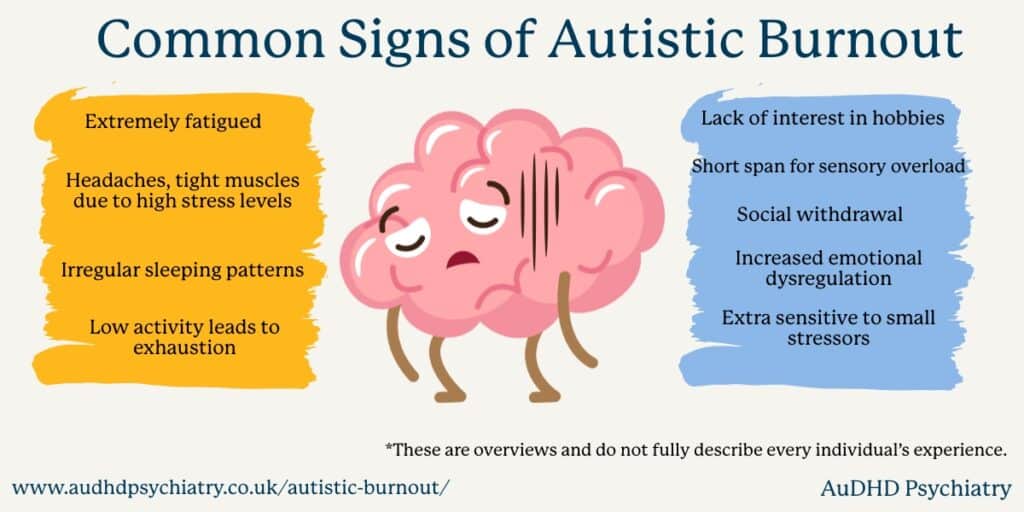
- more meltdowns than usual.
- sensory overload, with noise, light or touch harder to bear, often tied to sensory processing differences.
- physical pain and headaches.
- physically shutting down, sometimes to the point of losing speech.
If meltdowns or a shutdown are part of your picture, AuDHD Psychiatry covers both in a guide to autistic meltdowns and shutdowns. Taken together, the signs show someone who has run out of capacity.
What causes autistic burnout?
Autistic burnout comes from stress that keeps adding up, with no relief [1]. Two things work together here: the load itself, and whatever stops you putting it down. Autistic adults in the 2020 study named stressors piling up, plus barriers such as being dismissed or never getting a break [1]. Masking, hiding autistic traits or trying to seem non-autistic, was the stressor they described most [1]. Our guide to autistic masking looks at why it takes so much energy.

Other stressors included social expectations, places that didn’t suit them and big life changes [1]. Many first burned out as they moved into adulthood [1]. The NHS says masking can make everyday tasks and social contact feel exhausting and stressful [5]. The pressure doesn’t come only from big events, though. Autistic adults also point to sensory overload, social situations, holding back stimming and feeling they fall short of others’ expectations [2].
Is it autistic burnout or depression?
Autistic burnout and depression aren’t the same, though one can feed into the other [1]. In the 2020 interviews, loss of pleasure and sleep problems were rare, and some people with depression said burnout felt different [1]. Telling the two apart can be hard, because they can overlap. An online survey of 141 autistic adults linked burnout with masking and depression, and called for more research to separate them [3].

Autistic people are also more likely than others to have anxiety or depression [6]. Low mood that lingers deserves attention, whatever its cause. Depression means feeling persistently sad for weeks or months, often with lost interest in things you used to enjoy [7]. If that sounds familiar, a GP is the right person to see.
In the 2020 study, burnout harmed some people’s health and independence, and led some to suicidal thoughts or actions [1]. If you’re in danger right now, call 999 or go to A&E.
AuDHD burnout: when you’re autistic and have ADHD
AuDHD burnout is an everyday phrase, not a research term. ADHD is more common in autistic people than in others [6]. The NHS says signs of autism can be harder to spot in an adult who also has ADHD [5]. That means some adults may not know they’re autistic when burnout starts.

The demands of being autistic and the demands of ADHD can stack up on each other. If you have ADHD too, losing track of time or forgetting to rest can make early signs easy to miss. You might not notice you’re running low until you’ve already run out. Our guide to ADHD burnout covers how burnout shows up with ADHD on its own.
What helps with recovery?
Autistic adults linked recovery with acceptance, time off and room to be themselves [1]. No single step works for everyone, and recovery has no fixed timetable. Writing for the National Autistic Society, the 2020 study’s lead author grouped what helped into themes [8]:

- Less load: time off, more breaks, and fewer social or stressful activities.
- Being autistic: stimming, special interests and comfort items.
- Formal help: changes at school or work, and mental health care.
- Self-knowledge: spotting early signs, and cancelling plans to rest when they appear.
Some people also plan their days around their energy. Energy accounting means setting your energy budget for a day or week, then planning around what drains and restores you [2]. Wider attitudes matter as well as personal habits. A study of online posts from 683 people, mostly autistic adults, found acceptance of autism looked key to prevention and recovery [9].
Support at work, college or university
In England, Scotland and Wales, employers must make reasonable adjustments for disability or health conditions [10] [11]. The aim is that you aren’t put at a substantial disadvantage in your job [10]. Think about what drains you most at work, and start there. Examples include working another way, such as your own desk instead of hot-desking, or a phased return with flexible hours [10]. You can apply for Access to Work if you need extra help [10]. In Northern Ireland, the Disability Discrimination Act means employers must consider any reasonable adjustments you need [12].
Wherever you live, day-to-day habits help too. Practical steps include tracking your workload, telling your manager if it’s too much, taking regular breaks and planning your annual leave [2]. At college or university, ask the student services or disability team what changes they can make.
Could burnout point to undiagnosed autism?
Burnout alone doesn’t show that someone is autistic. An assessment looks at autism and ADHD, not at burnout.
An assessment may help if:
- you’ve hit the same wall again and again for years.
- people, change or busy places have always drained you.
- you wonder if ADHD plays a part too.
It might not be right today if:
- you need urgent help now. Call NHS 111 and choose the mental health option, or in Northern Ireland call Lifeline free on 0808 808 8000, any time. In an emergency, call 999 or go to A&E [13].
- you’re asking for someone under 18, who would need our child autism assessment, for ages 6 to 17.
At AuDHD Psychiatry, our adult autism assessment is two online appointments, including an interview with someone who knows you well. We can still assess you if there’s no one who can take part. Our assessment for ADHD and autism together is three appointments. Our free autism test is a short screening questionnaire, and a free 15-minute call lets you ask questions first.
Questions people ask
How long does autistic burnout last?
There’s no set length, though the 2020 definition says it typically lasts three months or more [1]. For some people it eases sooner, and for others it goes on longer. Resting early and getting help in place matter more than counting the weeks. If it drags on, or your mood drops, that’s a reason to talk to someone you trust.
Can autistic burnout happen more than once?
Yes, autistic adults in a study of online posts described burnout as something that can come back [9]. Learning your own early signs, and resting when they show, was one of the things people said helped [8]. Looking back at what came before a past burnout can make those signs easier to catch next time.
Is autistic burnout the same as work burnout?
No, the World Health Organization keeps burn-out for work stress [4], while autistic burnout reaches every part of life [2]. Someone can have both at once, for example when a demanding job adds to everyday strain. The difference lies in where the pressure comes from and how far it spreads.
What does autistic burnout feel like?
Many people describe feeling completely spent, with almost nothing left for ordinary tasks. One person in the 2020 study said they lost the ability to plan and to look after themselves [1]. Their tolerance for sensory and social input shrank to almost nothing, and they avoided speaking [1]. Your own version may look different, and that doesn’t make it any less valid.
Does a diagnosis help with burnout?
It can help some people: autistic adults counted a diagnosis as self-knowledge that helped them prevent or ease burnout [8]. A diagnosis isn’t a treatment, though, and it won’t end burnout on its own. Understanding why some things drain you more than others can make it easier to plan rest and ask for changes.
Can I get support at work while I’m in burnout?
Yes, in England, Scotland and Wales your employer must make reasonable adjustments so you aren’t at a substantial disadvantage [10] [11]. A phased return with flexible hours is one example, if you’ve had time off [10]. In Northern Ireland a different law applies, but you can still ask your employer about adjustments. Telling them what you need is usually where it starts.
In short
Autistic burnout is real, deep tiredness with causes you can name, not a personal failing. Heavy demands and too little help drive it, and it can sit beside depression, so raise low mood with a GP. Lighter demands, acceptance and space to be autistic helped many people feel more like themselves again. If repeated burnouts make you wonder about autism, AuDHD Psychiatry can look at that question with you in an online assessment.
Related
Sources
- Raymaker DM, Teo AR, Steckler NA and others, “‘Having All of Your Internal Resources Exhausted Beyond Measure and Being Left with No Clean-Up Crew’: Defining Autistic Burnout”, Autism in Adulthood, 2(2):132-143, June 2020, https://pmc.ncbi.nlm.nih.gov/articles/PMC7313636/ (read 01/10/2026)
- National Autistic Society, Autistic fatigue: a guide for autistic adults, last reviewed 20 August 2020, https://www.autism.org.uk/advice-and-guidance/topics/mental-health/autistic-fatigue/autistic-adults (read 01/10/2026)
- Arnold SR, Higgins JM, Weise J, Desai A, Pellicano E, Trollor JN, “Towards the measurement of autistic burnout”, Autism, October 2023, 27(7):1933-1948, https://europepmc.org/article/MED/36637292 (read 01/10/2026)
- World Health Organization, Burn-out an “occupational phenomenon”: International Classification of Diseases, 28 May 2019, https://www.who.int/news/item/28-05-2019-burn-out-an-occupational-phenomenon-international-classification-of-diseases (read 01/10/2026)
- NHS, Signs of autism in adults, https://www.nhs.uk/conditions/autism/signs-in-adults/ (read 01/10/2026)
- NHS, What is autism?, https://www.nhs.uk/conditions/autism/what-is-autism/ (read 01/10/2026)
- NHS, Overview: Depression in adults, https://www.nhs.uk/mental-health/conditions/depression-in-adults/overview/ (read 01/10/2026)
- National Autistic Society, Understanding autistic burnout, Dr Dora Raymaker, 1 March 2022, https://www.autism.org.uk/advice-and-guidance/professional-practice/autistic-burnout (read 01/10/2026)
- Mantzalas J, Richdale AL and others, “What Is Autistic Burnout? A Thematic Analysis of Posts on Two Online Platforms”, Autism in Adulthood, 2022, https://pmc.ncbi.nlm.nih.gov/articles/PMC8992925/ (read 01/10/2026)
- GOV.UK, Reasonable adjustments for workers with disabilities or health conditions, https://www.gov.uk/reasonable-adjustments-for-disabled-workers (read 01/10/2026)
- NHS, Autism and adult life, https://www.nhs.uk/conditions/autism/adult-life/ (read 01/10/2026)
- nidirect, Employment support information, https://www.nidirect.gov.uk/articles/employment-support-information (read 01/10/2026)
- nidirect, Mental health emergency: if you’re in crisis or despair, https://www.nidirect.gov.uk/articles/mental-health-emergency-if-youre-crisis-or-despair (read 01/10/2026)
About AuDHD Psychiatry
AuDHD Psychiatry is the trading name of ADHDdegree Ltd, a company registered in Scotland. The company number is SC822923. Our registered office is 3f1 Third Floor, Hill Street, Edinburgh, EH2 3JP.
Registered with the ICO, number ZB823033.
Last updated: 13 October 2026
Where to go from here
A private online screening for autism traits, with your results at the end. No commitment.
Take the free testA free, no-obligation call with our team to ask questions and find the right assessment for you.
Book a free callDarren is a Chartered Psychologist and specialist in ADHD and autism, with over 11 years of experience working in mental health and neurodevelopmental services. He holds a Doctorate in Counselling Psychology and has presented research at the British Psychological Society Annual Conference.
Read Darren’s full profileThis article is for general information and does not replace a clinical assessment. If you are struggling with your mental health right now, please contact your GP or NHS 111.