

Can autistic people drive? UK rules, challenges and support

Reviewed by Dr Darren O’Reilly, Chartered Psychologist and Clinical Director
Review and publication details
Clinically reviewed by Dr Darren O’Reilly, DPsych, Chartered Psychologist (CPsychol), HCPC registered practitioner psychologist, registration number PYL041661 (check the HCPC register).
AuDHD Psychiatry is the trading name of ADHDdegree Ltd, a company registered in Scotland, company number SC822923. Registered office: 3f1 Third Floor, Hill Street, Edinburgh, EH2 3JP. Registered with the ICO, number ZB823033.
In this article
Page summary
Autistic people can drive in the UK, and autism alone doesn’t stop anyone holding a licence. You only have to tell the licensing agency if autism affects your ability to drive safely. Northern Ireland has its own agency, the DVA, and its rules differ in a few details. Some autistic learners find lessons harder, while others become highly capable drivers. The driving test can be adjusted, though every candidate still drives to the same standard. If you’d like to know whether you’re autistic, AuDHD Psychiatry can assess adults online.
If you’re autistic, you might worry that a diagnosis could cost you your licence and your independence. Wanting the plain rules first makes sense, so this guide takes them straight from the DVLA and the DVA. Dr Darren O’Reilly, who reviewed it, has ADHD and autism himself. Learning to drive asks a lot at once, and knowing where you stand first can ease some of that.
At a glance
- Fines: not telling the agency when you should can mean a fine of up to £1,000.
- If you’re unsure: ask your doctor whether autism affects your driving.
- Northern Ireland: you tell the DVA, not the DVLA.
- The driving test: you can mention you’re autistic when you book it.
Can autistic people drive?
Yes, being autistic shouldn’t in itself be a barrier to holding a driving licence [1]. The licensing rules look at whether autism affects your ability to drive safely, not at the diagnosis on its own [2]. So the answer turns on you as a driver, and two autistic people can reach very different answers.
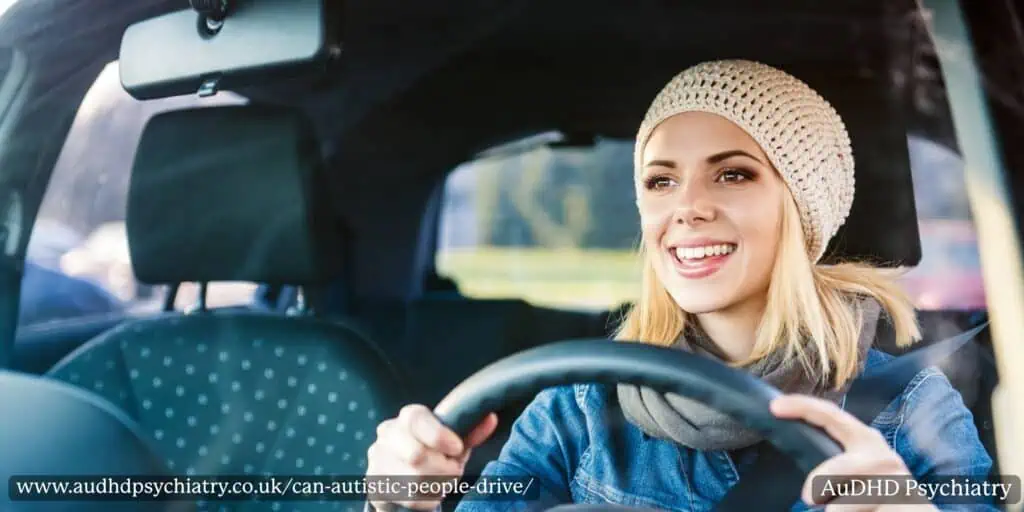
Autistic drivers don’t share one profile. Some autistic people find the skill of driving extremely difficult, while others are highly capable [3]. A diagnosis won’t tell you in advance which of those describes you, and your first few lessons will tell you far more. AuDHD Psychiatry’s guide to what autism is covers the condition itself, if you’d like that background first.
Do autistic people have to tell the DVLA?
The table shows who you tell, and when, in each part of the UK.
| Your situation | England, Scotland and Wales (DVLA) [2] | Northern Ireland (DVA) [3] |
|---|---|---|
| Driving not affected | Not needed | Not needed |
| Autism affects safe driving | Must tell | Must tell |
| Learner | Not usually; tell if your doctor says autism affects your safe driving (form A1) | Only if you think it may affect your safe driving |
| Full car or motorcycle licence | Tell if a change may make you unsafe (online or form A1) | Tell if a change may make you unsafe, or medication affects your driving (form A1 ODL) |
| Bus, coach or lorry licence | Form A1V | Form A1 VOC |
Not telling the DVLA about autism that affects your safe driving can mean a fine of up to £1,000 [2]. You may also be prosecuted if you’re involved in an accident as a result [2]. In Northern Ireland, the fine for not telling the DVA is also up to £1,000 [3]. Driving there after a false health declaration can mean up to £2,500 [3]. If you’re unsure, ask your doctor [2][3].
What makes learning to drive harder?
New situations and busy roads ask you to make many quick decisions at once. A 2017 review of 22 studies found many autistic people face challenges getting a licence [4]. It also found challenges with driving confidence and driving performance, compared with non-autistic people.
A 2018 review of the research found autistic drivers drive differently, with weaker tactical skills [5]. Tactical skills are the moment-to-moment choices in traffic, like judging a gap before you pull out. The same review found it’s unclear how far this affects safety, and that training can improve these skills [5].
You might tell your instructor you’re autistic and talk through anything that might affect how you learn, such as sensory differences [3]. Our guide to sensory processing differences explains how the senses can shape everyday tasks.
What do autistic drivers do well?
One US study of 486 autistic new drivers found fewer traffic offences [6]. It followed them and 70,990 non-autistic new drivers in New Jersey for their first four years. Autistic drivers had about half the moving violations, similar or lower crash rates, and fewer licence suspensions [6]. Moving violations are offences committed while driving, such as speeding. When autistic drivers did crash, they were half as likely to have crashed because of unsafe speed [6]. They were more likely to have failed to give way, or to have been turning across traffic [6].
The figures describe young drivers in one US state, not drivers on UK roads. A 2025 review of 37 studies concluded that autistic drivers aren’t generally at greater risk [7]. The same review found particular challenges in some driving situations, and results that don’t always agree [7]. So the research points to differences in how autistic people drive, not to a group that’s safer or riskier.
Support for learning and for the test
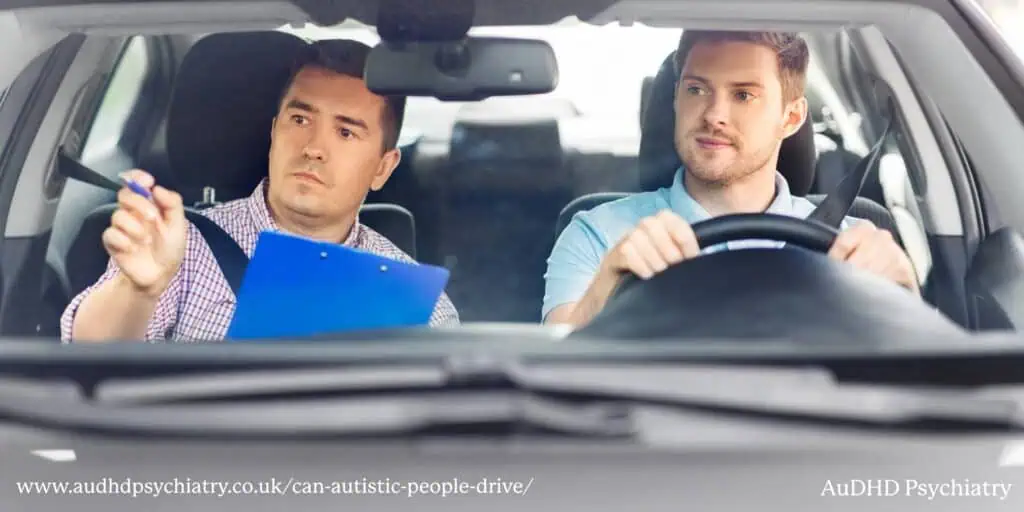
You can ask for changes to how your driving test runs. When you book in England, Scotland or Wales, say if you have a disability, health condition or learning difficulty [8]. You’ll still need to drive to the same standard to pass, but the examiner can make adjustments [8]. With a disability, the examiner might agree more time for instructions and directions. With a learning difficulty, the examiner adjusts the independent driving part, and might offer traffic signs instead of a sat nav [8]. In Northern Ireland, the DVA runs the test, so tell the DVA about your needs when you book [12].
For lessons, the 2017 review of 22 studies found certain teaching approaches can be useful [4]. They included direct communication, breaking tasks down, and regular, consistent lessons.
Driving Mobility, a charity, has a network of 20 independent driving and mobility assessment centres across the UK [9]. The National Autistic Society publishes a driving guide for autistic people in each UK nation [1].
Could you be autistic? How to find out
An assessment is how you find out whether you’re autistic.
An assessment may help if:
- the challenges above reach well beyond driving.
- you’ve wondered for years whether you’re autistic.
- you want a clear answer before work or study decisions.
It might not be right today if:
- you need urgent help now. Call NHS 111 and choose the mental health option, or in Northern Ireland call Lifeline free on 0808 808 8000, any time. In an emergency, call 999 or go to A&E [10].
- you’re under 18, when a child autism assessment applies.
AuDHD Psychiatry runs its adult autism assessment as two online appointments, and you don’t need a GP referral. We also speak with someone who knows you well. If no one can join, we can still assess you. A letter with the outcome reaches you the next day, and the full report follows within two weeks. To start smaller, take the free autism test, which screens rather than diagnoses. Or use a free 15-minute call to ask us questions, for information only.
Questions people ask
Do I need to tell the DVLA I’m autistic?
Only if autism affects your ability to drive safely [2]. If your driving isn’t affected, you don’t need to tell the DVLA. If you live in Northern Ireland, you tell the DVA instead, because it handles licences there [3]. The DVA has its own forms, separate from the DVLA’s.
Can an autism diagnosis stop you getting a driving licence?
Not on its own. The rule looks at how your condition affects your driving, not at the diagnosis [2]. Learners don’t usually need to tell the DVLA, because the driving test itself assesses how safely you drive. The exception is when a doctor has told you autism affects your ability to drive safely. In that case, you tell the DVLA before your test, using form A1 [2].
Should I tell my driving instructor I’m autistic?
It’s your choice, and telling them can help. Mentioning it lets you talk through anything, such as sensory differences, that might affect how you learn [3]. A 2017 review of 22 studies found clear, direct instructions, tasks broken into steps and regular lessons can all be useful [4]. You could ask a new instructor how they’d handle each of those before you commit to a block of lessons.
Can I get extra time in the driving test?
You can ask for it. If you have a disability, you’ll get time with the examiner at the start to talk it through [8]. The examiner might then agree more time for instructions and directions. You’ll still need to drive to the same standard as everyone else to pass [8]. In Northern Ireland, the DVA may allow more time, to talk through your disability [12].
Do I need to tell my car insurer?
The DVLA and DVA rules are about your licence, not your insurance. Read the health section of your policy, and ask your insurer if you’re unsure what it needs to know. Whatever your insurer asks, you must still tell the DVLA or the DVA if autism affects your safe driving [2][3].
What if I’m autistic and have ADHD?
The same approach applies to ADHD for drivers licensed by the DVLA. You must tell the DVLA if your ADHD, or your ADHD medication, affects your ability to drive safely [11]. If neither affects your driving, you don’t need to tell the DVLA about ADHD. In Northern Ireland, the same rule applies, and you tell the DVA [13]. Our guide to ADHD medication and driving looks at what to think about when treatment starts.
In short
Being autistic doesn’t by itself keep you off the road. You contact the DVLA or the DVA only when autism affects your ability to drive safely. Lessons can be shaped around how you learn, and the test itself can be adjusted. If autism might explain more than your driving, an assessment with AuDHD Psychiatry can help you find out.
Related
- autism benefits and your rights
- one assessment for ADHD and autism together
- what the autism levels mean
Sources
- National Autistic Society, Driving, read 30/09/2026, https://www.autism.org.uk/advice-and-guidance/topics/transport/driving
- GOV.UK, Autism spectrum disorder (ASD) and driving, read 30/09/2026, https://www.gov.uk/autism-and-driving
- nidirect, Autism and driving, read 30/09/2026, https://www.nidirect.gov.uk/articles/autism-and-driving
- Lindsay S, Systematic review of factors affecting driving and motor vehicle transportation among people with autism spectrum disorder, Disability and Rehabilitation, 2017, https://pubmed.ncbi.nlm.nih.gov/27045872/
- Wilson NJ, Lee HC, Vaz S, Vindin P, Cordier R, Scoping Review of the Driving Behaviour of and Driver Training Programs for People on the Autism Spectrum, Behavioural Neurology, 2018, https://pmc.ncbi.nlm.nih.gov/articles/PMC6136574/
- Curry AE, Metzger KB, Carey ME, Sartin EB, Huang P, Yerys BE, Comparison of Motor Vehicle Crashes, Traffic Violations, and License Suspensions Between Autistic and Non-Autistic Adolescent and Young Adult Drivers, Journal of the American Academy of Child and Adolescent Psychiatry, 2021, https://pmc.ncbi.nlm.nih.gov/articles/PMC8918049/
- Mercier A, Sherrod G, Ennis R, Clay OJ, Richter CG, Stavrinos D, The Driving Profile of Autistic Drivers and Their Driving Experiences: A Systematic Review, Journal of Autism and Developmental Disorders, 2025, https://pubmed.ncbi.nlm.nih.gov/39395127/
- GOV.UK, Driving test: cars, if you have a disability, health condition or learning difficulty, read 30/09/2026, https://www.gov.uk/driving-test/disability-health-condition-or-learning-difficulty
- Driving Mobility, read 30/09/2026, https://www.drivingmobility.org.uk/
- nidirect, Mental health emergency: if you’re in crisis or despair, read 29/09/2026, https://www.nidirect.gov.uk/articles/mental-health-emergency-if-youre-crisis-or-despair
- GOV.UK, Attention deficit hyperactivity disorder (ADHD) and driving, read 30/09/2026, https://www.gov.uk/adhd-and-driving
- nidirect, A guide to booking your practical driving test, read 30/09/2026, https://www.nidirect.gov.uk/articles/guide-booking-your-practical-driving-test
- nidirect, Attention deficit hyperactivity disorder (ADHD) and driving, read 30/09/2026, https://www.nidirect.gov.uk/articles/attention-deficit-hyperactivity-disorder-adhd-and-driving
About AuDHD Psychiatry
AuDHD Psychiatry is the trading name of ADHDdegree Ltd, a company registered in Scotland. The company number is SC822923. Our registered office is 3f1 Third Floor, Hill Street, Edinburgh, EH2 3JP.
Registered with the ICO, number ZB823033.
Last updated: 13 October 2026
Where to go from here
A private online screening for autism traits, with your results at the end. No commitment.
Take the free testA free, no-obligation call with our team to ask questions and find the right assessment for you.
Book a free callDarren is a Chartered Psychologist and specialist in ADHD and autism, with over 11 years of experience working in mental health and neurodevelopmental services. He holds a Doctorate in Counselling Psychology and has presented research at the British Psychological Society Annual Conference.
Read Darren’s full profileThis article is for general information and does not replace a clinical assessment. If you are struggling with your mental health right now, please contact your GP or NHS 111.