


ADHD in boys: signs by age, and what to do next

Reviewed by Dr Darren O’Reilly, Chartered Psychologist and Clinical Director
Review and publication details
Clinically reviewed by Dr Darren O’Reilly, DPsych, Chartered Psychologist (CPsychol), HCPC registered practitioner psychologist, registration number PYL041661 (check the HCPC register).
AuDHD Psychiatry is the trading name of ADHDdegree Ltd, a company registered in Scotland, company number SC822923. Registered office: 3f1 Third Floor, Hill Street, Edinburgh, EH2 3JP. Registered with the ICO, number ZB823033.
In this article
Page summary
ADHD in boys often shows as restlessness and acting on impulse, as well as trouble focusing. ADHD is more common in boys than in girls, and the signs begin in childhood. Very busy, easily distracted young children are common, and that alone isn’t ADHD. Girls with ADHD are recognised less often, partly because their signs tend to be quieter. For children, treatment starts with support for parents and changes at home and school. An assessment is worth considering when signs are long-standing and show at home and school. AuDHD Psychiatry assesses children aged 6 to 17 for ADHD online.
Maybe your son is always on the move, talks over people and gets told off for things he didn’t plan. Friends and family say boys will be boys, and you’re still not sure. Wanting to understand him better isn’t the same as looking for a label. Noticing a pattern is a sensible place to start, and you don’t need the answers yet.
At a glance
- How common: ADHD is more common in boys than girls [1].
- When it starts: The signs usually appear before the age of 12.
- Under 5: Being very busy and easily distracted is common at this age, and isn’t ADHD on its own.
- First step: Talk to your son’s teacher about what they notice in class.
How does ADHD show up in boys?
ADHD in boys shows as poor focus, or high energy and acting on impulse. Most children with ADHD show signs of both kinds, though some boys aren’t hyperactive at all [2]. A 2002 review of many studies rated boys with ADHD higher than girls on hyperactivity, inattention, impulsivity and disruptive behaviour [3].
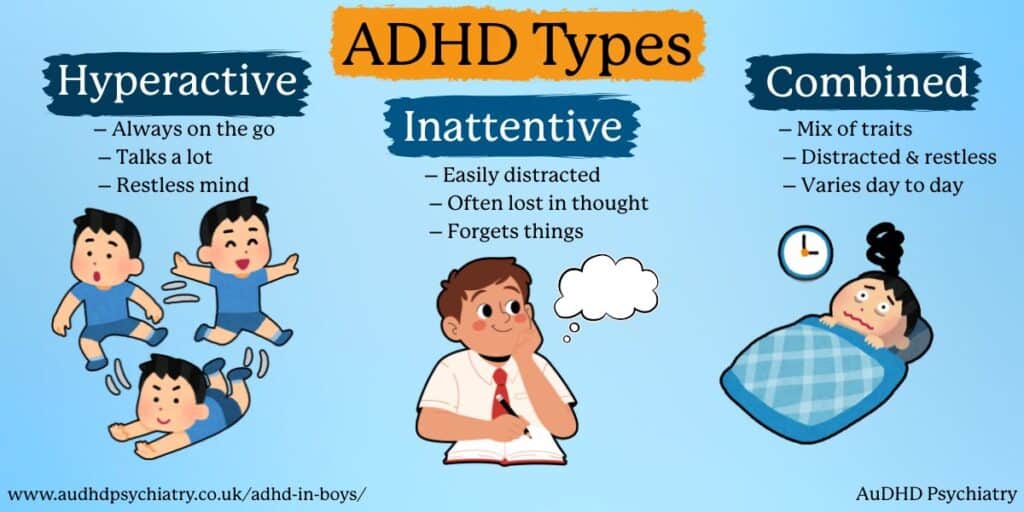
Outward signs like these are one reason ADHD in boys tends to get noticed, especially in a busy classroom. Other people may call a restless boy naughty. His restlessness isn’t bad behaviour by choice, and it isn’t caused by bad parenting either. What you’re seeing is a pattern worth understanding, not a fault in him or in you.
What are the signs of ADHD in boys at each age?
The signs of ADHD change shape as a boy grows up.
Under 5:
- Very busy, distractible and impulsive behaviour is common at this age [2].
- On its own, it doesn’t mean ADHD.
- Tiredness, worry or stress can look much the same [2].
At primary school:
- Being easily distracted, or finding it hard to follow instructions.
- Forgetting everyday tasks, such as brushing his teeth.
- Fidgeting, tapping, or getting up when he’s meant to sit still.
- Struggling to wait his turn, or interrupting others [2].
In the teenage years:
- The NHS lists the same signs for children and young people, so the ones above still apply to a teenager [2].
- Look for them in how he copes with homework, deadlines and waiting his turn.
- Signs usually start before 12, so his difficulties should reach back into childhood [2].
At any age, the signs must show in more than one setting, such as home and school, and cause real difficulty [4].
What other conditions often come with ADHD?
ADHD often comes with other conditions in children. Some children with ADHD also have anxiety or depression, or a learning difficulty such as dyslexia [2]. One condition can sit beside another, so it’s worth keeping an open mind. When a GP looks at your son’s symptoms, they can also consider conditions such as autism, Tourette’s or anxiety [2].

ADHD is more common in some groups of children, according to NICE [4]. The list includes children born early, autistic children, and children with epilepsy, tic disorders or a learning difficulty. Children with oppositional defiant disorder, conduct disorder, anxiety or depression are on it too. None of this means your son has another condition. Knowing the links simply helps whoever looks at his needs to see the whole picture.
Why is ADHD spotted more often in boys than in girls?
Boys with ADHD are spotted more often, because their signs tend to be easier to see [3]. Girls with ADHD more often have inattentive signs, and those are harder to notice [2]. The NHS gives this as one reason ADHD is recognised less often in girls [2]. A boy who can’t sit still draws more attention than a girl who daydreams quietly. Girls are also less likely to be referred for an assessment, according to NICE [4]. The same 2002 review found girls with ADHD had more problems turned inward than boys [3]. Problems turned inward are the ones a child carries quietly, such as feeling anxious or low.
A quiet boy can have ADHD too, and he’s easy to miss for the same reason. If you also have a daughter, our guide to ADHD in girls explains how the signs can show in her.
What treatment helps children with ADHD?
Treatment for children with ADHD starts with support around the child. For children under 5, the first treatment NICE recommends is a group parent-training programme focused on ADHD [4]. Medication isn’t given to a child under 5 without a second specialist opinion [4]. Parent training is a practical course about ADHD, not a judgement on you.
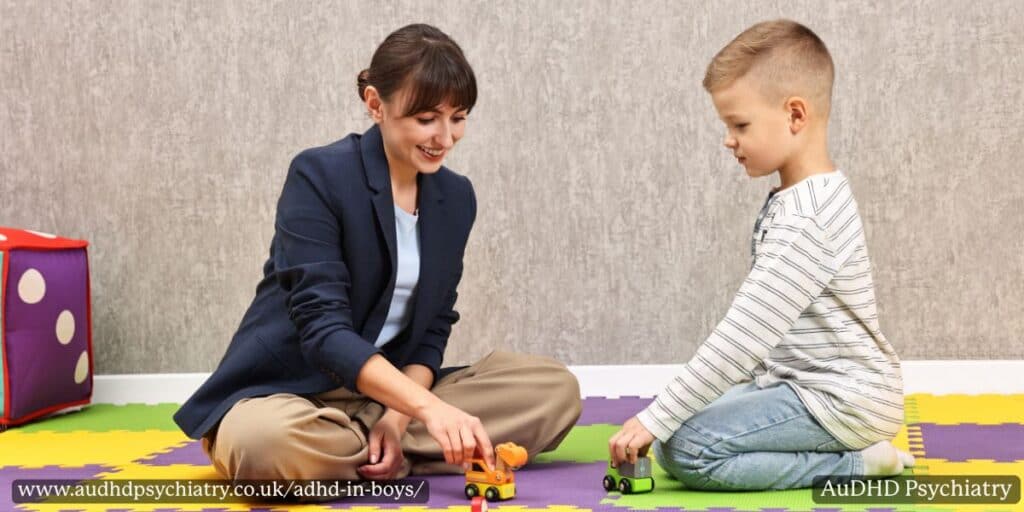
From the age of 5, parents are offered information about ADHD and extra support [4]. Some of the support runs in groups, and it can be as short as one or two sessions. Medication is only offered if difficulties still get in the way after changes to his surroundings have been made and reviewed [4]. Those changes include seating, fewer distractions, shorter tasks with movement breaks and written instructions [4].
An ADHD specialist must start and monitor any ADHD medication, such as methylphenidate, and not every child needs or wants it [2]. Talking therapies such as CBT are sometimes recommended, to help a child with problem-solving and expressing feelings [2].
What can you do now at home and at school?
You can start with small, steady changes at home this week. At home, the NHS suggests [2]:
- Time for physical activities he enjoys.
- Regular sleep.
- A balanced diet and regular mealtimes.
- A food and drink diary, if some foods seem to affect him, to share with school.
For homework and routine, it suggests [2]:
- Homework split into 15 to 20 minute slots, with breaks between.
- Clear, simple instructions, one at a time.
- A to-do list somewhere he can see it.
- Praise, or a reward chart.
Talk to his teacher first, and an older boy can speak to a teacher himself [2]. A teacher sees him in a different setting, so what they notice is worth hearing. In England, you can also talk to the special educational needs co-ordinator (SENCO) at his school or nursery [5]. SEN support is help given in school, and an education, health and care plan covers more complex needs [5]. Scotland, Wales and Northern Ireland each have their own systems for school support.
When is it worth getting him checked?
An assessment makes sense when home and school support isn’t helping. A GP or SENCO can discuss a referral [2].
An assessment may help if:
- The signs are long-standing, at home and at school.
- The support you’ve tried hasn’t helped enough.
It might not be right today if:
- He needs urgent help. Call NHS 111 and choose the mental health option, or in Northern Ireland call Lifeline free on 0808 808 8000, any time. In an emergency, call 999 or go to A&E [6].
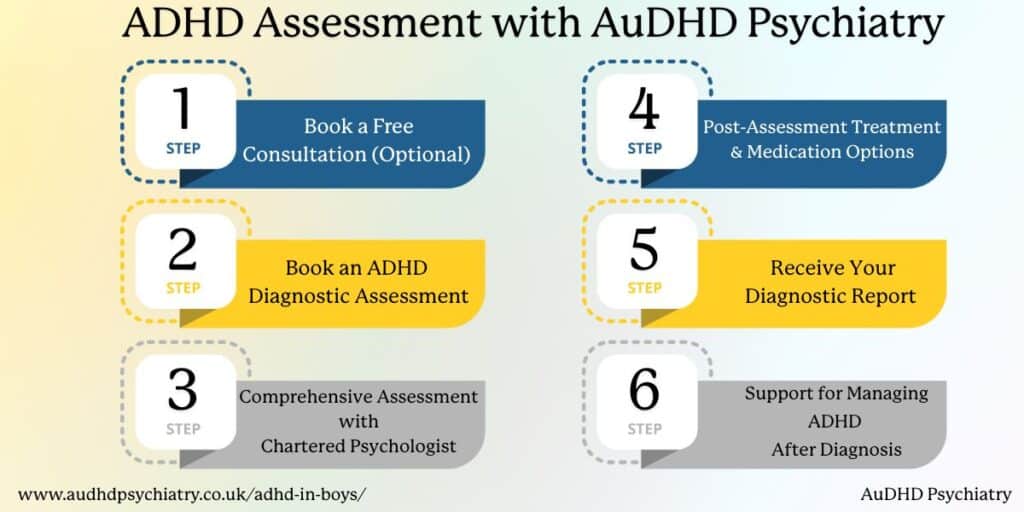
- He’s under 6, because our child assessment starts at 6.
If you decide to look into it, you don’t need a GP referral for the ADHD assessment for children at AuDHD Psychiatry. You can sit in with your son while it happens. A free 15-minute call is a chance to ask your questions first, and it isn’t an assessment.
Questions people ask
Is ADHD more common in boys than girls?
Yes, a 2021 international consensus statement says ADHD is more common in males [1]. The gap isn’t only about numbers. Girls are recognised less often, partly because their signs are more often inattentive and easier to overlook [2]. A boy and a girl can show ADHD in quite different ways, and both deserve to be taken seriously.
Can my son have ADHD if he isn’t hyperactive?
Yes, some children with ADHD show only the inattentive kind of signs [2]. A quiet boy who drifts off, loses things or can’t follow instructions is easy to miss, like many girls. He isn’t disrupting anyone, so his difficulties can go unnoticed for years. Signs like these still count, even when he’s never in trouble.
Can you claim PIP for a child with ADHD?
Not until 16, and young people in Scotland apply for Adult Disability Payment rather than PIP [8]. Before that, children in England, Wales and Northern Ireland can get Disability Living Allowance (DLA) for children [7]. In Scotland, it’s Child Disability Payment. DLA depends on how much more looking after a child needs than others the same age [7]. Our ADHD benefits guide covers the wider picture.
Does my child need medication for ADHD?
Not always, because not every child with ADHD needs or wants medicine [2]. Medication is only offered if difficulties continue after changes at home and school have been tried [4]. A specialist starts it and keeps it under review. The prescriber decides with you whether it’s right for your child, and you’re free to ask questions first.
Can changing his diet help with ADHD?
Cutting out colourings and additives isn’t advised as a general ADHD treatment, according to NICE [4]. If some foods do seem to affect your son, the NHS suggests a food and drink diary [2]. You can share the diary with his school, so everyone sees the same pattern.
Can a child have ADHD and autism?
Yes, the NHS lists being autistic among the things linked to ADHD [2]. A GP can also consider autism when looking at a child’s symptoms [2]. AuDHD Psychiatry looks at both conditions together. Our child AuDHD assessment takes four appointments, so each condition gets proper attention.
In short
Boys with ADHD often show it through restlessness and acting on impulse, alongside trouble focusing. The signs begin in childhood, and they turn up in more than one part of his life. Changes at home and at school come first, and they’re worth giving a fair try. If the signs have lasted and support hasn’t made enough difference, talk them through with someone who knows ADHD. AuDHD Psychiatry assesses children across the UK. Keep a short weekly note of what you see at home, because it gives a GP or specialist a clear start. Your view of your own son is worth trusting, and it belongs in every conversation.
Related
- a parent’s guide to ADHD in children
- ADHD in men
- how ADHD affects the brain
- what you receive after a child assessment
Sources
- Faraone SV, Banaschewski T, Coghill D, et al., “The World Federation of ADHD International Consensus Statement: 208 Evidence-based conclusions about the disorder”, Neuroscience and Biobehavioral Reviews, September 2021, 128:789-818, https://doi.org/10.1016/j.neubiorev.2021.01.022 (read 30/09/2026)
- NHS, ADHD in children and young people, page last reviewed 19 March 2025, https://www.nhs.uk/conditions/attention-deficit-hyperactivity-disorder-adhd/ (read 30/09/2026)
- Gershon J, “A meta-analytic review of gender differences in ADHD”, Journal of Attention Disorders, January 2002, 5(3):143-154, https://doi.org/10.1177/108705470200500302 (read 30/09/2026)
- National Institute for Health and Care Excellence (NICE), guideline NG87, Attention deficit hyperactivity disorder: diagnosis and management, published 14 March 2018, last updated 13 September 2019, https://www.nice.org.uk/guidance/ng87 (read 30/09/2026)
- GOV.UK, Children with special educational needs and disabilities (SEND), England, https://www.gov.uk/children-with-special-educational-needs (read 30/09/2026)
- nidirect, Mental health emergency: if you’re in crisis or despair, https://www.nidirect.gov.uk/articles/mental-health-emergency-if-youre-crisis-or-despair (read 30/09/2026)
- GOV.UK, Disability Living Allowance (DLA) for children, https://www.gov.uk/disability-living-allowance-children (read 30/09/2026)
- GOV.UK, Personal Independence Payment (PIP), https://www.gov.uk/pip (read 30/09/2026)
About AuDHD Psychiatry
AuDHD Psychiatry is the trading name of ADHDdegree Ltd, a company registered in Scotland. The company number is SC822923. Our registered office is 3f1 Third Floor, Hill Street, Edinburgh, EH2 3JP.
Registered with the ICO, number ZB823033.
Last updated: 13 October 2026
Where to go from here
A private online screening for ADHD traits in children, with results at the end. No commitment.
Take the free testA free, no-obligation call with our team to ask questions and find the right assessment for you.
Book a free callDarren is a Chartered Psychologist and specialist in ADHD and autism, with over 11 years of experience working in mental health and neurodevelopmental services. He holds a Doctorate in Counselling Psychology and has presented research at the British Psychological Society Annual Conference.
Read Darren’s full profileThis article is for general information and does not replace a clinical assessment. If you are struggling with your mental health right now, please contact your GP or NHS 111.