

What does neurodivergent mean?

Reviewed by Dr Darren O’Reilly, Chartered Psychologist and Clinical Director
In this article
Page summary
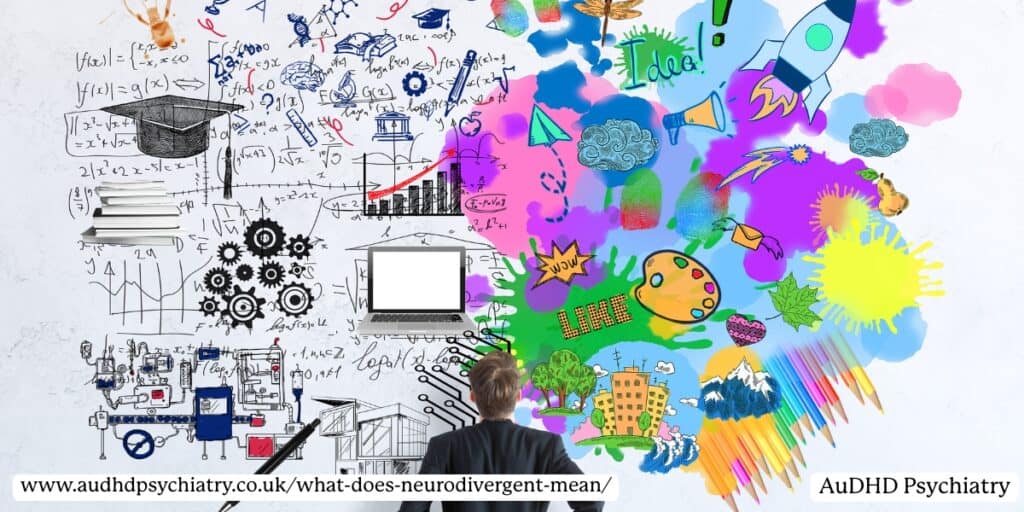
Neurodivergent means having a brain that works differently from what’s considered typical. The word covers conditions such as ADHD, autism, dyslexia, dyspraxia, dyscalculia and Tourette syndrome. It’s a description rather than a medical diagnosis, and there’s no single test for it. Each condition is assessed on its own, often by a different kind of professional. Signs worth noticing include lifelong trouble with focus, reading people or sensory overload. AuDHD Psychiatry assesses ADHD, autism and both together online, for adults and children.
Maybe a colleague used the word, or your child’s school did. Or maybe it’s the first word that’s ever seemed to fit something you’ve felt for years. Either way, wondering whether it describes you isn’t self-diagnosing. Knowing what the word covers is a sensible first step. Our founder, Dr Darren O’Reilly, has ADHD and autism himself, so these are questions we know from the inside.
Neurodivergent, neurodiversity and neurotypical: what do the words mean?
Neurodivergent describes a person whose brain works differently from what’s considered typical [1]. Neurodiversity is the bigger idea: the natural differences in how all our brains behave and handle information [1]. The word is usually credited to the Australian sociologist Judy Singer, who wrote about it in the late 1990s [14]. We all think, learn and act in our own way. Neurotypical is the word for someone whose brain works in the way that’s thought of as typical.

It’s a word that’s still settling, because neurodivergence is still being researched and understood [1]. The language keeps changing, and there’s no single term that everyone prefers. Many people say “I’m autistic” rather than “I have autism”. They see neurodivergence as part of who they are, not something separate from them [1].
Which conditions count as neurodivergent?
ADHD, autism, dyslexia and dyspraxia are the best-known types of neurodivergence [1]. Each condition below is classed as a neurodevelopmental condition in the DSM-5 diagnostic manual, meaning it starts as the brain develops [13]. Each one is a different way a brain can work, and there are others alongside them:
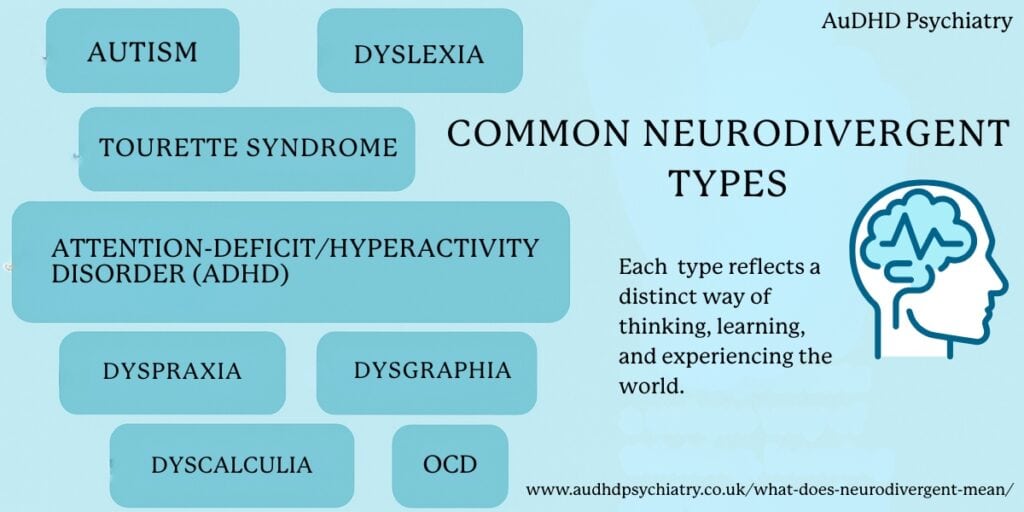
- ADHD affects attention, energy levels and impulse control [3].
- Autism is a difference in how the brain develops, which shapes how a person experiences the world [2].
- Dyslexia is a common learning difficulty that mainly affects reading and writing [4].
- Dyspraxia, also called developmental co-ordination disorder, mainly affects movement and co-ordination [5].
- Dyscalculia is a specific, lasting difficulty with understanding numbers [1].
- Tourette syndrome causes sudden, repeated sounds or movements called tics [6].
The list isn’t closed, and people still disagree about whether mental health conditions such as anxiety or depression belong on it [1]. Our guides What is ADHD and What is autism go further into the two conditions we assess at AuDHD Psychiatry.
Am I neurodivergent? Signs and a self-check
There’s no single sign that someone is neurodivergent. In our clinicians’ view, what matters is a pattern that’s been with you most of your life. A hard few months isn’t the same thing. The questions below draw on NHS descriptions of each condition [3][4][5][7]. They’re for reflection only, and nothing is scored:

- Have you always found it hard to stay focused, remember things or organise your time?
- Do facial expressions, tone of voice or social situations feel hard to read?
- Do you mask, copying others to fit in?
- Are you very sensitive to noise, light, textures or smells, or do you barely notice them?
- Do reading, spelling or following several instructions at once take more effort than they do for others?
- Do things like typing, driving or keeping your balance feel harder than you’d expect?
Recognising yourself in some of these is common, and it doesn’t mean you have a condition. If they’ve shaped your work, study or relationships, it’s worth talking to a professional. A self-check can point the way, but it can’t give you an answer.
How does a neurodivergent brain work?
A neurodivergent brain takes in and processes information differently [1]. Each person has their own mix of strengths and things they find hard. Two people with the same condition can experience it very differently, so there’s no single picture of it [1]. It’s common to have more than one type too, and ADHD is more common in autistic people [2].
Surroundings make a big difference. The same brain can struggle in a noisy, unstructured place and cope well once a few small things change. Under the Equality Act 2010, many neurodivergent people have the right to reasonable adjustments at work [1]. That’s worth knowing, because the answer often lies in the setting rather than in you. A neurodivergent brain isn’t faulty, and it isn’t an illness.
Monotropism and the double empathy problem
Monotropism and the double empathy problem are two ideas shaped by autistic researchers. Monotropism is a theory that autistic attention gathers tightly on a few interests at a time [11]. A 2005 paper by Dinah Murray and two colleagues set the idea out [11]. The paper argues that this narrow focus sits behind the other autism criteria, including social differences [11].
The double empathy problem comes from the autistic researcher Damian Milton, writing in 2012 [12]. It says misunderstandings between autistic and non-autistic people run both ways, so neither side is simply lacking [12]. Under this idea, a gap in shared understanding isn’t the same as a lack of empathy. That’s a useful answer when someone asks whether autistic people have empathy at all.
Is there a neurodivergent test?
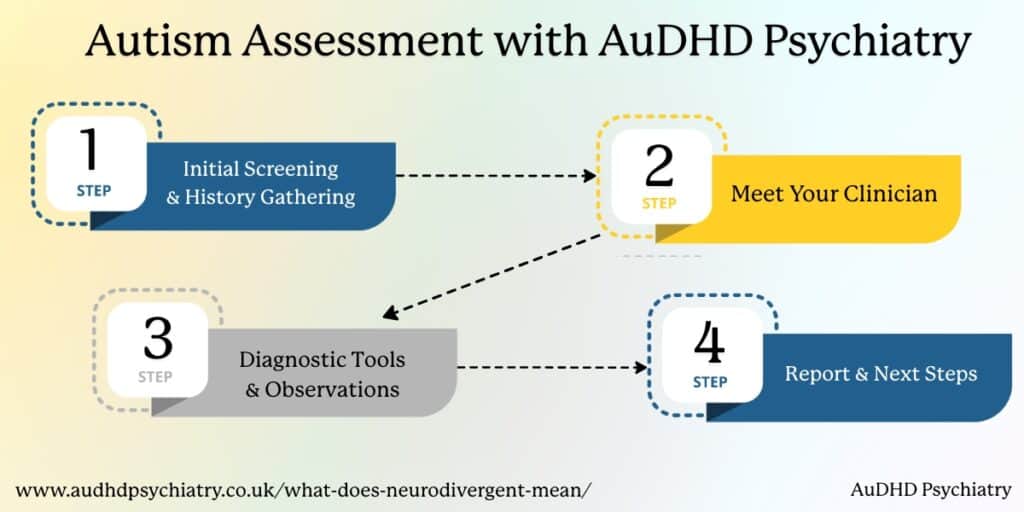
There’s no single test for being neurodivergent, because each condition has its own assessment. ADHD is assessed by a specialist, such as a psychiatrist [3]. The specialist asks about your symptoms now and in childhood, and may speak to someone who knows you well [3]. At AuDHD Psychiatry, a clinical or counselling psychologist leads the ADHD assessment. Autism is identified through a specialist assessment by an autism team [8]. Dyslexia is different again: an educational psychologist or a specialist dyslexia assessor does it, and most people pay [4].
Free online screeners can suggest whether an assessment is worth having, but they can’t diagnose anything. You can try our free ADHD test to see whether ADHD traits show up in your answers. Our free autism test does the same for autistic traits.
How do I get assessed?
You can be assessed for ADHD or autism through the NHS or privately.
This is for you if:
- The signs go back most of your life.
- They affect your work, study, relationships or daily life.
- You want a clinical view, to understand yourself or ask for support.
It might not be right today if:
- You need urgent help now. Call NHS 111 and choose the mental health option, or in Northern Ireland call Lifeline free on 0808 808 8000, any time. In an emergency, call 999 or go to A&E [9].
- You’re mainly looking into dyslexia, dyscalculia or dyspraxia, which other specialists assess.
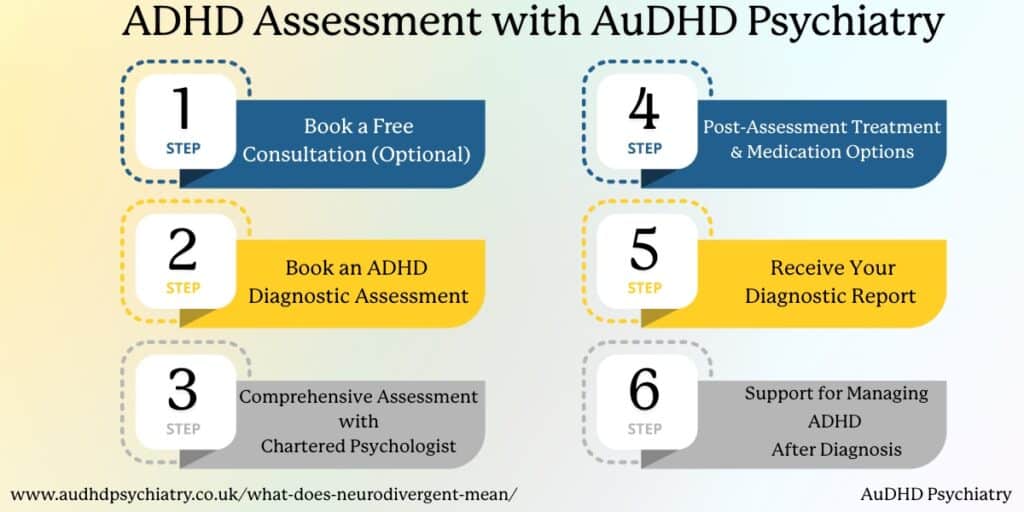
On the NHS, your GP can refer you for assessment [3][8]. In England, Right to Choose lets you pick which NHS service assesses you [8]. AuDHD Psychiatry offers a private ADHD assessment for adults, a private autism assessment for adults and an AuDHD assessment. All three are online for people living anywhere in the UK, with no GP referral. If you’re not sure which fits, a free 15-minute call can help you choose before you book. Each route is set out in how to get tested for neurodivergence.
Questions people ask
Is neurodivergent a diagnosis?
No, neurodivergent is a description rather than a diagnosis. A clinician diagnoses the specific conditions it covers, such as ADHD or autism. Many people still find the word useful for talking about themselves day to day. So the word is a good place to start, and an assessment gives the clinical answer.
What’s the difference between neurodivergent and neurodiverse?
Neurodivergent describes one person, while neurodiversity describes the natural variety across everyone’s brains [1]. Neurodiverse is usually used for a group, such as a neurodiverse team. A team like that includes neurodivergent and neurotypical people alike. You’ll still hear one person called neurodiverse in everyday speech, and most people will know what you mean.
Is anxiety or depression a type of neurodivergence?
There’s no agreement on this, and some definitions include mental health conditions while others don’t [1]. What’s clearer is that neurodivergent people often experience anxiety or low mood [1]. Those can be treated in their own right. So if you’re struggling with your mood, it’s worth raising with your GP, whatever else you’re trying to understand about yourself.
Is being neurodivergent a disability?
Being neurodivergent will often count as a disability under the Equality Act 2010 [1]. That gives you rights at work, including reasonable adjustments. Some neurodivergent people don’t see themselves as disabled, and that’s their choice to make. Access to Work is a government scheme that can help people get into work or stay in it [1].
Can you be more than one type of neurodivergent?
Yes, it’s common to have more than one type, sometimes called co-occurring conditions [1]. Having ADHD and autism together is often called AuDHD, and our guide What is AuDHD explains how the two can overlap. If you notice signs of more than one, mention them all when you first speak to a professional.
Can children be neurodivergent?
Yes. Neurodivergence starts early in life, so children can be neurodivergent too. Autism is something you’re born with, and ADHD symptoms usually start before the age of 12 [2][3]. Some people’s signs aren’t noticed until they’re adults. AuDHD Psychiatry assesses children aged 6 to 17, and a parent can be present during their child’s assessment.
In short
Neurodivergence takes many forms, and ADHD, autism, dyslexia and dyspraxia are the best-known. There’s no one test for it, so each condition gets its own assessment. For ADHD or autism, you can go through your GP or come to us privately. If you’re not sure where to begin, a free 15-minute call lets you ask your questions before you decide anything.
Related
- female autism checklist
- famous autistic people
- Meet our clinical team
- Exploring ADHD Across Cultures: A Different Lens on Being
- “Neuroqueer” Experiences: ADHD in the LGBTQ+ Community
Sources
- Acas, Neurodiversity at work: understanding neurodiversity, read 29 September 2026, https://www.acas.org.uk/neurodiversity-at-work.
- NHS, What is autism?, page last reviewed 6 May 2026, https://www.nhs.uk/conditions/autism/what-is-autism/.
- NHS, ADHD in adults, read 29 September 2026, https://www.nhs.uk/conditions/adhd-adults/.
- NHS, Dyslexia in adults, read 29 September 2026, https://www.nhs.uk/conditions/dyslexia-in-adults/.
- NHS, Dyspraxia in adults (developmental co-ordination disorder), read 29 September 2026, https://www.nhs.uk/conditions/developmental-coordination-disorder-dyspraxia-in-adults/.
- NHS, Tourette syndrome, read 29 September 2026, https://www.nhs.uk/conditions/tourettes-syndrome/.
- NHS, Signs of autism in adults, page last reviewed 6 May 2026, https://www.nhs.uk/conditions/autism/signs-in-adults/.
- NHS, Autism assessments, page last reviewed 6 May 2026, https://www.nhs.uk/conditions/autism/assessments/.
- nidirect, Mental health emergency: if you’re in crisis or despair, read 29 September 2026, https://www.nidirect.gov.uk/articles/mental-health-emergency-if-youre-crisis-or-despair.
- Companies House, Adhddegree Ltd, company number SC822923, https://find-and-update.company-information.service.gov.uk/company/SC822923.
- Murray D, Lesser M, Lawson W, Attention, monotropism and the diagnostic criteria for autism, Autism, 2005, 9(2):139-156, https://doi.org/10.1177/1362361305051398.
- Milton DEM, On the ontological status of autism: the ‘double empathy problem’, Disability & Society, 2012, 27(6):883-887, https://doi.org/10.1080/09687599.2012.710008.
- American Psychiatric Association, Diagnostic and Statistical Manual of Mental Disorders, fifth edition, text revision (DSM-5-TR), 2022, neurodevelopmental disorders chapter.
- Singer J, “Why can’t you be normal for once in your life?” From a “problem with no name” to the emergence of a new category of difference, in Corker M and French S (eds), Disability Discourse, Open University Press, 1999, pages 59-67.
About AuDHD Psychiatry
AuDHD Psychiatry is the trading name of Adhddegree Ltd, a company registered in Scotland. The company number is SC822923 [10]. Our registered office is 3f1 Third Floor, Hill Street, Edinburgh, EH2 3JP.
Registered with the ICO, number ZB823033.
Last updated: 13 October 2026
Where to go from here
A private online screening for ADHD traits, with your results at the end. No commitment.
Take the free testA free, no-obligation call with our team to ask questions and find the right assessment for you.
Book a free callDarren is a Chartered Psychologist and specialist in ADHD and autism, with over 11 years of experience working in mental health and neurodevelopmental services. He holds a Doctorate in Counselling Psychology and has presented research at the British Psychological Society Annual Conference.
Read Darren’s full profileThis article is for general information and does not replace a clinical assessment. If you are struggling with your mental health right now, please contact your GP or NHS 111.