

Female autism checklist: autistic traits in women and girls

Reviewed by Dr Darren O’Reilly, Chartered Psychologist and Clinical Director
Review and publication details
Clinically reviewed by Dr Darren O’Reilly, DPsych, Chartered Psychologist (CPsychol), HCPC registered practitioner psychologist, registration number PYL041661 (check the HCPC register).
AuDHD Psychiatry is the trading name of ADHDdegree Ltd, a company registered in Scotland, company number SC822923. Registered office: 3f1 Third Floor, Hill Street, Edinburgh, EH2 3JP. Registered with the ICO, number ZB823033.
In this article
Page summary
A female autism checklist helps you spot autistic traits that often go unnoticed in women and girls. Autism in women is often missed or recognised late, because many women mask their traits. Older ideas of autism were also built around boys, so the signs in girls were overlooked. The checklist groups the traits women describe most: social life, the senses, routines, interests and masking. It’s for noticing patterns, and only a specialist assessment can diagnose autism. AuDHD Psychiatry assesses autism online for adults and children living in the UK.
You might be here after years of working hard to seem fine. Maybe you’ve felt out of step for as long as you can remember, or nobody could quite say why. Notice what fits your life and let the rest go. You don’t have to decide anything today.
Why is autism missed in women and girls?
Autism is missed in women because it rarely matches the old stereotype [1]. Many struggle to get a diagnosis or are misdiagnosed with another condition. Autistic girls often seem to have fewer social difficulties, and masking may be one reason [1]. At school, a girl can belong to a friendship group and get good grades, so her teachers don’t notice anything.
Her interests and habits, such as reading or twirling her hair, can look like other girls’, only more intense [1]. A 2017 review of 54 studies found about three boys for every girl among children who meet the criteria [12]. That’s lower than the four-to-one figure often quoted [12]. If you’re reading for a younger girl, our guide to autism in children suits her age.
Social traits: what might I recognise in myself?
Social traits in autistic women often look like effort rather than obvious difficulty. Many of these social signs come from the NHS list for autistic adults [2]:
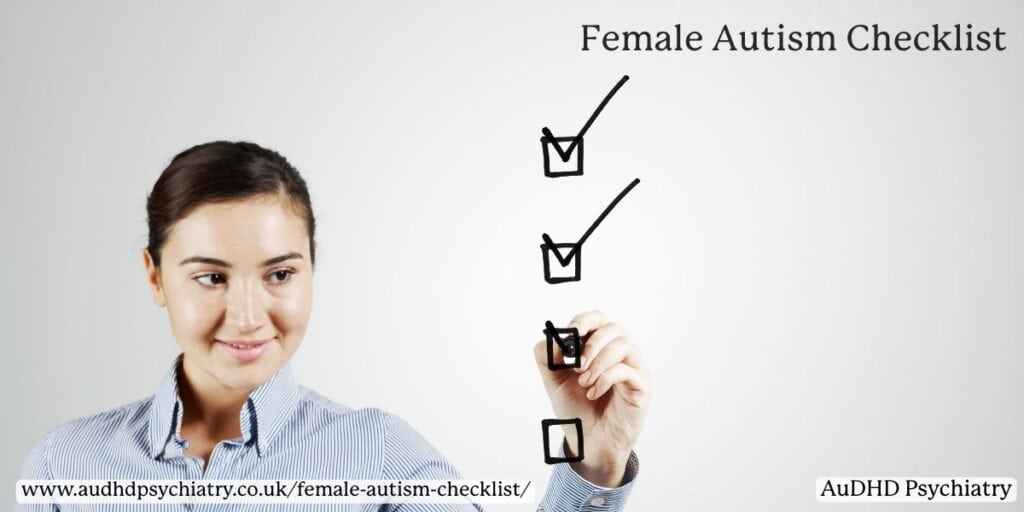
- You copy how other people talk and behave, or rehearse what to say before you say it.
- You seem to cope well in company, then need a long stretch alone to recover.
- You go very quiet in situations you find hard, and you keep your feelings to yourself.
- You find facial expressions, gestures or tone of voice hard to read, and you take things literally.
- You find it hard to put into words how you’re feeling.
None of these on its own points to autism, because plenty of people rehearse conversations or need quiet after a busy day. What matters is a pattern that has run through your whole life, across school, work and friendships. The core signs of autism set out that fuller picture.
Sensory, routine and interest traits
Autism also shows in how you handle your senses, routines and interests [2]. Here’s what women often recognise about sensory processing, routines and interests:
Could this be part of your story?
Try Our Free Autism Test Book a Screening CallOur specialist clinicians are here to help you understand yourself better.
- Clothing labels, busy rooms or strong smells feel unbearable, or some sensations barely register at all.
- You get anxious or upset when a routine or a plan changes without warning.
- You have very focused interests that look ordinary to others but run deeper and last longer [1].
- You make small repetitive movements, such as fiddling or rocking, and you hide them in public.
Some women only connect these traits to autism in adulthood, because each one had its own explanation growing up. A hatred of scratchy labels was called fussiness, and a meltdown after a change of plan was put down to tiredness. Noting which items go back to childhood gives a clinician much more to work with.
Emotion, identity and masking
Masking, also called camouflaging, means hiding or not showing the signs of autism [2]. Many adults learn it so well it becomes automatic, but it can make everyday life and social contact exhausting. The stress of keeping it up can also bring anxiety and overwhelm [1]. Signs that it’s costing you something include:
- You feel you’re performing a version of yourself for most of the day.
- You’re exhausted after days that look easy to everyone else.
- You’ve been treated for anxiety, depression or an eating disorder, which are more common in autistic women [2].
- You’re not sure who you are when you stop copying other people.
Our own guide to masking looks at how years of it can lead to autistic burnout [3]. Noticing that cost is as useful to a clinician as noticing the traits themselves. Jot down the days that drain you most, and what they had in common.
Could it be ADHD as well as autism?
ADHD is more common in autistic people, so you can have both [4]. Having both is often called AuDHD, and our guide to AuDHD in women covers how the two can show together. ADHD itself is thought to be recognised less often in women, perhaps because inattentive symptoms are harder to spot [5].

If you also lose focus or forget things, our guide to ADD symptoms in women looks at those quieter signs. You don’t have to pick one label from a list before you speak to anyone. A clinician can look at both conditions and how they affect each other in your daily life. If the ADHD side sounds familiar too, our free ADHD test is a short first check.
How do the diagnostic criteria apply to women?
In the UK, an autism diagnosis should be based on the DSM-5 or ICD-11 criteria [6]. Both look at two core areas that have been present throughout your life. The first is differences in social communication and interaction. The second is restricted or repetitive behaviours and interests, including sensory differences [6]. Specialists can use structured tools such as the ADOS, the Autism Diagnostic Observation Schedule, but no tool decides alone [6]. The National Autistic Society lists less sensitive assessment tools as one possible reason women are missed [1].
In our clinicians’ view, masking is common, especially in adults who’ve spent years compensating. So at AuDHD Psychiatry, we look beyond how you come across on the day and draw on your whole life history. On naming, Asperger syndrome is no longer given as a diagnosis, and it now sits within autism spectrum disorder [7]. Some women still use the term for themselves, and our guide to what the autism levels mean explains how the naming changed.
From checklist to assessment: what happens next?
If a lot of this fits, the next step is a conversation with someone who assesses autism.
An assessment may help if:
- These traits go back years, not just a hard few months.
- Masking or being misunderstood wears you out.
- You want a written clinical view, for yourself or for adjustments at work.
It might not be right today if:
- You need urgent help. Call NHS 111 and choose the mental health option, or in Northern Ireland call Lifeline free on 0808 808 8000, any time. In an emergency, call 999 or go to A&E [9].
- You’re looking for a medication for autism: there isn’t one.
A GP can refer you to an NHS autism team [8]. In England, Right to Choose for autism lets you pick the service. AuDHD Psychiatry offers a private autism assessment for adults, a child autism assessment and an AuDHD assessment online, with no GP referral. We assess people living in the UK. Adult autism assessments have two appointments: the assessment and an interview with someone close to you. We can still assess you if nobody can take part. Start with the free autism test or a free 15-minute call, which is for information.
Questions people ask
Is there a female autism test?
There’s no separate autism test for women. Questionnaires can suggest whether an assessment is worth having, but only a specialist assessment diagnoses autism [6][8]. AuDHD Psychiatry offers a short screening questionnaire, and it asks for your name and email before it shows your result. You can take our free autism test whenever you feel ready.
Can a checklist tell me if I’m autistic?
A checklist can’t confirm or rule out autism, but it helps you notice patterns. Some women recognise very few items, because they’ve adapted for so long that the traits feel like ordinary habits. Others recognise many for other reasons entirely. That’s why a clinician looks at your whole history, from childhood onwards, rather than at a score.
Can you be diagnosed with autism as an adult woman?
Yes, autism can be diagnosed at any age. NICE has separate guidance on diagnosing autistic adults [10]. Many women reach a diagnosis well into adulthood, after years of being overlooked [1]. Autism is something you’re born with, and it isn’t an illness [4]. So an adult diagnosis describes how you’ve always been, rather than something new.
What is masking in autistic women?
Many autistic women mask without realising it, toning their traits down to fit in. Masking is one reason autism can be harder to see in women, though autistic men mask too [2]. For the signs and what it costs over time, read autistic masking explained.
Is Asperger’s in women the same as autism?
Yes, Asperger’s is now part of autism spectrum disorder rather than a separate diagnosis [7]. Many women who read about “female Asperger’s” are describing the same traits set out in this checklist. The older term still turns up online, so the two often get mixed up. Our guide to Asperger syndrome covers where the name came from.
Can autistic women be misdiagnosed with anxiety or depression?
It happens: women can be misdiagnosed with a mental health condition instead [1]. Their autistic traits can also get missed among the symptoms of other conditions. Anxiety or depression can also be real and sit alongside autism, and each one is treated in its own right. An assessment looks at the whole picture, including the diagnoses you already have.
In short
Female autism traits are often quieter than the picture most people carry. The three checklists here cover social life, the senses, routines and interests, and the cost of hiding your traits. If many items have been true for as long as you can remember, that’s worth taking to a clinician. Noting which items fit, and since when, makes that first conversation easier.
Related
- autism in adults
- how to get tested for neurodivergence
- What is autism
- Meet our clinical team
Sources
- National Autistic Society, Autistic women and girls, read 29 September 2026, https://www.autism.org.uk/advice-and-guidance/what-is-autism/autistic-women-and-girls.
- NHS, Signs of autism in adults, page last reviewed 6 May 2026, https://www.nhs.uk/conditions/autism/signs-in-adults/.
- AuDHD Psychiatry, Autistic Masking Guide, reviewed by Dr Darren O’Reilly, published 11 May 2026, https://www.audhdpsychiatry.co.uk/insights/autistic-masking/.
- NHS, What is autism?, page last reviewed 6 May 2026, https://www.nhs.uk/conditions/autism/what-is-autism/.
- NHS, ADHD in adults, read 29 September 2026, https://www.nhs.uk/conditions/adhd-adults/.
- National Autistic Society, Criteria and tools used in an autism assessment, read 29 September 2026, https://www.autism.org.uk/advice-and-guidance/diagnosis/assessment-and-diagnosis/criteria-and-tools-used-in-an-autism-assessment.
- National Autistic Society, Asperger syndrome, last reviewed June 2023, https://www.autism.org.uk/advice-and-guidance/what-is-autism/the-history-of-autism/asperger-syndrome.
- NHS, Autism assessments, page last reviewed 6 May 2026, https://www.nhs.uk/conditions/autism/assessments/.
- nidirect, Mental health emergency: if you’re in crisis or despair, read 29 September 2026, https://www.nidirect.gov.uk/articles/mental-health-emergency-if-youre-crisis-or-despair.
- National Institute for Health and Care Excellence (NICE), guideline CG142, Autism spectrum disorder in adults: diagnosis and management, published 27 June 2012, last updated 14 June 2021, https://www.nice.org.uk/guidance/cg142.
- Companies House, ADHDdegree Ltd, company number SC822923, https://find-and-update.company-information.service.gov.uk/company/SC822923.
- Loomes R, Hull L, Mandy WPL. What Is the Male-to-Female Ratio in Autism Spectrum Disorder? A Systematic Review and Meta-Analysis. Journal of the American Academy of Child and Adolescent Psychiatry, June 2017, 56(6):466-474. https://pubmed.ncbi.nlm.nih.gov/28545751/
About AuDHD Psychiatry
AuDHD Psychiatry is the trading name of ADHDdegree Ltd, a company registered in Scotland. The company number is SC822923 [11]. Our registered office is 3f1 Third Floor, Hill Street, Edinburgh, EH2 3JP.
Registered with the ICO, number ZB823033.
Last updated: 13 October 2026
Where to go from here
A private online screening for autism traits, with your results at the end. No commitment.
Take the free testA free, no-obligation call with our team to ask questions and find the right assessment for you.
Book a free callDarren is a Chartered Psychologist and specialist in ADHD and autism, with over 11 years of experience working in mental health and neurodevelopmental services. He holds a Doctorate in Counselling Psychology and has presented research at the British Psychological Society Annual Conference.
Read Darren’s full profileThis article is for general information and does not replace a clinical assessment. If you are struggling with your mental health right now, please contact your GP or NHS 111.