



Autistic meltdowns and shutdowns: what happens, and what helps

Reviewed by Dr Darren O’Reilly, Chartered Psychologist and Clinical Director
Review and publication details
Clinically reviewed by Dr Darren O’Reilly, DPsych, Chartered Psychologist (CPsychol), HCPC registered practitioner psychologist, registration number PYL041661 (check the HCPC register).
AuDHD Psychiatry is the trading name of ADHDdegree Ltd, a company registered in Scotland, company number SC822923. Registered office: 3f1 Third Floor, Hill Street, Edinburgh, EH2 3JP. Registered with the ICO, number ZB823033.
In this article
Page summary
When an autistic meltdown hits, overwhelm takes control and the person may shout, cry or lash out. A shutdown is the quieter response, where someone withdraws and goes still or silent instead. Neither is chosen, and neither is bad behaviour, in a child or in an adult. Small changes help: spotting the build-up, cutting noise and demands, and allowing time to recover. When meltdowns sit alongside other lifelong differences, an assessment can look at the wider picture. AuDHD Psychiatry assesses adults and children living in the UK for autism, online.
A meltdown or a shutdown can leave you embarrassed and wrung out, and the people nearby confused or frightened. Both reactions make sense, and neither one means anybody has failed. Many autistic adults spent years being called “too sensitive” before anyone gave them a better word for what was happening.
At a glance
- Not a tantrum: a meltdown isn’t a temper tantrum, and it isn’t bad or naughty behaviour [1].
- Shutdown: the quieter response, where a person withdraws from everything around them [2].
- Common triggers: sensory differences, changes in routine, anxiety and difficulty communicating [1].
- Early warning: distress often shows first, through pacing, repeated questions, rocking or going very still [1].
What is an autistic meltdown?
An autistic meltdown is an intense response to a situation that has become too much [1]. For a while, the person loses control of their behaviour [1]. Losing control can show in words, like shouting or crying, in actions, like kicking or biting, or in both [1].
Many autistic people have meltdowns [1]. Autistic children may need extra help when they feel very overwhelmed or upset [3]. If you’d like the wider background first, our guide to what autism is starts there.
What happens in your body during a meltdown?
From the inside, a meltdown can feel like losing control of your own body. In a 2021 interview study of eight autistic young people, participants described meltdowns as “feeling out of control” [2]. They mentioned tense muscles, getting hot, warm cheeks and blurred vision [2]. Speech and instructions can be hard to take in when someone is overloaded [4]. The researchers likened these reactions to a fight-or-flight response, though their study was small [2].
A study this small can’t show how common meltdowns are, but it does show how they feel from the inside [2].
What causes autistic meltdowns?
Common triggers include too much sensory input, sudden change, worry and trouble communicating [1]. Each autistic person is different, so the mix varies from one person to the next [1]. Knowing which ones apply to you, or to your child, is the first step to planning around them.
Sensory input can do more than irritate. For someone over-sensitive to touch and sound, being brushed past at a station during a loud announcement can actually hurt [1]. That can lead to sensory overload, a term autistic people use for taking in more than they can process [4]. Our guide to sensory processing differences covers the senses in more detail.
Change can be just as hard. A different route to school can cause enough anxiety to set off a meltdown [1]. Not being able to say what you want or need can also build into anger and frustration [1].
What is an autistic shutdown?
An autistic shutdown is an inward response, where a person withdraws from their surroundings [2]. It’s often accompanied by emotional pain [2]. You’ll also see it called an autism shutdown, or an ASD shutdown, after autism spectrum disorder, the medical name.
How much someone can do during a shutdown varies a lot [2]. Some people can still walk around and talk, while others feel detached from their own body [2]. Quiet doesn’t mean the person is fine. One young person in the 2021 study described freezing up and being unable to talk [2].
Autistic people also describe not speaking, seeming “closed off” and finding it hard to focus as signs of sensory overload [4].
Meltdown, shutdown or tantrum: how can you tell?
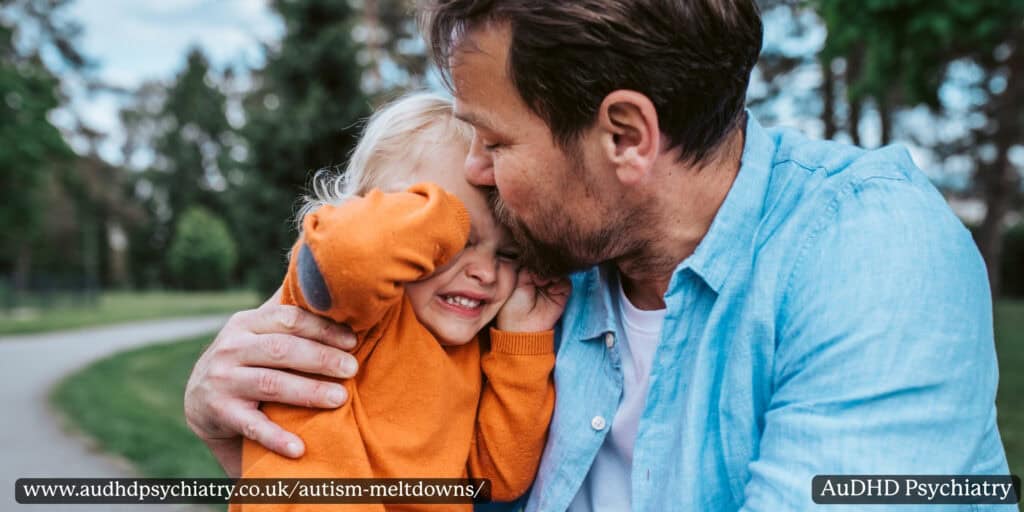
Many people find meltdowns and temper tantrums hard to tell apart, but they’re very different things [1]. The difference is the cause: a meltdown comes when someone is completely overwhelmed and loses control for a while [1]. Calling it a tantrum can leave a child, or an adult, feeling blamed for something outside their control. Shutdowns are even easier to miss, so the table sets them beside meltdowns.
| Response | What you might see |
|---|---|
| Meltdown | Outward: shouting, crying or lashing out [1] |
| Shutdown | Inward: going quiet and still, and pulling away [2] |
| Both | A response to too much at once [1] [2] |
If you’re not sure which one you’re seeing, treat it as overwhelm: less noise, fewer demands and more time.
What are the early signs of a meltdown?
Distress often shows before a meltdown, in a build-up some call the “rumble stage” [1]. Pacing, asking the same question again and again, rocking or going very still are all signs to watch for [1]. Stillness is easy to mistake for calm. Every person’s signs are different, so learning one person’s own pattern matters more than any list. At this stage, there may still be a chance to prevent a meltdown [1].
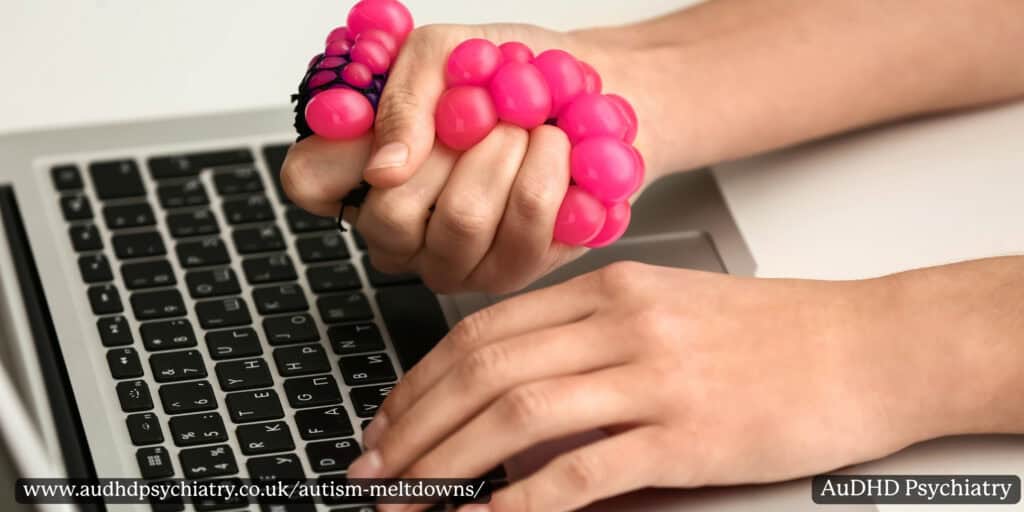
Try one of these while there’s still time [1]:
- a distraction, or a change of activity.
- something calming, such as a fiddle toy or music.
- taking away a likely trigger, if you can spot one.
- staying calm yourself.
What helps during a meltdown or shutdown?
Calm, space and fewer demands help most once a meltdown or shutdown has begun. These steps come from UK autism guidance [1] [4]:
- Don’t judge, and ask anyone nearby to move along rather than stare.
- Make it quieter: turn off music or the TV, dim bright lights and remove strong smells.
- If you can’t remove the triggers, move to a quieter place, such as another room or outside.
- Keep talking and information to a minimum, because the person may not be able to take in more.
- Calmly ask if they’re OK, then wait longer for an answer than you’d expect.
- Tell them they’re safe.
- Avoid touching them if they’re sensitive to touch, unless you know a kind of touch helps.
If someone is stimming to calm themselves, don’t stop them unless they’re hurting themselves [4]. If you’re the one who has meltdowns, you can agree these steps in advance with people you trust.
What helps after a meltdown or shutdown?
Give the person plenty of recovery time and space once it’s over [4]. Getting over sensory or information overload can take a while [1]. Talk about what happened later, when they’re ready, and let them lead.
A diary of what happened before, during and after each meltdown can show patterns over time [1]. You don’t need to write it in the moment, because a few notes once things are calm will do. Autistic fatigue and autistic burnout happen when pressures build until they lead to extreme exhaustion [5]. Time for interests that re-energise you, time off school or work, and unmasking can all help you recover [5].
How can you make meltdowns less likely?
Planning around known triggers can make meltdowns less likely [1]. The diary from the section above is the place to start, because it shows which times, places or events matter. Here are some changes to try for each kind of trigger [1]:
- Sensory: a low-arousal space, such as one with fewer bright lights, or ear defenders, tinted glasses or a weighted blanket.
- Routine: a clear visual explanation of any change, reassurance that the rest of the day stays the same, and timetables or countdown timers.
- Anxiety: a plan before you go out, such as a calming playlist, and relaxation time built into the day.
- Communication: visual supports, social stories, written information and short, clear sentences.
For children, keeping to familiar routines and telling them about changes as soon as you can also helps [3]. If sensory differences are constant and affect daily life, a sensory assessment by an occupational therapist is one option [4].
Meltdowns and shutdowns in autistic adults
Autistic adults have meltdowns and shutdowns too, though other people don’t always see them. Many autistic adults have learned to hide their signs, called autistic masking, which can make daily life exhausting [6]. If you were diagnosed late, or never, you may have spent years hiding these moments at work or at home.
The 2021 study noted that adults’ accounts give shutdowns more weight than the young people’s did [2]. Its authors asked whether autistic people learn over time to manage or avoid meltdowns, or swap them for shutdowns [2]. That’s still an open question.
At work, reasonable adjustments might include a quieter area, more home working, or choosing how you talk to colleagues [7]. Think about which of these would have helped on your hardest days. In England, Scotland and Wales, your employer must make reasonable adjustments if you need them [7]. The Access to Work scheme can fund extra support [7].
When could an assessment help?
At AuDHD Psychiatry, an assessment looks at your whole life, not at meltdowns alone.
An assessment may help if:
- meltdowns or shutdowns have happened for years, and nobody has ever explained them.
- you or your child show signs of autism, such as finding social contact hard or getting upset when routines change [6].
- you’ve wondered whether autism, ADHD or both are part of it.
It might not be right today if:
- you or someone else is in danger or needs urgent help now. Call NHS 111 and choose the mental health option, or in Northern Ireland call Lifeline free on 0808 808 8000, any time. In an emergency, call 999 or go to A&E [9].
- you want to know whether one meltdown means autism, because a single event can’t show that.
Support doesn’t wait for an assessment. Help can come from a GP or local autism team, or from your local council [8]. Your school, college or workplace, local support services and national charities can help too [8].
AuDHD Psychiatry assesses autism online, and you don’t need a GP referral. Our adult autism assessment is two appointments: the assessment, and an interview with someone who knows you well. If there’s no one who can take part, we can still assess you. Our child autism assessment takes three appointments. If you think ADHD is involved too, you can have ADHD and autism assessed together. You get an outcome letter the next day and the full report within two weeks.
To start smaller, try our free autism test, which is a screen rather than a diagnosis. Or book a free 15-minute call, an information call rather than an assessment.
Questions people ask
What does meltdown mean in autism?
A meltdown is an intense reaction to complete overwhelm, when the person loses control of their behaviour for a while [1]. The word describes what someone is going through in that moment. Used that way, it can help you explain to others what happened and what you needed.
How long does an autistic meltdown last?
There’s no set length, and it varies from person to person and from one meltdown to the next. Recovery can outlast the meltdown itself, because it takes time to recover from too much sensory input [1]. Plan for some quiet time afterwards, rather than expecting the person to carry on as before.
Can an autistic meltdown just be crying?
Yes, a meltdown can show as crying, because loss of control can come out in sounds as well as actions [1]. A meltdown doesn’t have to be loud or dramatic to be real. If someone goes quiet and withdrawn instead, it may be a shutdown, the more inward response described earlier on this page.
How is a shutdown different from burnout?
A shutdown happens in the moment, while burnout is extreme exhaustion that builds when pressures get too much [5]. The two can feel linked, especially when you’re already running low. Recovery time helps with both, so it’s worth protecting it whichever one you’re facing.
Are meltdowns a sign of autism?
Not on their own, because no single sign, a meltdown included, tells you whether someone is autistic. Autism shows up across many areas of life. For adults, the NHS lists signs such as taking things literally and struggling to read faces or tone of voice [6]. Only a full assessment can answer the question.
Can you stop a meltdown once it has started?
Often not, because once a meltdown is under way the aim is safety, quiet and time rather than stopping it. During the build-up, though, there may still be a chance to head it off [1]. That’s why learning someone’s early signs is worth the effort, for them and for you.
In short
Meltdowns and shutdowns are both reactions to too much, one loud and outward, the other quiet and inward. The build-up can often be spotted, which leaves room to step in early. In the moment, less noise and fewer demands help, and afterwards time matters most. If these moments are part of a lifelong pattern, an assessment with AuDHD Psychiatry is one way to understand it.
Related
Sources
- National Autistic Society, Meltdowns: a guide for all audiences, last reviewed 14 August 2020, https://www.autism.org.uk/advice-and-guidance/topics/behaviour/meltdowns/all-audiences (read 01/10/2026)
- Phung J, Penner M, Pirlot C, Welch C, “What I Wish You Knew: Insights on Burnout, Inertia, Meltdown, and Shutdown From Autistic Youth”, Frontiers in Psychology, 2021, doi 10.3389/fpsyg.2021.741421, https://pmc.ncbi.nlm.nih.gov/articles/PMC8595127/ (read 01/10/2026)
- NHS, Supporting an autistic child, page last reviewed 6 May 2026, https://www.nhs.uk/conditions/autism/supporting-a-child/ (read 01/10/2026)
- National Autistic Society, Autism and sensory processing, https://www.autism.org.uk/advice-and-guidance/about-autism/sensory-processing (read 01/10/2026)
- National Autistic Society, Autistic fatigue and burnout, last reviewed 20 August 2020, https://www.autism.org.uk/advice-and-guidance/mental-health/autistic-fatigue (read 01/10/2026)
- NHS, Signs of autism in adults, page last reviewed 6 May 2026, https://www.nhs.uk/conditions/autism/signs-in-adults/ (read 01/10/2026)
- NHS, Autism and adult life, page last reviewed 6 May 2026, https://www.nhs.uk/conditions/autism/adult-life/ (read 01/10/2026)
- NHS, Help and support for autistic people and their families, page last reviewed 6 May 2026, https://www.nhs.uk/conditions/autism/support/ (read 01/10/2026)
- nidirect, Mental health emergency: if you’re in crisis or despair, https://www.nidirect.gov.uk/articles/mental-health-emergency-if-youre-crisis-or-despair (read 01/10/2026)
About AuDHD Psychiatry
AuDHD Psychiatry is the trading name of ADHDdegree Ltd, a company registered in Scotland. The company number is SC822923. Our registered office is 3f1 Third Floor, Hill Street, Edinburgh, EH2 3JP.
Registered with the ICO, number ZB823033.
Last updated: 13 October 2026
Where to go from here
A private online screening for autism traits, with your results at the end. No commitment.
Take the free testA free, no-obligation call with our team to ask questions and find the right assessment for you.
Book a free callDarren is a Chartered Psychologist and specialist in ADHD and autism, with over 11 years of experience working in mental health and neurodevelopmental services. He holds a Doctorate in Counselling Psychology and has presented research at the British Psychological Society Annual Conference.
Read Darren’s full profileThis article is for general information and does not replace a clinical assessment. If you are struggling with your mental health right now, please contact your GP or NHS 111.