

Apps for focus and concentration with ADHD: what works

Reviewed by Dr Darren O’Reilly, Chartered Psychologist and Clinical Director
Review and publication details
Clinically reviewed by Dr Darren O’Reilly, DPsych, Chartered Psychologist (CPsychol), HCPC registered practitioner psychologist, registration number PYL041661 (check the HCPC register).
AuDHD Psychiatry is the trading name of ADHDdegree Ltd, a company registered in Scotland, company number SC822923. Registered office: 3f1 Third Floor, Hill Street, Edinburgh, EH2 3JP. Registered with the ICO, number ZB823033.
In this article
Page summary
Apps for focus and concentration suit ADHD when each one does a single, clear job. A timer, a planner or a way to work alongside someone can hold structure outside your head. Body doubling means doing your own task while another person works nearby, in person or online. A simple routine you keep up can matter as much as the app itself, because novelty fades. Research on ADHD apps is still limited, and these tools sit alongside treatment, not instead of it. AuDHD Psychiatry offers online ADHD assessments for adults in the UK.
If your phone holds a row of planners you each tried for about a week, you’re in very good company. That pattern isn’t a character flaw, and it doesn’t mean you’re lazy. Dr Darren O’Reilly, who reviewed this guide, has ADHD and autism himself. An ADHD mind often needs structure that lives outside the head, and the trick is matching one tool to one problem.
At a glance
- Structure outside your head: NICE lists fewer distractions and short spells of focus with movement breaks among the first changes to try with ADHD [1].
- The research: Reviews of ADHD apps and games report some benefits, but most of that evidence is low quality [3].
- Your phone: iPhones and some Android phones have built-in settings that silence notifications or limit time in apps [4][5].
Why do tools help with focus when you have ADHD?
Tools help by taking over jobs an ADHD mind finds hard to do alone. A timer does the starting, a list does the remembering, and a person nearby does the nudging. NICE guidance describes changes to your surroundings that reduce the impact of ADHD, such as cutting distractions with headphones [1]. Some people play music or brown noise, a low, steady sound, through them. Its examples also include short bursts of concentration with movement breaks, and spoken instructions backed up in writing. Adults are offered medication if symptoms still cause significant problems after those changes are tried and reviewed [1]. So outside structure is an early step, not a lesser one. Needing a timer says something about how ADHD works, not about how hard you try.
Which timers and focus apps can help?
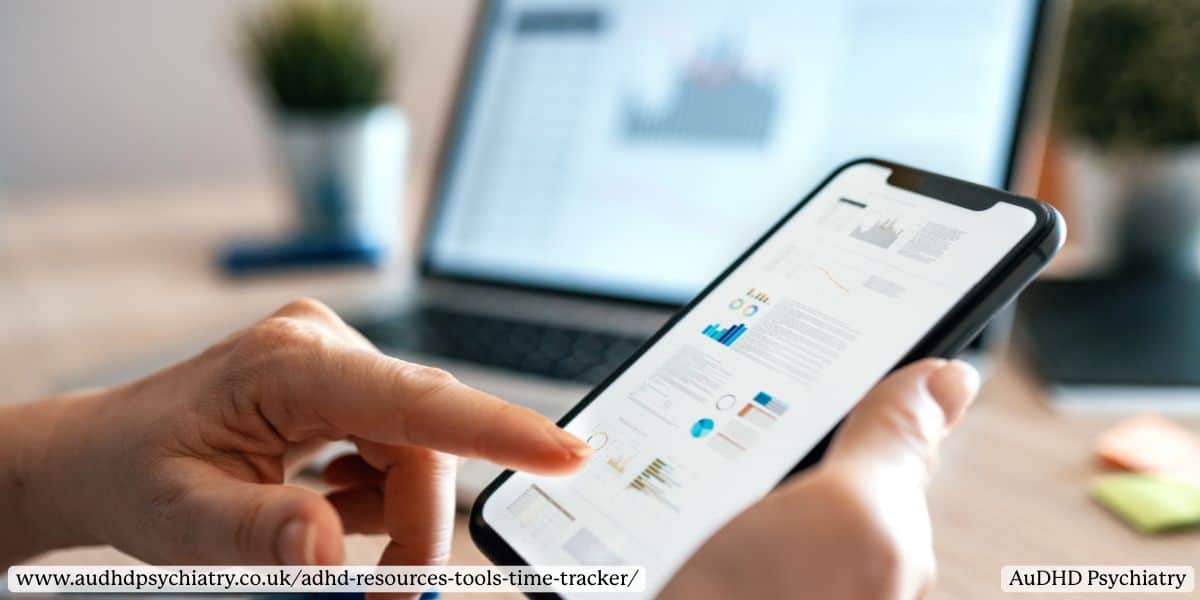
Every app we name here is an example of its kind, not a recommendation. AuDHD Psychiatry doesn’t make or sell any of them. A timer that runs short work blocks, as the Pomodoro Technique does, is the simplest place to start. A visual timer, with a countdown you can see, makes a short spell of focus feel finite. Forest, for example, grows a virtual tree while you stay off your phone, and it can block chosen apps [6]. For mood and stress rather than focus, our guide to the best apps for mental health covers a different set.
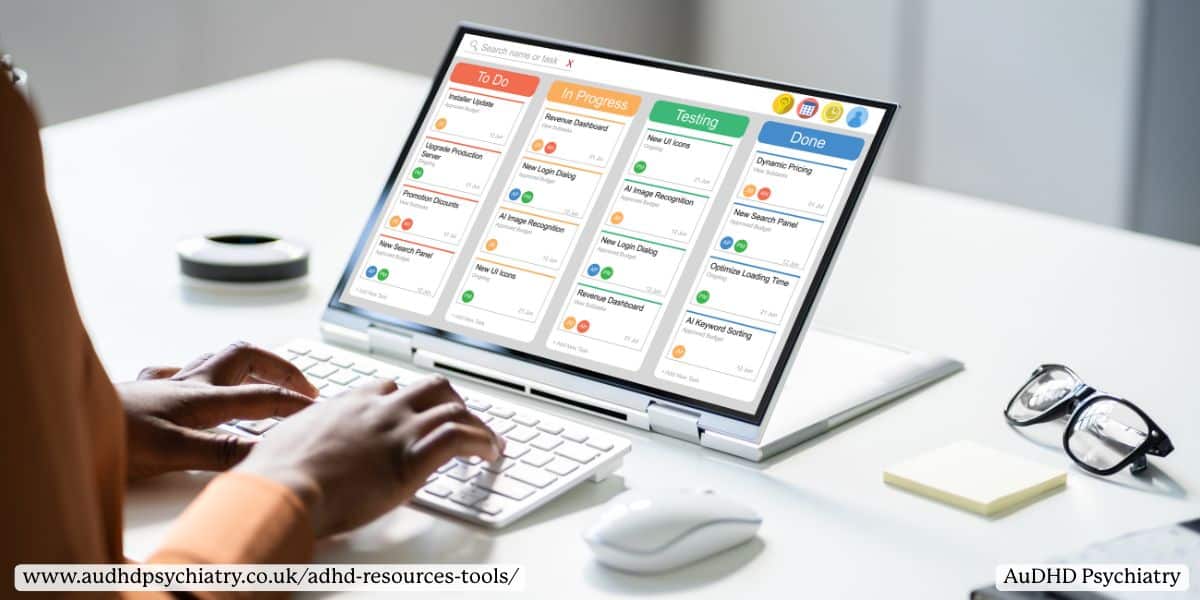
Your phone’s own settings can cover much of the same ground. On an iPhone, a Focus holds back notifications and can run on a schedule [4]. Digital Wellbeing, on some Android phones, can set a daily time limit for each app [5]. A timer can also mark when a long session should end, if ADHD hyperfocus tends to swallow your afternoon.
What is body doubling, and where can you try it?
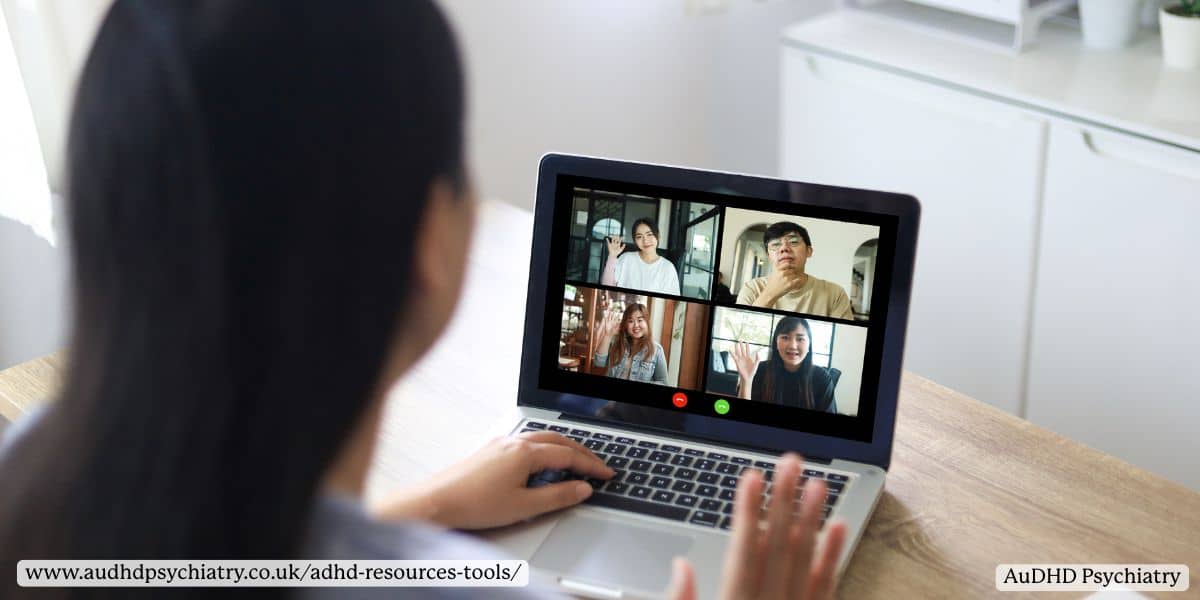
Body doubling is working on your task while someone else is present [7]. The other person isn’t part of your task, and they can be in the room or on video. Offline, you can sit with a friend at the same table, or use a library or shared office. Focusmate is one online option: it pairs you with another member for a session on camera [7]. Focusmate has a free level, so check its own page for the current limits [7].
Could this be part of your story?
Try Our Free ADHD Test Book a Screening CallOur specialist clinicians are here to help you understand yourself better.
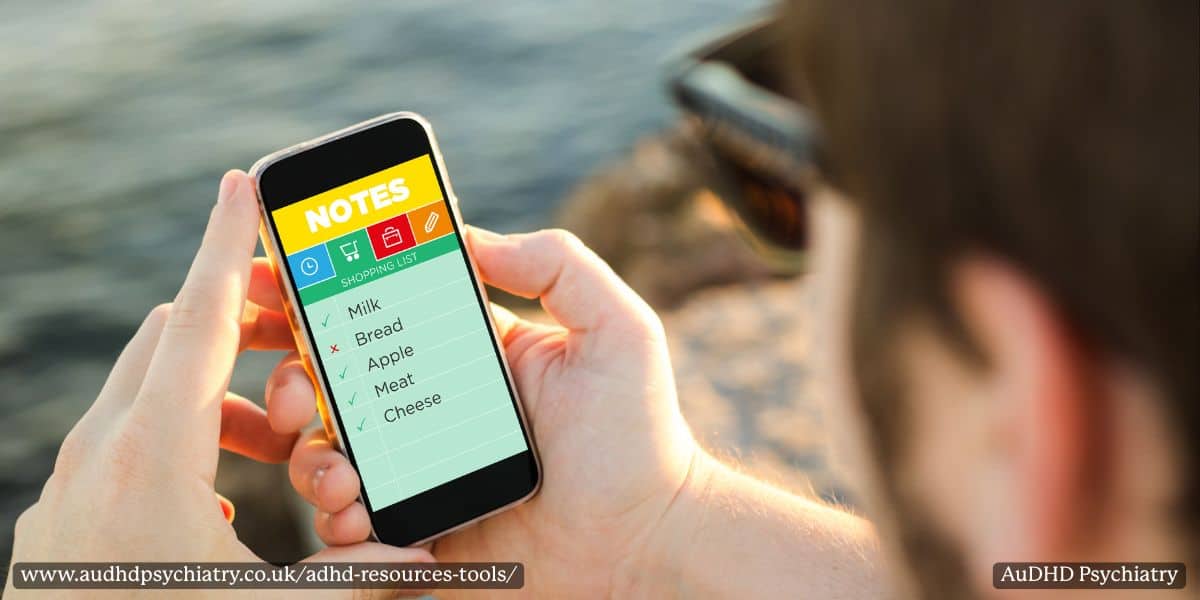
Most of what’s written about body doubling comes from people’s own experience. It hasn’t been properly tested in research yet, so treat it as an experiment, not a treatment. Some people use a body double to get going when ADHD task paralysis sets in.
Which task tools suit an ADHD mind?
A task tool suits an ADHD mind when it’s simple enough to check daily. Tiimo is a visual planner, and its maker says it was built by and for neurodivergent people [8]. The goblin.tools collection is a set of small, single-task tools, mostly designed to help neurodivergent people with tasks they find overwhelming [9].
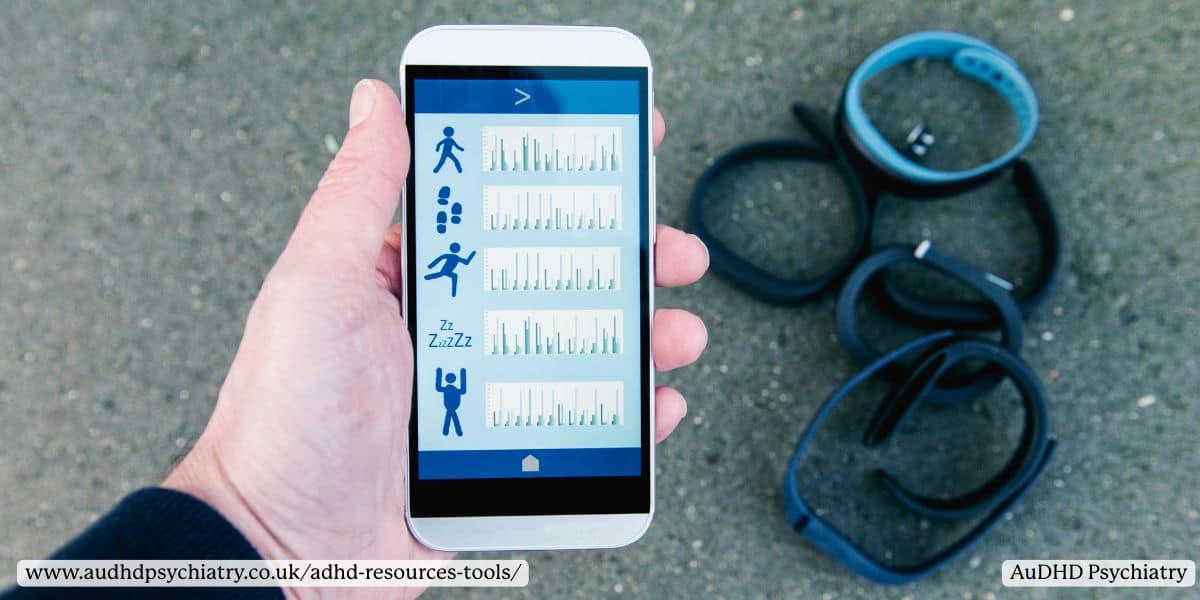
One place for tasks beats three, because a list you can’t find can’t remind you. A plain planner you check beats a clever one you don’t. Paper counts too, if a notebook by the kettle is where your eyes land each morning. If you’d like help choosing one, our guide to picking an ADHD planner goes further. Whatever you choose, set it up in one sitting, so it’s ready the first time you need it.
How do you make a focus tool stick?
A timer or planner sticks when it’s tied to a routine, not willpower. Pick one tool for one job, and put it where you’ll see it. Time blocking, giving each task its own slot in your day, puts the plan where you can see it too. One way in is habit stacking for ADHD, which ties a new habit to one you already have. Starting a timer as the kettle boils is a simple example.
The rest of your day matters as well. The NHS suggests a regular bedtime and a quiet, dark bedroom, because sleep matters with ADHD [10]. Its advice also covers avoiding screens, caffeine and alcohol close to bedtime [10]. Exercise can ease anxiety and low mood [10]. Both can make ADHD symptoms worse. Expect the novelty of any new app to fade, and swap it for another rather than giving up.
Can ADHD podcasts help?
ADHD podcasts can help you learn, but they aren’t a treatment. Hearing other adults describe the same struggles can make your own feel less strange. Listening while you walk or cook also suits people who find long articles hard to finish. Choose shows whose hosts say plainly what their background is: a coach, a clinician or someone sharing their own experience. Try one idea from an episode at a time, then check whether it changed anything for you. Many popular shows are made in the US, so advice about services, medicine or rights may not match the UK. A podcast can’t assess you, and it can’t tell you which treatment suits you.
What does the research say about ADHD apps?
The evidence here is thin, and most of it involves children. A 2025 review of 26 earlier reviews covered more than 34,000 people, most of them children and young people [3]. Apps, games and brain training showed some benefits for attention and organisation, but the evidence was generally low quality [3]. In plain terms, whether they help with ADHD is still an open question.
Side effects were reported in 8 of the 26 reviews, including discomfort, emotional reactions and, with video games, problem use [3]. A 2018 review of studies in children and young people found potential, but the studies were small and not robust [11]. An app can help you day to day, but no app has been shown to treat ADHD [3].
When are tools not enough?
When tools aren’t enough, treatment, coaching and support at work come next. Adults can be offered a structured psychological treatment focused on ADHD, which can include CBT (cognitive behavioural therapy) [1]. A prescriber decides on ADHD medication after a full assessment.
ADHD coaching is practical support for the same daily problems a planner tackles, with a person beside you. You don’t need a diagnosis to start coaching. We accept Access to Work funding and insurance for coaching.
At work, an Access to Work grant can help pay for specialist equipment and assistive software [2]. Our ADHD benefits guide covers the rest of the support you can apply for.
Could it be ADHD, and when should you seek an assessment?
An assessment makes sense when the same problems keep returning, whatever you try.
An ADHD assessment is worth considering if:
- you’ve struggled with focus, organisation or restlessness since childhood.
- a new planner or timer helps for a week, then stops helping.
- the same problems show up at work, at home and with people.
It might not be right today if:
- you need urgent help now. Call NHS 111 and choose the mental health option, or in Northern Ireland call Lifeline free on 0808 808 8000, any time. In an emergency, call 999 or go to A&E [12].
- you’re under 18, when a child assessment applies.
When apps keep letting you down, an assessment can show whether ADHD is behind it. AuDHD Psychiatry offers a private ADHD assessment for adults online, in one appointment, for people living in the UK. You don’t need a GP referral. If you’re not ready to book, the free ADHD test is a quick screen, though it can’t diagnose you. A free 15-minute call lets you ask us questions first.
Questions people ask
What is the best app for focus with ADHD?
There isn’t one best app, because the research is still too thin to name one [3]. Choose by the job instead: a timer to get started, a planner to remember, or a room to work alongside someone. Try one at a time, so you can tell whether it’s helping. If it isn’t, swap it for a different kind of tool rather than a fancier version of the same one.
What is body doubling?
Body doubling is doing your own task while someone else is present, working on theirs [7]. The other person doesn’t help with your task. They’re simply there, doing their own. It can be a friend at the same table, a quiet library or an online room with a stranger on camera. You choose the task and the setting.
Are there free focus apps for ADHD?
Yes: your phone’s own notification and screen-time settings come with it, so they’re a free place to start. Some apps also have a free level. Their terms change, so check the maker’s own page before you rely on one. A free option you actually open each day will do more than a paid one you forget.
Can an app replace ADHD treatment?
No: a timer or planner can help day to day, but no app has been shown to treat ADHD [3]. If tools aren’t enough, a clinician can talk through treatment with you. For adults, treatment can include a structured psychological treatment focused on ADHD, with regular follow-up [1]. An app can still sit alongside it.
Can I get help paying for ADHD tools at work?
Yes, an Access to Work grant can help pay for specialist equipment and assistive software [2]. You don’t pay it back, and it doesn’t affect any other benefits. Your workplace can include your home, if that’s where you do your job [2]. Access to Work covers England, Scotland and Wales, and Northern Ireland has a different system [13]. Our guide to benefits and rights explains who can apply.
Does body doubling work for ADHD?
Many people with ADHD say working alongside someone helps them start and keep going, but it hasn’t been properly tested in research. It costs little to try, in person with a friend or online. If it helps, keep it. If it doesn’t, you’ve lost very little, and you’ve learned something about what suits you.
In short
Outside structure helps an ADHD mind, and one tool for one job usually beats a stack of apps. Body doubling, a timer or a plain planner can each carry part of the load. The research is still limited, so treat any app as a helper, not a treatment. When that isn’t enough, treatment and coaching are there, and neither asks you to have failed first. If your apps keep running out of steam, an assessment with AuDHD Psychiatry is a sensible next step to consider.
Related
- ADHD burnout
- ADHD and intrusive thoughts
- our clinical team
- The Best ADHD Tools for Remembering Daily Tasks (That Aren’t Just Alarms)
Sources
- National Institute for Health and Care Excellence (NICE). Attention deficit hyperactivity disorder: diagnosis and management, guideline NG87. Published 14/03/2018, last updated 13/09/2019. Read 30/09/2026. https://www.nice.org.uk/guidance/ng87
- GOV.UK. Access to Work: get support if you have a disability or health condition. Read 30/09/2026. https://www.gov.uk/access-to-work
- Gabarron E, Denecke K, Lopez-Campos G. Evaluating the evidence: a systematic review of reviews of the effectiveness and safety of digital interventions for ADHD. BMC Psychiatry, 04/2025, 25(1):414. https://pubmed.ncbi.nlm.nih.gov/40264083/
- Apple Support (UK). Turn on or schedule a Focus on iPhone. Read 30/09/2026. https://support.apple.com/en-gb/guide/iphone/iph5c3f5b77b/ios
- Android Help. Manage how you spend time on your Android phone with Digital Wellbeing. Read 30/09/2026. https://support.google.com/android/answer/9346420?hl=en-GB
- Forest. What is Forest? Read 30/09/2026. https://www.forestapp.cc/
- Focusmate. Frequently asked questions. Read 30/09/2026. https://www.focusmate.com/faq/
- Tiimo. Home page. Read 30/09/2026. https://www.tiimoapp.com/
- goblin.tools. About. Read 30/09/2026. https://goblin.tools/About
- NHS. ADHD in adults. Page last reviewed 19/03/2025. Read 30/09/2026. https://www.nhs.uk/conditions/adhd-adults/
- Powell L, Parker J, Harpin V. What is the level of evidence for the use of currently available technologies in facilitating the self-management of difficulties associated with ADHD in children and young people? A systematic review. European Child and Adolescent Psychiatry, 11/2018, 27(11):1391-1412. https://pubmed.ncbi.nlm.nih.gov/29222634/
- nidirect. Mental health emergency: if you’re in crisis or despair. Read 29/09/2026. https://www.nidirect.gov.uk/articles/mental-health-emergency-if-youre-crisis-or-despair
- GOV.UK. Access to Work: eligibility. Read 30/09/2026. https://www.gov.uk/access-to-work/eligibility
About AuDHD Psychiatry
AuDHD Psychiatry is the trading name of ADHDdegree Ltd, a company registered in Scotland. The company number is SC822923. Our registered office is 3f1 Third Floor, Hill Street, Edinburgh, EH2 3JP.
Registered with the ICO, number ZB823033.
Last updated: 13 October 2026
Where to go from here
A private online screening for ADHD traits, with your results at the end. No commitment.
Take the free testA free, no-obligation call with our team to ask questions and find the right assessment for you.
Book a free callDarren is a Chartered Psychologist and specialist in ADHD and autism, with over 11 years of experience working in mental health and neurodevelopmental services. He holds a Doctorate in Counselling Psychology and has presented research at the British Psychological Society Annual Conference.
Read Darren’s full profileThis article is for general information and does not replace a clinical assessment. If you are struggling with your mental health right now, please contact your GP or NHS 111.