

What is ADD? ADD vs ADHD, and what it means today

Reviewed by Dr Darren O’Reilly, Chartered Psychologist and Clinical Director
Review and publication details
Clinically reviewed by Dr Darren O’Reilly, DPsych, Chartered Psychologist (CPsychol), HCPC registered practitioner psychologist, registration number PYL041661 (check the HCPC register).
AuDHD Psychiatry is the trading name of ADHDdegree Ltd, a company registered in Scotland, company number SC822923. Registered office: 3f1 Third Floor, Hill Street, Edinburgh, EH2 3JP. Registered with the ICO, number ZB823033.
In this article
Page summary
ADD, or attention deficit disorder, is the older name for ADHD without obvious hyperactivity. The name changed in the late 1980s, and the condition has been called ADHD since. Today the same picture is diagnosed as ADHD, predominantly inattentive presentation. An old ADD diagnosis isn’t wrong, and it still matters as part of your history. ADD and ADHD differ in name, and in whether hyperactivity is part of the picture. AuDHD Psychiatry assesses adults for ADHD online, across the UK.
Maybe a teacher or a doctor said “ADD” years ago, and nobody ever updated the word. Or a parent still uses it about you, and you’re not sure whether it still counts. The name has changed since then, and the condition behind it hasn’t.
At a glance
- What ADD stands for: attention deficit disorder.
- When the name changed: in the 1987 revision of the American diagnostic manual, ADD became ADHD.
- ADD today: diagnosed as ADHD, predominantly inattentive presentation.
- An old ADD diagnosis: still worth mentioning to a clinician.
What does ADD mean?
ADD is the older name for the condition now called ADHD. The letters stand for attention deficit disorder (ADD), and the name dates from 1980. That year the American Psychiatric Association published DSM-III, the third edition of its diagnostic manual [1]. It named the condition “attention deficit disorder (ADD), with or without hyperactivity” [1].

The last four words were the change that mattered. Until then, hyperactivity had been central to the diagnosis [1]. DSM-III took the position that it was no longer essential [1]. So a child who lost track of instructions, but sat quietly, could be diagnosed too. That’s still the gap the word ADD points to: trouble with attention, without the obvious restlessness.
Why did ADD become ADHD?
ADD became ADHD in 1987, seven years after the name first appeared. The revised manual, DSM-III-R, removed the two subtypes and renamed the condition attention deficit hyperactivity disorder [1]. Hyperactivity moved into the title, and the “with or without” split went. Then in 1994 the next edition, DSM-IV, brought a split back in a new form: three subtypes of ADHD [1].
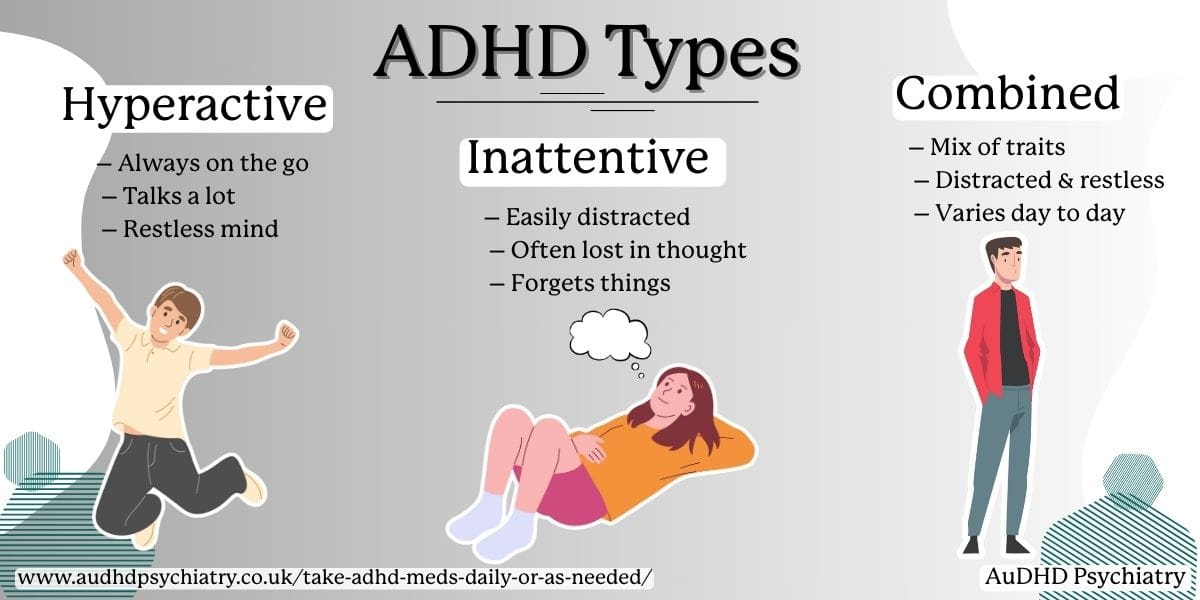
Today’s manual, DSM-5, calls them presentations rather than subtypes [2]. The three are predominantly inattentive, predominantly hyperactive-impulsive and combined [2]. Each one is ADHD, so there’s no longer a separate word for the quieter form.
Despite updates in medical terminology, many people, especially adults diagnosed decades ago, continue to use the term ADD. Parents and partners often use it too, because it’s the word they were given at the time. Older books and websites keep it in circulation as well. None of that makes the word wrong, only out of date.
What is the difference between ADD and ADHD?
The difference between ADD and ADHD is the name, not a separate condition. ADD maps most closely to the predominantly inattentive presentation of ADHD [2]. Most people with ADHD have signs of both inattention and hyperactivity and impulsivity, and some show only one [3]. The old name picked out that second group, and the new name covers everyone.
The table sets the old label against today’s diagnosis.
| ADD (older name) | ADHD today | |
|---|---|---|
| The name | Attention deficit disorder [1] | Attention deficit hyperactivity disorder [1] |
| Is hyperactivity part of it? | Not required: the label allowed ADD without it [1] | Not always: one presentation is mainly inattentive [2] |
| How is it diagnosed today? | It isn’t: today’s manuals don’t list it [2] | As ADHD, with the presentation named [2] |
Both columns describe the same people, and only the paperwork has changed. Our page on the three types of ADHD explains how a clinician decides which presentation fits. If the quieter picture sounds like you, inattentive ADHD today covers how it shows in adults.
Does an old ADD diagnosis still count?
An old ADD diagnosis still counts, and a clinician today would call it ADHD. The condition hasn’t changed. The label has. If you were assessed as a child and told you had ADD, bring that history with you. Symptoms of ADHD usually start before the age of 12 [3], so a childhood diagnosis shows the pattern was there early. Old letters and school reports help a new assessment for the same reason.

A new diagnosis today follows set criteria. NICE guidance says symptoms should cause at least moderate impairment in two or more important settings [4]. That judgement comes after a full clinical assessment [4]. Our guide to how ADHD is diagnosed now walks through each step. Treatment, including ADHD medication, follows today’s ADHD diagnosis, and your prescriber decides what suits you.
When is it worth looking into an ADHD assessment?
An assessment is worth a look when attention problems still get in the way.
An assessment may help if:
- Your attention difficulties go back to childhood.
- They still affect your work, study or home life.
- You’re 18 or over.
It might not be right today if:
- You need urgent help now. Call NHS 111 and choose the mental health option, or in Northern Ireland call Lifeline free on 0808 808 8000, any time. In an emergency, call 999 or go to A&E [5].
At AuDHD Psychiatry, the adult ADHD assessment is one online appointment, and you don’t need a GP referral. You’ll have an outcome letter the next day and the full report within two weeks. Dr Darren O’Reilly has ADHD and autism himself. Our clinicians assess adults living anywhere in the UK. To start small, take the free ADHD test, which doesn’t diagnose, or book a free 15-minute call to talk it through.
Questions people ask
What does ADD stand for?
ADD stands for attention deficit disorder, and ADHD stands for attention deficit hyperactivity disorder. The newer name added “hyperactivity” to the title when the manual was revised. You’ll also see it written as A.D.D., and some people say “ADD disorder”, which repeats the last word. The meaning is the same in each case. Whatever the spelling, the condition a clinician assesses for today is ADHD.
Is ADD still a diagnosis?
Today’s diagnostic manuals don’t list ADD as a diagnosis. They diagnose ADHD and describe a predominantly inattentive presentation instead [2]. So a clinician who assesses you now writes ADHD on the report, with the presentation named. At AuDHD Psychiatry, that’s the wording you’d see in your report too. If a GP or employer asks which word to use, ADHD is the one they’ll recognise.
Can adults have ADD?
Yes, in the sense that adults can have ADHD with mainly attention difficulties. The signs start in childhood, usually before the age of 12 [3], even when nobody named them at the time. Many adults only hear the word ADD from a parent, years later. What people call ADD in adults is assessed today as adult ADHD.
Is ADD different in women?
The NHS says ADHD is recognised less often in women than in men [3]. One likely reason is that women more often have inattentive symptoms, which are harder to notice [3]. The condition itself isn’t different, but the route to a diagnosis often is. Our guide to ADD in women covers the signs that get missed and why.
Is ADD the same as ADHD without hyperactivity?
Very nearly: the 1980 manual allowed ADD with or without hyperactivity [1], so the label never ruled it out. Today, though, people who say ADD almost always mean the quieter form. The closest match for that in current terms is the predominantly inattentive presentation of ADHD. So “ADD” and “ADHD without hyperactivity” point at the same group of people, under two different names.
In short
ADD was the name, and ADHD is the name now. The condition behind both is the same, so an old ADD diagnosis is useful history rather than a mistake. If attention has been hard since childhood and still is, an assessment can give you a current answer. AuDHD Psychiatry assesses adults online, and the first step can be as small as a phone call.
Related
Sources
- Lange KW, Reichl S, Lange KM and others. The history of attention deficit hyperactivity disorder. ADHD Attention Deficit and Hyperactivity Disorders, December 2010, 2(4):241-255. https://pmc.ncbi.nlm.nih.gov/articles/PMC3000907/
- American Psychiatric Association. What is ADHD? Physician review October 2025. https://www.psychiatry.org/patients-families/adhd/what-is-adhd
- NHS. ADHD in adults. Page last reviewed 19 March 2025. https://www.nhs.uk/conditions/adhd-adults/
- National Institute for Health and Care Excellence (NICE). Attention deficit hyperactivity disorder: diagnosis and management, guideline NG87. Published 14 March 2018, last updated 13 September 2019. https://www.nice.org.uk/guidance/ng87
- nidirect. Mental health emergency: if you’re in crisis or despair. Read 01/10/2026. https://www.nidirect.gov.uk/articles/mental-health-emergency-if-youre-crisis-or-despair
About AuDHD Psychiatry
AuDHD Psychiatry is the trading name of ADHDdegree Ltd, a company registered in Scotland. The company number is SC822923. Our registered office is 3f1 Third Floor, Hill Street, Edinburgh, EH2 3JP.
Registered with the ICO, number ZB823033.
Last updated: 13 October 2026
Where to go from here
A private online screening for ADHD traits, with your results at the end. No commitment.
Take the free testA free, no-obligation call with our team to ask questions and find the right assessment for you.
Book a free callDarren is a Chartered Psychologist and specialist in ADHD and autism, with over 11 years of experience working in mental health and neurodevelopmental services. He holds a Doctorate in Counselling Psychology and has presented research at the British Psychological Society Annual Conference.
Read Darren’s full profileThis article is for general information and does not replace a clinical assessment. If you are struggling with your mental health right now, please contact your GP or NHS 111.