


ADHD and addiction: why the risk is higher, and what helps

Reviewed by Dr Darren O’Reilly, Chartered Psychologist and Clinical Director
Review and publication details
Clinically reviewed by Dr Darren O’Reilly, DPsych, Chartered Psychologist (CPsychol), HCPC registered practitioner psychologist, registration number PYL041661 (check the HCPC register).
AuDHD Psychiatry is the trading name of ADHDdegree Ltd, a company registered in Scotland, company number SC822923. Registered office: 3f1 Third Floor, Hill Street, Edinburgh, EH2 3JP. Registered with the ICO, number ZB823033.
In this article
Page summary
ADHD and addiction are linked: people with ADHD more often have alcohol, drug or nicotine problems. Acting on impulse and self-medicating are two likely reasons, though research hasn’t proven the cause. Long-term studies back the link, but most followed children, so less is known about adults. Doctors check the risk of misuse before prescribing ADHD medication, and prescribers keep checking afterwards. UK helplines for alcohol, drugs and gambling give support, to you and to worried family members. An ADHD assessment makes sense when traits go back to childhood, and AuDHD Psychiatry assesses adults online.
A lot of people drink or use drugs to switch off a restless mind, or just to get through the day. Many of them have never been told that ADHD might be part of the picture. That isn’t weakness, and it isn’t a lack of willpower. Our founder, Dr Darren O’Reilly, has ADHD and autism himself, and nobody here will judge you. Putting a name to what’s going on can be a first small step.
At a glance
- The link: children with ADHD are more likely than other children to go on to have alcohol, nicotine and drug problems [1].
- In treatment services: almost one in four people with a substance use problem also meets the criteria for ADHD [2].
- Medication: a review of 15 long-term studies found childhood stimulant treatment neither raised nor lowered later substance problems [3].
- Before prescribing: NICE guidance says the checks before ADHD medication include the risk of misuse [4].
- Help any time: FRANK, the national drugs helpline, answers on 0300 123 6600, 24 hours a day [5].
Is there a link between ADHD and addiction?
ADHD and addiction are linked, and long-term studies of children back this up. One 2011 review pooled studies that followed children with and without ADHD into their teens or adult life. Those with ADHD were more likely to develop problems with a wide range of substances. The higher risk held for boys and girls, at different ages, and however the study was run [1]. It works the other way round too: ADHD is more common in people with a history of substance misuse [4]. So after an ADHD diagnosis, your clinician should talk with you about the risk of misuse and self-medication [4].
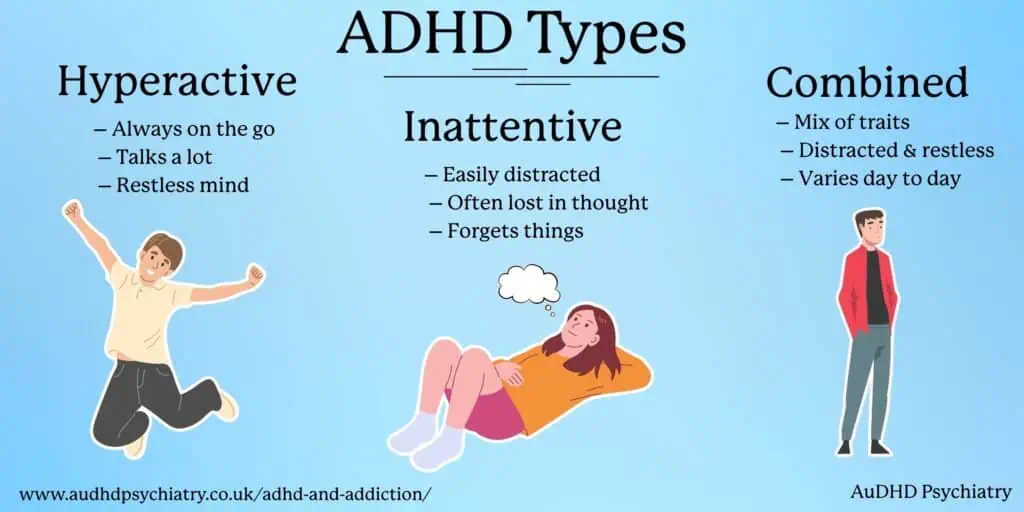
A connection isn’t the same as a cause, though. Most of this evidence comes from studies that followed children, so it says less about adults diagnosed later.
Why does ADHD raise the risk of addiction?
Acting on impulse and self-medication are two likely reasons, and NICE guidance names both as risks to discuss [4]. Acting on impulse can mean saying yes to one more drink before you’ve thought it through. Self-medication means using alcohol, cannabis or other drugs to calm restlessness, quiet a busy mind or get to sleep. For some people, it’s a drink to switch off after a day of holding everything together.
Some children in these studies also had serious behaviour problems, which doctors call conduct problems [1]. That makes it harder to say how much of the risk comes from ADHD itself. Our guide on how ADHD affects the brain covers the biology, and ADHD and emotional dysregulation covers the feelings side.
What does the research show about ADHD and addiction?
The research shows a real but uneven link, clearest for alcohol and nicotine. Two reviews supply the main figures:
- A second 2011 review, of 13 long-term studies, tied childhood ADHD to alcohol use disorder by young adulthood [6]. It also tied ADHD to nicotine use by the middle teenage years, and these two findings held up best [6]. The finding for other drug disorders leaned heavily on a single study, so it’s less certain [6].
- A 2012 review of 29 studies looked at how common ADHD is among people with a substance use disorder [2]. Its figures changed a lot depending on the substance and on how ADHD was assessed [2].
Which substances and behaviours are linked with ADHD?
Alcohol, drugs, nicotine and gambling all show a link with ADHD in research:
- Alcohol: childhood ADHD is tied to alcohol problems by early adult life [6].
- Drugs: children with ADHD are more likely to develop cannabis (weed or marijuana), cocaine and other drug problems later on [1].
- Nicotine: ADHD in childhood goes with nicotine use by the middle teenage years [6].
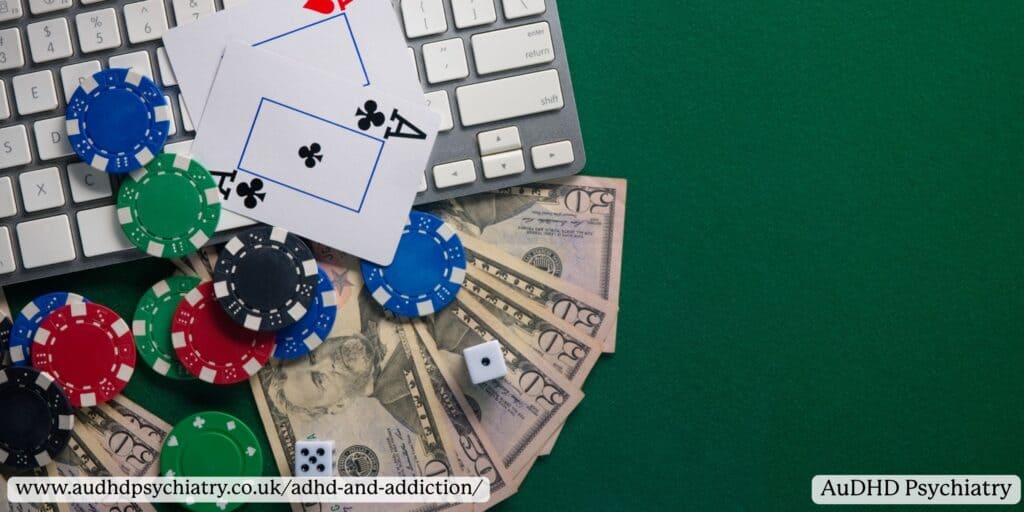
- Gambling: a 2019 review found a small but real link between ADHD symptoms and how severe gambling problems become [7]. The review saw a hint that the link grows with age, but it wasn’t a firm finding [7].
Autistic people with ADHD, sometimes called AuDHD, face a higher risk again. A 2017 Swedish register study followed 26,986 autistic people and compared them with the general population [19]. Autism on its own doubled the risk of substance use problems, alcohol problems included [19]. The risk was highest in autistic people who also had ADHD [19]. If that’s you, tell your GP or prescriber about your drinking as well as your diagnoses.
Screen time is a different question, because a screen isn’t a substance. A 2018 US study followed 2,587 teenagers with no significant ADHD symptoms for two years [20]. Teenagers who used more kinds of digital media many times a day were more likely to report ADHD symptoms later [20]. The researchers called the link modest and couldn’t say whether screens caused it [20].
Does ADHD medication raise or lower the risk of addiction?
Long-term studies find childhood stimulant treatment doesn’t raise the risk of addiction [3]. A 2013 review of 15 of those studies found it didn’t lower the risk either [3]. A large US records study of almost 3 million people with ADHD found fewer substance-related emergency visits while on medication [8]. That records study shows an association, not proof that medication protects. Atomoxetine isn’t a stimulant, and its patient leaflet says it isn’t addictive [9].
Stimulant medication such as methylphenidate is thought to raise dopamine and noradrenaline, two chemical messengers in the brain [10]. Stimulants can be misused or passed to someone else, so prescribers check for both before and during treatment [4]. If you’ve had problems with alcohol or drugs, the dose usually rises more slowly, with more check-ins [4]. The NHS says methylphenidate is unlikely to cause problems if you take it as prescribed [10]. The risk may rise if you take it more often, or at a higher dose, than prescribed [10]. Your prescriber decides which medicine, if any, is right for you. Our ADHD medication guide explains the options.
Where can you get support for addiction in the UK?
If you’re struggling right now, call Samaritans free on 116 123, day or night, from any phone [11]. Call NHS 111 and choose the mental health option, or in Northern Ireland call Lifeline free on 0808 808 8000, any time. In an emergency, call 999 or go to A&E [12].
A GP is a good place to start, whether the problem is drinking, drugs or gambling [13][14][15]. If you’d rather not see a GP, you can contact your local drug treatment service yourself [13]. These routes cover you and the people close to you:
| Who | What for | How to reach them |
|---|---|---|
| FRANK, the national drugs helpline | Drugs | 0300 123 6600, 24 hours a day, 7 days a week, or by text and email, with interpreters in 120 languages [5] |
| Drinkline, in England | Your own or someone else’s drinking | Free and confidential on 0300 123 1110, weekdays 9am to 8pm, weekends 11am to 4pm [14] |
| Drinkline Scotland, run by WithYou | Your own or someone else’s drinking, in Scotland | Free on 0800 731 4314, weekdays 9am to 9pm, weekends 10am to 4pm [16] |
| DAN 24/7, the Wales drug and alcohol helpline | Drugs and alcohol, in Wales | Free on 0808 808 2234, any time, in English or Welsh [17] |
| Local drug and alcohol services, in Northern Ireland | Drugs and alcohol, in Northern Ireland | nidirect lists support services near you [18] |
| National Gambling Helpline, run by GamCare | Gambling | Free on 0808 8020 133, 24 hours a day, 7 days a week [15] |
| NHS gambling clinics | Gambling | Refer yourself, in England [15] |
| Alcoholics Anonymous, Narcotics Anonymous, SMART Recovery | Support groups | Local and online meetings [13][14] |
| Nacoa | Children of parents who drink | 0800 358 3456 [14] |
| Carers Trust | People caring for someone with alcohol or drug problems | Local carer services [14] |
Some people need a short stay in a medically supported unit to come off alcohol safely [14]. Stopping suddenly after heavy drinking can be harmful, so get advice from a GP or alcohol service first [14]. Call 999 for severe withdrawal signs, such as hallucinations, severe tremors or fits [14].
ADHD support can sit alongside addiction support, but it doesn’t replace it. At AuDHD Psychiatry, ADHD coaching doesn’t need a diagnosis.
Could it be ADHD, and when should you seek an assessment?
An ADHD assessment makes sense when your traits started in childhood.
An ADHD assessment may help if:
- focus, restlessness or acting on impulse have followed you since childhood, not only when drinking.
- you drink or use drugs to calm a busy mind or to sleep.
- you’re in recovery and the same patterns keep coming back.
It might not be right today if:
- you need urgent help now. Call NHS 111 and choose the mental health option, or in Northern Ireland call Lifeline free on 0808 808 8000, any time. In an emergency, call 999 or go to A&E [12].
- you need help to stop drinking or using now. Start with your GP or local service [13].
- you’re under 18, when a child ADHD assessment applies.
AuDHD Psychiatry assesses adults in the UK for ADHD online, with no GP referral needed. Our private ADHD assessment for adults is one appointment. If you’re not sure yet, the free ADHD test is a quick screen, and a free 15-minute call can help you decide.
Questions people ask
Does ADHD cause addiction?
ADHD doesn’t make addiction certain, but people with ADHD do face a higher risk [1]. Researchers can’t yet say how much of that extra risk comes from ADHD itself. Children who also had serious behaviour problems make the picture harder to read [1]. Whatever the mix of causes, an addiction isn’t a sign of weak character, and it isn’t something you have to face alone.
How common is ADHD in people with addiction?
A 2012 review of 29 studies found almost one in four people with a substance use disorder met ADHD criteria [2]. The figure varied with the substance and with how ADHD was assessed [2]. The review left out studies where nicotine was the main substance. The figure describes people with a substance use problem, not people with ADHD.
How are ADHD and alcohol linked?
ADHD and alcohol are linked: childhood ADHD is tied to alcohol use disorder by young adulthood [6]. This was one of the two findings that held up best in a 2011 review [6]. Some people drink to calm restlessness, and NICE guidance names self-medication as a risk to discuss [4]. If you take methylphenidate, the NHS advises trying not to drink alcohol [10]. If you drink heavily, get advice from a GP or alcohol service before you stop [14].
Can you drink alcohol while taking ADHD medication?
The NHS advises trying not to drink alcohol while you take methylphenidate [10]. Alcohol can strengthen the medicine’s effects and make side effects more likely [10]. Advice differs between ADHD medicines, so ask your prescriber about your own. Only stop a medicine if your doctor tells you to [10].
Does caffeine help with ADHD?
Caffeine isn’t an ADHD treatment, and NICE guidance doesn’t list it among the options [4]. The NHS advises adults with ADHD to avoid caffeine, screens, sugar and alcohol close to bedtime [21]. Getting enough sleep matters with ADHD, and caffeine late in the day can get in the way of it [21]. If you take ADHD medication, ask your prescriber how much caffeine suits you.
Can you get ADHD medication if you’ve had an addiction?
A past addiction doesn’t rule out ADHD medication, but NICE guidance asks for extra care [4]. If you’ve had problems with alcohol or drugs, the dose goes up more slowly and checks come more often [4]. Your prescriber makes the final decision, after a full assessment. Being open about your history helps them plan your care safely.
How can I support someone with ADHD and an addiction?
Drinkline takes calls from anyone worried about someone else’s drinking, free and in confidence, on 0300 123 1110 [14]. The Carers Trust supports people caring for someone with alcohol or drug problems [14]. Encourage the person rather than push, and let them choose their own next step. Your own support matters too, so these services are there for you as well.
Is gambling linked to ADHD?
A 2019 review found a small but real link between ADHD symptoms and how severe gambling problems are [7]. A small link means ADHD is one factor among several, not the whole story. Free help is available any time through the National Gambling Helpline, run by GamCare. In England, you can also refer yourself to an NHS gambling clinic [15].
In short
People with ADHD are more likely to have alcohol, drug and nicotine problems, but it isn’t certain. ADHD medication comes with checks for misuse, and long-term studies haven’t found it raises the risk. Support for addiction and support for ADHD can run side by side. If ADHD traits have followed you since childhood, AuDHD Psychiatry can assess you online, and that’s a reasonable next step.
Related
- alternatives to ADHD medication
- starting ADHD medication
- ADHD medication side effects
- habit stacking for ADHD
- our clinical team
Sources
- Lee SS, Humphreys KL, Flory K, Liu R, Glass K. “Prospective association of childhood attention-deficit/hyperactivity disorder (ADHD) and substance use and abuse/dependence: a meta-analytic review”. Clinical Psychology Review, April 2011, 31(3):328-341. https://pubmed.ncbi.nlm.nih.gov/21382538/
- van Emmerik-van Oortmerssen K, van de Glind G, van den Brink W and others. “Prevalence of attention-deficit hyperactivity disorder in substance use disorder patients: a meta-analysis and meta-regression analysis”. Drug and Alcohol Dependence, April 2012, 122(1-2):11-19. https://pubmed.ncbi.nlm.nih.gov/22209385/
- Humphreys KL, Eng T, Lee SS. “Stimulant medication and substance use outcomes: a meta-analysis”. JAMA Psychiatry, July 2013, 70(7):740-749. https://pubmed.ncbi.nlm.nih.gov/23754458/
- National Institute for Health and Care Excellence (NICE). Attention deficit hyperactivity disorder: diagnosis and management, guideline NG87. Published 14 March 2018, last updated 13 September 2019. https://www.nice.org.uk/guidance/ng87 (read 30/09/2026)
- FRANK. Contact Frank. https://www.talktofrank.com/contact-frank (read 30/09/2026)
- Charach A, Yeung E, Climans T, Lillie E. “Childhood attention-deficit/hyperactivity disorder and future substance use disorders: comparative meta-analyses”. Journal of the American Academy of Child and Adolescent Psychiatry, January 2011, 50(1):9-21. https://pubmed.ncbi.nlm.nih.gov/21156266/
- Theule J, Hurl KE, Cheung K, Ward M, Henrikson B. “Exploring the Relationships Between Problem Gambling and ADHD: A Meta-Analysis”. Journal of Attention Disorders, October 2019, 23(12):1427-1437. https://pubmed.ncbi.nlm.nih.gov/26832122/
- Quinn PD, Chang Z, Hur K and others. “ADHD Medication and Substance-Related Problems”. American Journal of Psychiatry, September 2017, 174(9):877-885. https://pubmed.ncbi.nlm.nih.gov/28659039/
- Electronic medicines compendium. Atomoxetine 10 to 100 mg capsules: patient information leaflet. https://www.medicines.org.uk/emc/product/12571/pil (read 30/09/2026)
- NHS. Common questions about methylphenidate for adults. Page last reviewed 25 March 2025. https://www.nhs.uk/medicines/methylphenidate-adults/common-questions-about-methylphenidate-for-adults/ (read 30/09/2026)
- Samaritans. Contact a Samaritan. https://www.samaritans.org/how-we-can-help/contact-samaritan/ (read 30/09/2026)
- nidirect. Mental health emergency: if you’re in crisis or despair. https://www.nidirect.gov.uk/articles/mental-health-emergency-if-youre-crisis-or-despair (read 29/09/2026)
- NHS. Drug addiction: getting help. Page last reviewed 13 February 2023. https://www.nhs.uk/live-well/addiction-support/drug-addiction-getting-help/ (read 30/09/2026)
- NHS. Alcohol support. Page last reviewed 17 August 2026. https://www.nhs.uk/live-well/alcohol-advice/alcohol-support/ (read 30/09/2026)
- NHS. Help for problems with gambling. Page last reviewed 8 December 2023. https://www.nhs.uk/live-well/addiction-support/gambling-addiction/ (read 30/09/2026)
- WithYou. WithYou in Scotland: call Drinkline. https://www.knowthescore.info/ (read 30/09/2026)
- DAN 24/7. Wales Drug and Alcohol Helpline. https://dan247.org.uk/ (read 30/09/2026)
- nidirect. Getting help with drug or alcohol problems. https://www.nidirect.gov.uk/articles/getting-help-drug-or-alcohol-problems (read 30/09/2026)
- Butwicka A, Långström N, Larsson H and others. “Increased Risk for Substance Use-Related Problems in Autism Spectrum Disorders: A Population-Based Cohort Study”. Journal of Autism and Developmental Disorders, January 2017, 47(1):80-89. https://pmc.ncbi.nlm.nih.gov/articles/PMC5222913/ (read 01/10/2026)
- Ra CK, Cho J, Stone MD and others. “Association of Digital Media Use With Subsequent Symptoms of Attention-Deficit/Hyperactivity Disorder Among Adolescents”. JAMA, July 2018, 320(3):255-263. https://pmc.ncbi.nlm.nih.gov/articles/PMC6553065/ (read 01/10/2026)
- NHS. ADHD in adults. Page last reviewed 19 March 2025. https://www.nhs.uk/conditions/adhd-adults/ (read 01/10/2026)
About AuDHD Psychiatry
AuDHD Psychiatry is the trading name of ADHDdegree Ltd, a company registered in Scotland. The company number is SC822923. Our registered office is 3f1 Third Floor, Hill Street, Edinburgh, EH2 3JP.
Registered with the ICO, number ZB823033.
Last updated: 13 October 2026
Where to go from here
A private online screening for ADHD traits, with your results at the end. No commitment.
Take the free testA free, no-obligation call with our team to ask questions and find the right assessment for you.
Book a free callDarren is a Chartered Psychologist and specialist in ADHD and autism, with over 11 years of experience working in mental health and neurodevelopmental services. He holds a Doctorate in Counselling Psychology and has presented research at the British Psychological Society Annual Conference.
Read Darren’s full profileThis article is for general information and does not replace a clinical assessment. If you are struggling with your mental health right now, please contact your GP or NHS 111.