


High-functioning ADHD: the signs and challenges people miss

Reviewed by Dr Darren O’Reilly, Chartered Psychologist and Clinical Director
Review and publication details
Clinically reviewed by Dr Darren O’Reilly, DPsych, Chartered Psychologist (CPsychol), HCPC registered practitioner psychologist, registration number PYL041661 (check the HCPC register).
AuDHD Psychiatry is the trading name of ADHDdegree Ltd, a company registered in Scotland, company number SC822923. Registered office: 3f1 Third Floor, Hill Street, Edinburgh, EH2 3JP. Registered with the ICO, number ZB823033.
In this article
Page summary
High-functioning ADHD is the everyday name for ADHD that hard work keeps out of sight. It isn’t a diagnosis, and it isn’t one of the ADHD types. It fits adults who cope well outwardly, often through lists, alarms and late nights. Coping like that takes daily effort, which can leave people exhausted, anxious or burnt out. Practical changes at work, coaching and medication can all help. A specialist makes any diagnosis, and AuDHD Psychiatry assesses adults online across the UK.
Maybe you hold everything together at work, then get home with nothing left, and nobody sees the effort. Finding ordinary things hard isn’t a weakness. Our founder, Dr Darren O’Reilly, has ADHD and autism himself, so he knows how much work that effort can hide.
What does high-functioning ADHD mean?
High-functioning ADHD is an everyday description, not a diagnosis. The diagnostic manual, DSM-5, describes ADHD by presentation and by severity, not by how well someone copes [1]. Its three presentations are combined, predominantly inattentive and predominantly hyperactive-impulsive, and severity is rated mild, moderate or severe [1].
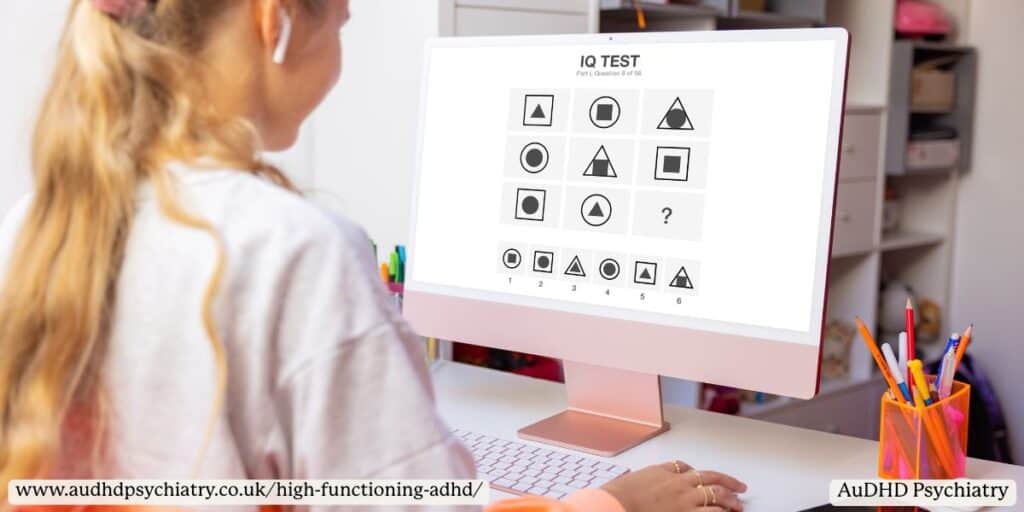
When people use the phrase, they usually mean ADHD in someone who holds down work, study or family life. They keep up through extra effort, careful systems and late nights. Under NICE guidance, a diagnosis needs symptoms causing at least moderate difficulty in two or more areas of life [2]. So “high-functioning” tends to describe struggles other people can’t see, not struggles that aren’t there.
What are the signs of high-functioning ADHD?
The signs are the same as in any ADHD. The NHS lists being easily distracted or forgetful, and finding it hard to organise your time or finish tasks [3]. Feeling restless, interrupting people and making quick decisions without thinking them through are on the list too [3]. Symptoms usually start before the age of 12 [3].
In someone who copes, those signs often show up like this:
- Leaning on lists, alarms and routines to stay on top.
- Doing your best work only when a deadline is close.
- Working late to catch up on what slipped during the day.
- Sharp focus on what interests you, and stalling on routine admin.
- Restlessness in long meetings.
From the outside, each habit looks like being organised or driven, so few people connect it with ADHD. Plenty of people work this way without ADHD. What matters is how much the habits cost you to keep up. You’ll find the full picture, from childhood onwards, in our guide to the signs and symptoms of ADHD.
What does coping well cost?
Coping well usually costs a great deal of hidden effort. A single US study compared adults with high IQ, with and without ADHD [4]. The group with ADHD did less well on tests of executive function, such as planning, memory and attention [4]. Their scores still sat in the average range. In our clinicians’ view, being bright can hide the difficulty, but it doesn’t remove it.
NICE guidance lists adults with a mental health condition among groups where ADHD may be more common [2]. In our clinicians’ view, anxiety or low mood can be treated while the ADHD underneath is missed. The cost tends to show as exhaustion, anxiety, feeling like a fraud and, when demands rise, burnout. Our guide to ADHD burnout covers the signs.
Is high-functioning ADHD a type of ADHD?
No, high-functioning ADHD isn’t one of the types clinicians diagnose. The diagnostic manual records three presentations, and coping well isn’t part of any of them [1]. Combined ADHD means enough symptoms of both inattention and hyperactivity-impulsivity over the past six months [1]. Adults aged 17 and over need at least 5 symptoms in each group to meet it [1]. A person’s presentation can change over time, and our guide to the types of ADHD explains each one.

Most people with ADHD have symptoms of both types [3]. High-functioning, by contrast, describes how someone copes, and it can sit alongside any of the three presentations. If your main difficulty is focus rather than restlessness, our guide to inattentive ADHD covers that presentation.
What helps with high-functioning ADHD?
Help usually starts with practical changes to how you work and live, and NICE guidance adds medication if difficulties continue [2]. The changes are often small: fewer interruptions, focus in shorter spells, and instructions you can keep in writing. At work, Access to Work for ADHD can help cover the cost of support. Our ADHD medication guide explains the medicines and their side effects.
The steps are the same whatever your presentation, and our inattentive ADHD guide sets out how ADHD is treated in more detail. At AuDHD Psychiatry, our prescribers can start medication if ADHD is found. We also offer ADHD coaching. We accept Access to Work funding and insurance for coaching.
Is it worth getting assessed?
It can be, though a diagnosis has downsides too. NICE guidance says that after a diagnosis, your clinician should talk through how ADHD affects your life [2]. The positives include understanding your symptoms, building on your strengths and better access to services [2]. The negatives include stigma and labelling [2].
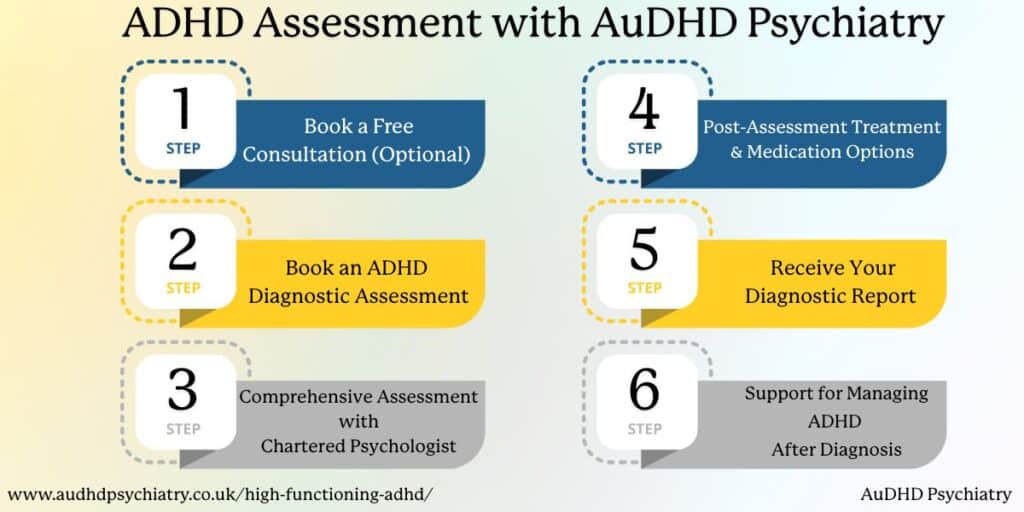
A good assessment looks at your whole history, not just how you come across on the day. A free ADHD test is a sensible first step, but it’s a screen, not a diagnosis. AuDHD Psychiatry assesses adults online, by video, anywhere in the UK.
This is for you if:
- You’re 18 or over.
- The signs and the cost described above sound familiar.
- You’d like to book directly, without a GP referral.
It might not be right today if:
- You need urgent help now. Call NHS 111 and choose the mental health option, or in Northern Ireland call Lifeline free on 0808 808 8000, any time. In an emergency, call 999 or go to A&E [5][6].
- You’re under 18. A child ADHD assessment is the right place to start.
If the first list fits you, the next place to look is our private ADHD assessment for adults.
Questions people ask
Can you be successful and still have ADHD?
Yes, a successful career or degree doesn’t rule ADHD out. At AuDHD Psychiatry, we often see ADHD behind a strong track record. High-performing adults tend to be the last to suspect ADHD, because their results look fine. A good next step is to notice what your success costs you day to day, and jot down a few examples.
Is high-functioning ADHD a real diagnosis?
No, high-functioning ADHD is a description people use, not a diagnosis. The diagnosis is ADHD, which clinicians record by its presentation and severity rather than by how well you cope [1]. So if someone has told you you’re too capable to have ADHD, that’s an opinion about your coping. It isn’t a clinical finding, and it shouldn’t stop you asking the question.
Why is high-functioning ADHD often missed?
High-functioning ADHD is often missed because the effort hides the difficulty. Someone who’s organised, punctual and good at their job doesn’t fit the picture many people hold of ADHD. Anxiety or low mood can also get treated on its own, while the ADHD beneath it goes unnoticed. If that’s happened to you, mention it at any assessment, because it’s useful history.
Could it be ADHD and autism together?
Yes, ADHD and autism often occur together, and masking can hide both. In our clinicians’ experience, adults who’ve spent years adapting to fit in can find it hard to tell which traits belong where. An AuDHD assessment looks at both conditions together. It’s the one to consider if both sets of signs sound familiar.
Will coping well stop me getting a diagnosis?
Coping well doesn’t rule you out, because a careful assessment looks behind the coping. Clinicians ask about work, home and relationships, and what it takes to keep going. Before your appointment, write down the systems you rely on and what happens when they slip. That list gives the clinician a clearer picture of your day.
In short
The label matters less than whether the signs fit you and what they cost. Practical changes, coaching and medication can all help, and an assessment helps you weigh up whether a diagnosis is right for you. A specialist assessment is how you find out whether it’s ADHD.
Related
- ADHD and task paralysis
- how to break a hyperfocus cycle
- Meet our clinical team
- Book a free 15-minute call
Sources
- American Psychiatric Association, Diagnostic and Statistical Manual of Mental Disorders, fifth edition, text revision (DSM-5-TR), 2022.
- National Institute for Health and Care Excellence (NICE), guideline NG87, Attention deficit hyperactivity disorder: diagnosis and management, published 14 March 2018, last updated 13 September 2019, https://www.nice.org.uk/guidance/ng87 (recommendations 1.2.1, 1.3.3, 1.4.3, 1.5.15, 1.5.16, 1.5.18, 1.7.11, and the definition of environmental modifications).
- NHS, ADHD in adults, page last reviewed 19 March 2025, https://www.nhs.uk/conditions/adhd-adults/.
- Antshel KM, Faraone SV, Maglione K, Doyle AE, Fried R, Seidman LJ, Biederman J. Executive functioning in high-IQ adults with ADHD. Psychological Medicine, 2010, 40(11), 1909 to 1918. https://doi.org/10.1017/S0033291709992273.
- NHS, Where to get urgent help for mental health, https://www.nhs.uk/nhs-services/mental-health-services/where-to-get-urgent-help-for-mental-health/ (read 29/09/2026).
- nidirect, Mental health emergency: if you’re in crisis or despair, https://www.nidirect.gov.uk/articles/mental-health-emergency-if-youre-crisis-or-despair (read 29/09/2026).
About AuDHD Psychiatry
AuDHD Psychiatry is the trading name of ADHDdegree Ltd, a company registered in Scotland. The company number is SC822923. Our registered office is 3f1 Third Floor, Hill Street, Edinburgh, EH2 3JP.
Registered with the ICO, number ZB823033.
Last updated: 13 October 2026
Where to go from here
A private online screening for ADHD traits, with your results at the end. No commitment.
Take the free testA free, no-obligation call with our team to ask questions and find the right assessment for you.
Book a free callDarren is a Chartered Psychologist and specialist in ADHD and autism, with over 11 years of experience working in mental health and neurodevelopmental services. He holds a Doctorate in Counselling Psychology and has presented research at the British Psychological Society Annual Conference.
Read Darren’s full profileThis article is for general information and does not replace a clinical assessment. If you are struggling with your mental health right now, please contact your GP or NHS 111.