

ADHD in men: signs, challenges and support

Reviewed by Dr Darren O’Reilly, Chartered Psychologist and Clinical Director
Review and publication details
Clinically reviewed by Dr Darren O’Reilly, DPsych, Chartered Psychologist (CPsychol), HCPC registered practitioner psychologist, registration number PYL041661 (check the HCPC register).
AuDHD Psychiatry is the trading name of ADHDdegree Ltd, a company registered in Scotland, company number SC822923. Registered office: 3f1 Third Floor, Hill Street, Edinburgh, EH2 3JP. Registered with the ICO, number ZB823033.
In this article
Page summary
ADHD symptoms in men are the same core signs as in anyone with ADHD. They involve attention, restlessness and acting on impulse, and they start in childhood. In adult life they often show as trouble with work, money, relationships or health. ADHD is more common in males, and many men are first diagnosed as adults. Depression, anxiety, addictions or a learning difficulty such as dyslexia often come alongside it. Support ranges from structured psychological help to medication after a full assessment. AuDHD Psychiatry assesses adults for ADHD online, for people living anywhere in the UK.
You might have spent years being called lazy, careless or “just a lad” by people who meant well. Maybe you’ve built a life that works on the outside and costs you more than anyone sees. Looking at ADHD now isn’t an excuse: it’s a reasonable question to ask.
At a glance
- How common: ADHD is more common in males than females.
- When it starts: signs begin in childhood, usually before 12, even if no one named them.
- What often comes with it: depression, anxiety, addictions or a learning difficulty such as dyslexia.
- First step: a GP can refer you, or you can contact a private service directly.
What are the symptoms of ADHD in men?
ADHD in men shows the same core symptoms as ADHD in anyone. The NHS groups the signs into two kinds, and most people have some of both [1]:

- Inattentive signs: being easily distracted or forgetful, finding it hard to organise time or finish tasks, and losing things.
- Hyperactive and impulsive signs: feeling restless, being very talkative or interrupting, and making quick decisions without thinking through what might happen.
Some people have only one kind [1]. Impulsivity can feel like decisiveness from the inside, so it’s easy to miss. The DSM-5, the diagnostic manual, needs symptoms present before the age of 12 and in more than one setting [2]. The American Psychiatric Association also says symptoms can look different in adults than in children [2]. In men, as in anyone, that often means missed deadlines, money trouble, restlessness or acting on impulse. This is in no way a lack of ability.
Deadlines, admin and a full inbox are often where men first notice the pattern.
How can ADHD affect work, money and relationships?
ADHD can affect work, money and relationships at the same time. A 2021 international consensus statement links ADHD with lower quality of life, educational underachievement and difficulties socialising [3]. At work, common difficulties include:

- Time management struggles.
- Multitasking challenges.
- Difficulty maintaining calendars or inboxes.
Money often follows the same pattern, with bills paid late, impulse buys and paperwork left in a pile. Feelings that rise fast and are hard to calm are common with ADHD, and our guide to emotional dysregulation explains why. At home, a partner can read a forgotten task as not caring. Family members may struggle to understand and interpret volatile shifts in the person’s energy and emotional presence. Naming the pattern helps, because it gives both of you something to work on that isn’t blame. Couples therapy, reading articles together, or simply conversing about one another’s lived experiences can assist partners in trust-building and resentment repair.
What conditions often come with ADHD in men?
Other conditions often sit alongside ADHD, and they often get noticed first. The NHS says people with ADHD often have other conditions too, such as depression, anxiety or addictions [1]. A learning difficulty such as dyslexia is also common alongside ADHD [1]. Substance use matters here. NICE lists a history of substance misuse among the groups in which ADHD is more common [4]. If drink or drugs are part of your picture, our guide to ADHD and addiction covers how the two affect each other. A GP looking at ADHD also considers other explanations, such as autism, Tourette’s or anxiety [1]. So if you’ve been treated for anxiety or low mood for years, that doesn’t rule ADHD out.

How do men get assessed for ADHD?
Two routes lead to an ADHD assessment: a GP referral or a private service such as AuDHD Psychiatry. If symptoms affect your study, work or relationships, the NHS says to see a GP [1]. Your GP decides whether to refer you to an ADHD specialist [1]. Whichever route you take, the assessment itself looks for the same things. NICE says a diagnosis needs symptoms that cause at least moderate impairment in two or more settings [4]. Impairment means the symptoms get in the way of ordinary life, not just that they’re present. Expect questions about school and childhood as well as about your life now. After a diagnosis, NICE recommends adults get, as a minimum, structured psychological support focused on ADHD with regular follow-up [4]. That support can include cognitive behavioural therapy, known as CBT [4]. Medication is a separate step, which the prescriber decides on and monitors, and our ADHD medication page explains how that works.

When is it worth looking into an ADHD assessment?
An assessment is worth it when long-standing difficulties keep getting in the way.
An assessment may help if:
- The difficulties go back to childhood.
- They affect work, money, home or relationships.
- You’re 18 or over.
It might not be right today if:
- You need urgent help. Call NHS 111 and choose the mental health option, or in Northern Ireland call Lifeline free on 0808 808 8000, any time. In an emergency, call 999 or go to A&E [5].
- Drinking or drug use is the main problem right now. A GP or local drug and alcohol service is the first step.
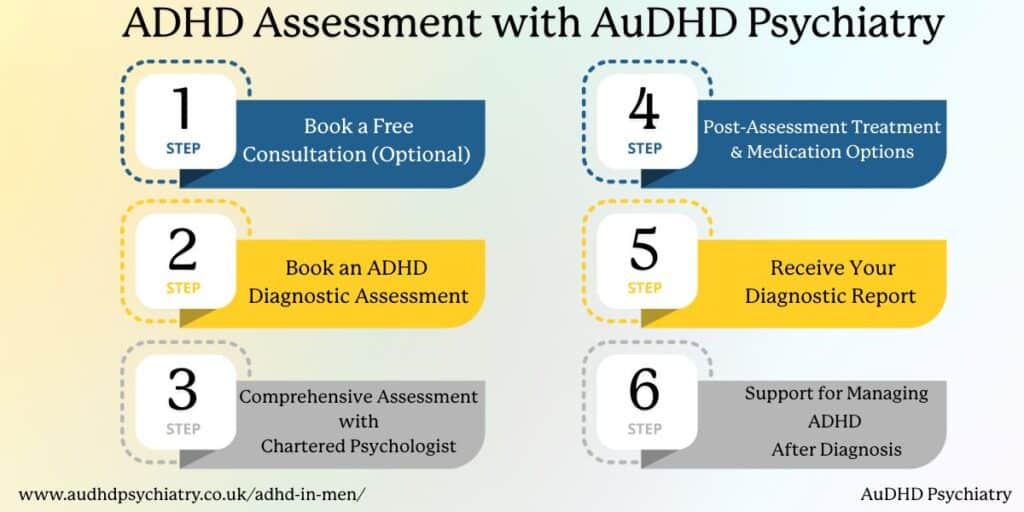
AuDHD Psychiatry assesses adults for ADHD in one online appointment, with no GP referral needed. You’ll get an outcome letter the next day and the full report within two weeks. Dr Darren O’Reilly, our Chartered Psychologist and Clinical Director, has ADHD and autism himself. Our adult ADHD assessment page sets out what happens. Or start with the free ADHD test, which doesn’t diagnose, or a free 15-minute call: an information call, not an assessment.
Questions people ask
Is ADHD more common in men?
Yes: an international consensus statement from 2021 says ADHD is more common in males than females [3]. The NHS also says ADHD is thought to be recognised less often in women than men [1]. So part of the gap is about who gets noticed, not only how common ADHD is. Many men still reach adulthood without anyone naming it, and that’s a common story rather than a rare one.
Can a man be diagnosed with ADHD as an adult?
Yes: the American Psychiatric Association says ADHD can be diagnosed at any age, though it begins in childhood [2]. An adult ADHD assessment looks for a pattern that has been there since school, even if nobody named it then. Old school reports, or a parent’s memory, can help fill in that early picture. It’s never too late to ask the question, and a late diagnosis is no less real.
Can ADHD in men look like depression or anxiety?
It can sit alongside them, so a clinician looks at the whole picture before deciding what explains what. Low mood or constant worry can be the thing you notice first, with the ADHD underneath. Both can also be real in their own right, and one diagnosis doesn’t cancel the other. Telling your GP or assessor about low mood or worry helps them get it right.
Does ADHD medication work for men?
Medication is one option, and NICE sets out when it’s offered after a full assessment [4]. At AuDHD Psychiatry, as anywhere, the prescriber decides whether to offer it and monitors it from then on. Nothing about being a man changes that route. Medication isn’t the whole of ADHD support, and no one has to take it to be assessed.
What is AuDHD in men?
AuDHD is an everyday name for having ADHD and autism together. NICE lists autism among the conditions where ADHD is more common [4]. It isn’t a diagnosis in its own right: a clinician assesses each condition on its own evidence. The two can hide each other, so one gets spotted and the other doesn’t. Our guide to what AuDHD means covers the combination in full.
In short
ADHD in men looks much as it does in anyone: trouble with attention, restlessness and acting on impulse. It often shows up at work, with money or at home, and other conditions can sit on top. None of that is a character flaw, and none of it is too late to look into. If this sounds like your life, read how the assessment works or talk to your GP about where to start.
Related
Sources
- NHS. ADHD in adults. Page last reviewed 19 March 2025. https://www.nhs.uk/conditions/adhd-adults/
- American Psychiatric Association. What is ADHD? Physician review October 2025. https://www.psychiatry.org/patients-families/adhd/what-is-adhd
- Faraone SV, Banaschewski T, Coghill D and others. The World Federation of ADHD International Consensus Statement: 208 evidence-based conclusions about the disorder. Neuroscience and Biobehavioral Reviews, September 2021, 128:789-818. https://pmc.ncbi.nlm.nih.gov/articles/PMC8328933/
- National Institute for Health and Care Excellence (NICE). Attention deficit hyperactivity disorder: diagnosis and management, guideline NG87. Published 14 March 2018, last updated 13 September 2019. https://www.nice.org.uk/guidance/ng87
- nidirect. Mental health emergency: if you’re in crisis or despair. Read 01/10/2026. https://www.nidirect.gov.uk/articles/mental-health-emergency-if-youre-crisis-or-despair
About AuDHD Psychiatry
AuDHD Psychiatry is the trading name of ADHDdegree Ltd, a company registered in Scotland. The company number is SC822923. Our registered office is 3f1 Third Floor, Hill Street, Edinburgh, EH2 3JP.
Registered with the ICO, number ZB823033.
Last updated: 13 October 2026
Where to go from here
A private online screening for ADHD traits, with your results at the end. No commitment.
Take the free testA free, no-obligation call with our team to ask questions and find the right assessment for you.
Book a free callDarren is a Chartered Psychologist and specialist in ADHD and autism, with over 11 years of experience working in mental health and neurodevelopmental services. He holds a Doctorate in Counselling Psychology and has presented research at the British Psychological Society Annual Conference.
Read Darren’s full profileThis article is for general information and does not replace a clinical assessment. If you are struggling with your mental health right now, please contact your GP or NHS 111.