



Table of Contents
1. Can Autistic People Drive? The Short Answer
2. Do Autistic People Have to Tell the DVLA?
3. Autism and Driving: The Real Challenges
4. Strengths Autistic People Often Bring to Driving
5. Learning to Drive With Autism: Practical Support
6. Is Your Autistic Child or Teen Ready to Learn to Drive?
7. Driving Safely With Autism: Ongoing Tips
8. When Might an Autistic Person Need to Avoid Driving?
9. AuDHD and Driving: When Autism and ADHD Overlap
10. Frequently Asked Questions
In Focus:
- Autistic people can legally drive in the UK, and many do so safely and confidently.
- No law prevents autistic people from obtaining a driving licence. Disclosure to the DVLA is required only when a condition affects the ability to drive safely.
- Driving presents specific challenges for some autistic people, but these are individual, not universal.
- Autistic people often bring genuine strengths to driving: strong rule-following, attention to detail, and commitment to safe driving practices.
- With the right support, like appropriate driving instructors, occupational therapy, and gradual exposure, many autistic people achieve their driving goals successfully.
Driving represents something significant: independence, employment opportunities, and the ability to manage daily life skills without relying on others. For autistic people and their families, the question of whether driving is possible, appropriate, or achievable arises frequently and deserves a clear, evidence-based answer.
The short answer is yes. Autistic people can and do drive. But the fuller picture requires understanding both the genuine challenges some autistic individuals face behind the wheel and the equally genuine strengths that autism can bring to driving. It also requires understanding the UK legal framework, including what, if anything, needs to be disclosed to the Driver and Vehicle Licensing Agency (DVLA), and what practical support is available.
AuDHD Psychiatry is a UK-based neurodevelopmental assessment and diagnosis centre specialising in autism and ADHD across the lifespan. We work with autistic adults, adolescents, and families navigating questions exactly like this one. If you have concerns about your own driving or your child’s readiness to learn, an autism assessment can provide the clarity and direction you need.
Can Autistic People Drive? The Short Answer
Yes. There is no legal restriction in the UK preventing autistic people from holding a driving licence. Autism spectrum disorder (ASD) is not, by itself, a disqualifying condition for a standard car or motorcycle licence, a provisional driving licence, or any other licensing category.
What matters under UK law is how the condition affects the individual. Autism presents very differently between individuals, and two autistic people may have completely different driving profiles. One may drive without difficulty; another may find certain aspects of driving genuinely challenging. The DVLA’s approach reflects this individual difference, focusing on functional ability rather than diagnostic label.
Research supports the view that many autistic people are capable, responsible drivers. A 2014 study by Classen and colleagues found that autistic young adults could acquire driving skills with appropriate training, and several studies have noted that autistic drivers often show strong adherence to traffic laws and road rules. The picture is not one of blanket incapacity; it is one of individual variation, specific challenges, and the right support.
Do Autistic People Have to Tell the DVLA?
This is one of the most frequently asked questions around autism and driving, and it is important to get right. In the UK, you are legally required to tell the DVLA if you have a medical condition that affects your ability to drive safely. ASD does not automatically trigger this requirement. However, co-occurring or related conditions sometimes do.
You should inform the DVLA if you experience:
- Seizures or epilepsy (which can co-occur with autism)
- Severe anxiety or a mental health condition that significantly affects your driving
- ADHD, where impulsivity or inattention materially affects driving safety (this is assessed individually)
- Any other condition, whether diagnosed or suspected, that causes functional impairment behind the wheel
If you are unsure whether you need to notify the DVLA, the appropriate step is to speak to your GP or the clinician managing your care. Failing to notify the DVLA when you are legally required to do so can result in a fine and invalidate your insurance.
Provisional Driving Licence and Full Car Licence
For a standard car or motorcycle licence, the DVLA assesses whether the condition affects driving fitness. An autism diagnosis alone does not prevent you from applying for a provisional driving licence or progressing to a full licence.
Lorry, Bus, and Coach Licences
Higher-category licences (C, C+E, D, D+E) carry stricter medical standards because of the greater risk associated with larger vehicles. If you are seeking one of these licences and have a condition that might be relevant, it is advisable to seek medical guidance before applying. Again, autism alone is not a disqualifier, but co-occurring conditions, particularly those affecting attention, response times, or cognitive flexibility, may be assessed more carefully.
Autism and Driving: The Real Challenges
Driving is a cognitively demanding task. It requires the simultaneous management of sensory input, motor coordination, social interpretation, executive functioning, and real-time decision-making under pressure. For some autistic individuals, one or more of these areas presents a specific challenge. Understanding these challenges clearly without overstating or universalising them is essential.
Sensory Sensitivities and Sensory Overload
Many autistic people experience heightened sensitivity to sensory input, and the driving environment is saturated with it. Bright lights from oncoming headlights, loud noises from traffic or horns, the visual complexity of busy junctions, and even the physical sensation of vibration can all contribute to sensory overload. When a person reaches sensory overload, cognitive capacity for hazard detection and decision-making is reduced, and driving safety may be compromised.
Sensory sensitivities vary enormously between individuals. Some autistic drivers manage motorway driving comfortably but find city centres overwhelming; others find night driving problematic because of bright lights from oncoming vehicles. Identifying your own sensory profile is a crucial part of understanding your driving environment.
Executive Functioning and Cognitive Flexibility
Driving demands sustained executive functioning. This is the ability to:
- Plan
- Prioritise
- switch attention between stimuli, and
- Update responses in real time
For some autistic people, executive functioning presents a specific area of difficulty. Cognitive flexibility, the ability to adapt quickly when conditions change unexpectedly, such as a road diversion, a cyclist swerving, or a sudden change in traffic signals, can be particularly challenging.
Working memory is also implicated in driving: holding a route in mind, remembering recent road signs, and monitoring multiple environmental features simultaneously all draw on this capacity. Research by Cox and colleagues (2012) found that working memory and processing speed were significant predictors of on-road driving performance in autistic young adults.
Social Cues and the Unwritten Rules of the Road
Driving is, in part, a social interaction. It involves reading the intentions of other drivers through informal signals: brief eye contact at a junction, the angle of another car’s approach, the body language of a pedestrian deciding whether to cross. These unspoken social cues are often processed differently by autistic individuals, which can create uncertainty in ambiguous driving situations.
Traffic stops and interactions with law enforcement or police officers present a distinct challenge. Communication barriers, including literal interpretation of language, difficulty with spontaneous social interaction under stress, and sensory overload in an unexpected situation, can make traffic stops more stressful and harder to navigate. Carrying a medical alert card noting autism can be helpful in these situations, and in many areas, schemes exist to support autistic drivers during traffic stops.
Motor Coordination Challenges
Motor coordination difficulties, sometimes associated with dyspraxia, which frequently co-occurs with autism, can affect the physical skills involved in driving:
- Smooth steering
Clutch control - Maintaining lane position, and
- Coordinating braking and acceleration
These gross motor skills can be learned with appropriate practice sessions and patient, structured instruction, but they may require more time and repetition than for non-autistic drivers.
It is important to note that motor coordination difficulties are not universal in autism. Many autistic people have no motor skill difficulties whatsoever. Where they are present, they are a learnable area, not an absolute barrier.
Anxiety, Attention, and Crash Risks
Elevated anxiety is common among autistic people and can have a real impact on driving performance. Anticipatory anxiety about driving itself, about unexpected road conditions, or about navigating unfamiliar routes can impair concentration and increase the mental load of each journey. Attention problems, particularly in the context of AuDHD, can contribute to missed road hazards or delayed responses.
The research on crash risks in autistic drivers is nuanced. Some studies suggest elevated crash rates compared to non-autistic drivers, particularly in younger and less experienced autistic drivers; others show no significant difference once experience is accounted for. What the evidence consistently supports is that proper training and the right support make a measurable difference in driving outcomes.
Strengths Autistic People Often Bring to Driving
A balanced, evidence-informed account of autism and driving must include what autistic people often do particularly well behind the wheel. Several characteristics associated with autism spectrum disorder translate into genuine driving strengths, and it is worth remembering that many of the world’s most accomplished people are autistic.
- Strong adherence to traffic rules and road signs. Many autistic drivers take traffic laws seriously because following clear, explicit rules is something autistic people often do very well. Speed limits, stopping at traffic lights, and observing road signs tend to be areas of reliable strength.
- Attention to detail. The capacity for focused, detailed observation, a well-documented feature of many autistic people’s cognitive style, supports hazard detection and careful monitoring of the driving environment.
- Lower likelihood of road rage and risk-taking. Studies suggest autistic drivers are generally less likely to engage in aggressive driving or deliberate risk-taking. The impulsivity-driven risky behaviour associated with ADHD is less characteristic of autism in the absence of co-occurring ADHD.
- Preference for routine. Once a route is learned, autistic drivers often become highly reliable and efficient on that route. Familiarity reduces cognitive load and supports safe, consistent driving performance.
- Rule-following in unpredictable environments. In situations where the rules are clear, autistic drivers often perform confidently and competently.
If you are an autistic adult considering driving, or the parent of an autistic adolescent approaching driving age, a formal autism assessment can help clarify your specific profile of strengths and challenges, giving you and any driving instructor the most useful possible foundation to work from.
Learning to Drive With Autism
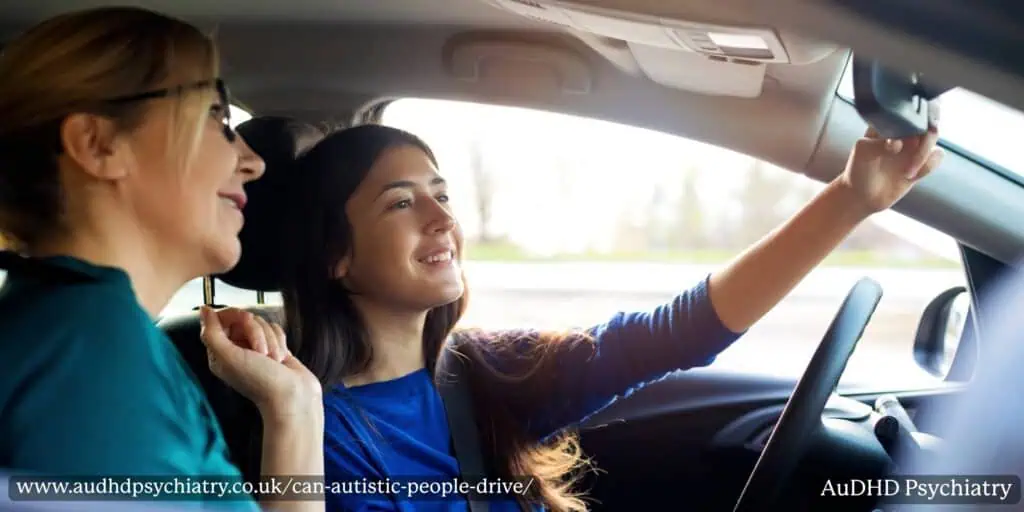
Choosing the Right Driving Instructor
The relationship between a learner and their driving instructor is particularly important for autistic learners. Consistency matters: learning with the same instructor across all lessons allows trust to build gradually and removes the added cognitive load of adapting to a new person each time.
When looking for a driving instructor, consider asking:
- Do you have experience working with autistic learners or people with additional needs?
- Are you willing to adapt your communication style—using more explicit verbal instruction, written notes, or visual aids alongside spoken directions?
- Can lessons be kept at a consistent pace, with new material introduced gradually rather than in large steps?
- Are you flexible about lesson length, location, and the conditions in which early practice sessions take place?
Some driving schools specifically advertise autism-aware or neurodivergent-friendly instruction. The DVSA does not operate a formal accreditation scheme for this, so asking directly and speaking to the instructor before committing to a course of lessons is the most reliable approach.
Occupational Therapy and Driver Rehabilitation Specialists
Occupational therapists play a significant role in supporting autistic people who are learning to drive. Driver rehabilitation specialists, many of whom are occupational therapists with specialist training, can conduct pre-driving assessments that evaluate motor skills, visual perception, cognitive processing, and sensory sensitivities in the context of driving specifically.
These assessments are available at DVLA-approved mobility centres across the UK and can be accessed through a GP referral or privately. They provide a comprehensive profile of driving-relevant abilities and can recommend specific adaptations, assistive technology, or training programs before formal driving lessons begin. For autistic learners who are uncertain about their readiness, this is a valuable resource and a recommended starting point.
Driving Simulators and Graduated Exposure
Driving simulators offer a genuinely useful learning tool for some autistic drivers. The controlled, predictable environment of a simulator allows practice sessions to focus on specific skills like hazard perception, junction management, and motorway driving without the unpredictability of real road conditions. Several driving schools and rehabilitation centres in the UK now offer simulator sessions as part of a comprehensive approach to learning.
Gradual exposure is a well-established approach in autism-informed driving instruction. Small steps, repeated consistently, build both competence and confidence. Night driving, motorway driving, and city centre navigation can all be introduced as manageable steps once the foundational skills are established.
Visual Aids, Written Instructions, and Assistive Technology
Many autistic learners find visual supports and written instructions more effective than purely verbal instruction. Route cards, written checklists for pre-drive checks, and visual diagrams of complex junctions can all support the learning process. Sat navigation systems reduce working memory demands for route-finding, allowing more cognitive capacity for managing the driving environment. Some autistic drivers use noise-cancelling headphones during lessons to reduce auditory sensory load — this is worth discussing with an instructor beforehand.
Is Your Autistic Child or Teen Ready to Learn to Drive?
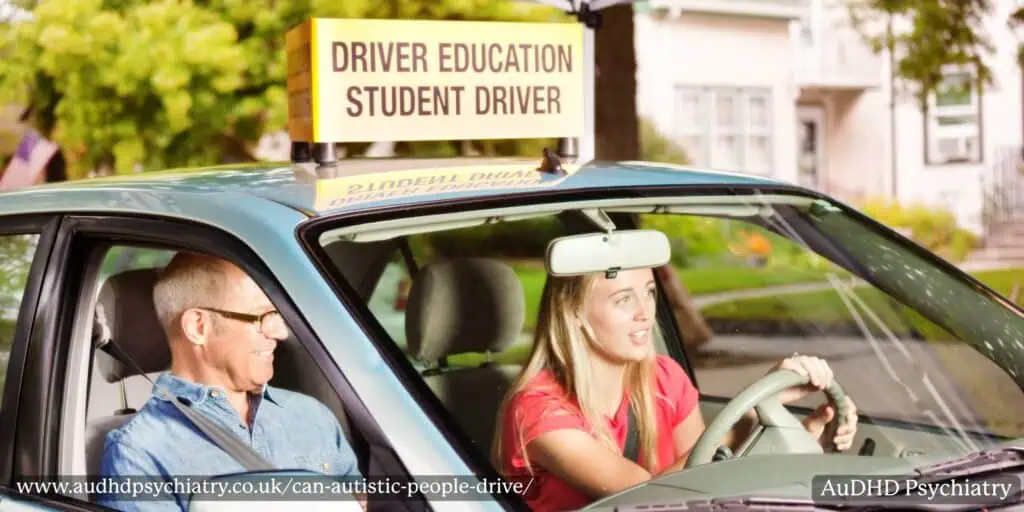
Driving age in the UK is 17 for a car, but the question of whether an autistic adolescent is ready to learn has no single answer. Readiness varies significantly across individuals and is shaped by a range of factors beyond chronological age.
Rather than applying a fixed age threshold, it is more useful to consider the following indicators:
Can the young person sustain attention on a complex task for an extended period without becoming overwhelmed?
- How does the young person manage sensory sensitivities in busy, unpredictable environments?
- Are emotional regulation skills sufficiently developed to handle the frustration, uncertainty, and time pressure involved in learning to drive?
- Does the young person have a reasonable level of motor coordination for vehicle control?
- Is the young person motivated to drive, or is there pressure from others that may not reflect their own readiness?
There is no rush. Many autistic young adults learn to drive in their early twenties rather than at 17, and achieve the same outcomes. Learning at a pace that matches the individual’s developmental readiness produces better results than pushing too early. Our guides to autism symptoms in girls and the child autism checklist can help families understand what traits to look for and when to seek a formal assessment.
Driving Safely With Autism
For autistic people who already drive, or who are close to achieving their licence, the following evidence-informed strategies support safe, sustainable driving:
Know your sensory limits. Be honest with yourself about which driving environments and conditions are manageable and which are not. Avoiding driving during sensory overload, when fatigued, or in hazardous weather that pushes your limits is a mark of good judgment, not limitation.
Plan routes in advance. Familiarity with a route significantly reduces cognitive load. Using mapping apps to preview a journey before driving it and identifying potential challenges, such as complex junctions or motorway sections, allows preparation that reduces in-the-moment demands.
Keep the driving environment manageable. Limit passengers, music, or in-car conversation in the early stages of independent driving. A lower-stimulation environment supports sustained attention and hazard detection.
Prepare for traffic stops. In the UK, it can be helpful to carry a card or document noting that you are autistic, particularly if communication under stress is challenging. Some police forces have awareness training for interactions with autistic individuals. Knowing in advance what to expect at a traffic stop and having practised a response reduces the cognitive and emotional demand of these encounters.
Monitor the impact of medication. If you take medication for ADHD, anxiety, or another co-occurring condition, speak to your prescriber about how that medication may affect driving. Some medications carry specific driving-related warnings.
Build in recovery time. Driving can be cognitively and sensorially demanding for autistic people in ways that non-autistic drivers may not experience to the same degree. Allowing time to decompress after a long or challenging journey is a sensible, self-aware practice.
When Might an Autistic Person Need to Avoid Driving?
Avoiding driving at certain times or in certain conditions is not a failure. It is a considered, safety-conscious decision. The following circumstances warrant extra caution:
- During or immediately after a period of autistic burnout, when cognitive and emotional resources are significantly depleted
- When sensory overload has already occurred before getting behind the wheel
- When anxiety is severe enough to impair concentration and response times
- When experiencing side effects from a new or changed medication that may affect alertness or coordination
- In weather hazards—heavy rain, ice, fog—that add an additional cognitive and sensory load to already-demanding conditions
- When co-occurring conditions, such as epilepsy, are not yet well-controlled
These are decisions for the individual, guided by self-awareness and, where appropriate, their healthcare providers. The goal is not to restrict independence but to support driving safety in a way that is realistic and sustainable over the long term.
AuDHD and Driving: When Autism and ADHD Overlap
A significant proportion of autistic people also have ADHD—a combination sometimes referred to as AuDHD. When both conditions are present, the driving profile becomes more complex because the challenges associated with each condition can interact and compound.
ADHD adds impulsivity, inattention, difficulty sustaining concentration on tasks perceived as unstimulating, and elevated risk-taking to the picture. Alongside autism’s sensory sensitivities, executive functioning difficulties, and social cue processing differences, this can create a more demanding overall driving profile than either condition alone.
At the same time, ADHD medication can meaningfully improve the attention and impulse control difficulties that are most relevant to driving safety. Research found that stimulant medication was associated with a significant reduction in traffic accident rates in individuals with ADHD.
Frequently Asked Questions
Are autistic people allowed to drive?
Yes. There is no legal restriction on autistic people driving in the UK. Many autistic individuals drive confidently and safely. Specific co-occurring conditions, such as epilepsy or severe anxiety, may need to be disclosed to the DVLA, but autism itself does not trigger an automatic obligation to inform.
Does autism make it hard to drive?
For some autistic people, certain aspects of driving present specific challenges: sensory overload, executive functioning demands, and interpreting the informal social cues of other road users, among them. For others, driving presents no significant difficulty. The experience is highly individual.
Do I need to tell the DVLA I am autistic?
Not automatically. You are required to tell the DVLA if any condition, including autism, affects your ability to drive safely. If you are uncertain, speak to your GP. Failing to disclose when legally required can result in a fine and affect your insurance validity.
What support is available for autistic people learning to drive?
Several forms of support are available in the UK: specialist driving instructors with experience of neurodivergent learners, occupational therapy driving assessments at DVLA-approved mobility centres, driving simulators for controlled practice, and gradual exposure approaches adapted to the individual’s pace and sensory profile. A pre-driving occupational therapy assessment is a particularly useful starting point for autistic learners who have specific concerns.
Can autistic people get a provisional driving licence?
Yes. Applying for a provisional driving licence follows the same process for autistic people as for anyone else.
Can Autistic People Drive: Conclusion
Autistic people can drive. That is the starting point, and it is an important one because the question is not whether autistic individuals have a legal right to independence and mobility, but how to support them in achieving it as safely and confidently as possible.
The challenges are real and deserve to be acknowledged: sensory sensitivities, executive functioning demands, and the social complexity of the road can all make driving harder for some autistic people than for their non-autistic peers. But the strengths are equally real—the attention to detail, the commitment to traffic rules, the reliability on familiar routes—and they matter just as much in a complete picture of autism and driving.
With proper training, the right instructor, appropriate occupational therapy support, and a clear understanding of the individual’s own profile, driving is a realistic, achievable goal for many autistic people.
If you are an autistic adult thinking about driving, a parent supporting an autistic teenager approaching driving age, or someone who suspects autism may be shaping their experience behind the wheel, the most useful first step is understanding your own neurodevelopmental profile. Book an autism assessment with AuDHD Psychiatry and get the clarity that makes every next step easier.
References
Chang, Z., Lichtenstein, P., D’Onofrio, B. M., Sjölander, A., & Larsson, H. (2014). Serious transport accidents in adults with attention-deficit/hyperactivity disorder and the effect of medication: A population-based study. JAMA Psychiatry, 71(3), 319–325. https://doi.org/10.1001/jamapsychiatry.2013.4174
Classen, S., Monahan, M., & Wang, Y. (2013). Driving characteristics of teens with attention deficit hyperactivity and autism spectrum disorder. American Journal of Occupational Therapy, 67(6), 664–673. https://doi.org/10.5014/ajot.2013.008821
Cox, N. B., Reeve, R. E., Cox, S. M., & Cox, D. J. (2012). Brief report: Driving and young adults with ASD: Parents’ experiences. Journal of Autism and Developmental Disorders, 42(10), 2257–2262. https://doi.org/10.1007/s10803-012-1470-3
Daly, B. P., Nicholls, E. G., Patrick, K. E., Daly, M. J., & Schmitt, S. A. (2014). Driving behaviors in adults with autism spectrum disorders. Journal of Autism and Developmental Disorders, 44(12), 3119–3128. https://doi.org/10.1007/s10803-014-2166-y
Huang, P., Kao, T., Curry, A. E., & Durbin, D. R. (2012). Factors associated with driving in teens with autism spectrum disorders. Journal of Developmental and Behavioral Pediatrics, 33(1), 70–74. https://doi.org/10.1097/DBP.0b013e31823a43b7
Sheppard, E., Ropar, D., Underwood, G., & van Loon, E. (2010). Brief report: Driving hazard perception in autism. Journal of Autism and Developmental Disorders, 40(4), 504–508. https://doi.org/10.1007/s10803-009-0890-5
DVLA. (2024). Assessing fitness to drive: A guide for medical professionals. Driver and Vehicle Licensing Agency. https://www.gov.uk/guidance/assessing-fitness-to-drive-a-guide-for-medical-professionals
Find the Right Assessment
Our clinicians are ready to help you get the complete support you need.
Author:



Contact Us
We’re here to answer any questions you might have.
Get in Touch
Opening Hours
Contact Form
We’re here to help. Reach out and we’ll get back to you within 24 hours (Monday – Friday).
Leave a Reply